
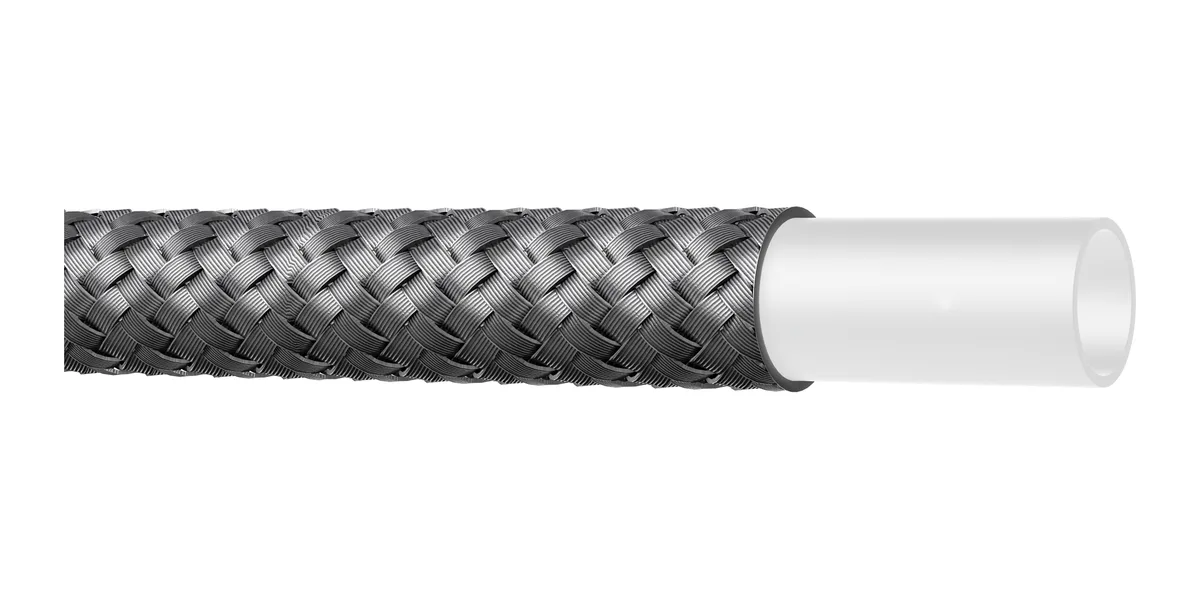
JCC-02100 is the build we send when a smooth-bore PTFE line has to hold high pressure and the single-braid series is not enough. The core is the same extruded, sintered PTFE tube, wrapped first in a 304 stainless steel wire braid, then covered with a second layer of high-strength 304 stainless wire bundle braid. That double stainless jacket is what carries the load: working ratings run from 41 MPa at 3/8" down to 17 MPa at 2".
- Temperature−70 to +260 °C / −94 to +500 °F
- Bore9.5–50.5 mm (3/8"–2")
- Working pressure41 → 17 MPa (5945 → 2392 psi)
- Braided OD15.8–60 mm
Overview
The failure we see most often on high-pressure braided hose is not the PTFE itself. The tube is usually fine right up to the moment the braid lets go — a wire strands, the cover opens, and the hose starts to balloon at the point where the bend has been working. A single braid is a good general-purpose reinforcement, but on a spray line running at 300 bar or more it is doing a lot of work with not much material.
JCC-02100 solves that by doubling the stainless: the 304 braid over the tube takes the primary load and the outer 304 wire-bundle braid adds a second, heavier layer of mechanical resistance. The catalog describes the result as good mechanical resistance, and in practice that is what you feel when you handle the hose — it is stiffer than a single-braid build and it does not kink as easily at the couplings.
The trade-off is honest: two stainless layers make the hose heavier, less flexible and more expensive per metre than a single braid. If your line runs at 10–20 MPa and the routing is tight, this is more reinforcement than you need and the single-braid JCC-01100 will do the job for less. JCC-02100 earns its place on high-pressure chemical spraying, high-pressure gluing and high-pressure transfer, where the pressure is the reason the line exists.
Specifications
| Model | Nominal size | ID mm ±0.2 |
OD mm ±0.2 |
Braided OD mm ±0.2 |
Working psi |
Working MPa |
Burst psi |
Burst MPa |
Min bend radius in |
Min bend radius mm |
|---|---|---|---|---|---|---|---|---|---|---|
| JCC-02110-PTFE | 3/8" | 9.5 | 11.9 | 15.8 | 5945 | 41 | 17719 | 122.2 | 2.95 | 75 |
| JCC-02113-PTFE | 1/2" | 12.7 | 15.1 | 18.3 | 5713 | 39 | 17139 | 118.2 | 4.45 | 113 |
| JCC-02216-PTFE | 5/8" | 16.3 | 19.9 | 26.3 | 5959 | 41 | 17879 | 123.3 | 6.69 | 170 |
| JCC-02219-PTFE | 3/4" | 19 | 23 | 30 | 5872 | 41 | 17618 | 121.5 | 8.07 | 205 |
| JCC-02225-PTFE | 1" | 25 | 29 | 35.5 | 5118 | 35 | 15356 | 105.9 | 9.76 | 248 |
| JCC-02232-PTFE | 1-1/4" | 31.5 | 35.5 | 43.5 | 3770 | 26 | 11310 | 78 | 19.29 | 490 |
| JCC-02238-PTFE | 1-1/2" | 38 | 42 | 50 | 2392 | 17 | 7178 | 49.5 | 25.59 | 650 |
| JCC-02250-PTFE | 2" | 50.5 | 54.5 | 60 | 2537 | 18 | 7613 | 52.5 | 35.43 | 900 |
All values as printed in the Jingcheng PTFE hose catalog. Product certification stated in the catalog: ISO 9001:2015 / US FDA 21 CFR 177.1550 / SGS. Custom sizes and lengths are made to your drawing on request.
Materials and construction
- Inner tube: smooth PTFE, extruded, dried and sintered. The same smooth bore as our JCC-00000 tube, so the chemical resistance and the low-friction, cleanable bore come with it.
- Middle layer: 304 stainless steel braided wire wound over the tube. This is the primary pressure-carrying layer.
- Outer layer: high-strength 304 stainless steel wire bundle braid. The bundle braid is a heavier construction than a flat wire braid, and it is the layer that gives the series its mechanical resistance and its pressure rating.
- Bore profile: smooth and cylindrical, no corrugation, so it drains and cleans like the base tube.
- End connections: not part of the catalog sizes. Tell us the threads, flanges or compression fittings on the equipment and the assembly is specified from there.
Temperature and pressure notes
The catalog temperature range is −70 to +260 °C (−94 to +500 °F). That is the tube's range; the stainless braid is not the limiting item at either end.
The pressure figures in the table fall steeply as the bore grows — 41 MPa at 3/8" against 17 MPa at 2" — because a larger bore puts more tube wall area under the same internal pressure. That is geometry, not a manufacturing limit.
Rated pressure at room temperature is not the number to design to at 200 °C. Reducing allowable working pressure as temperature rises is standard practice for polymer hose, and PTFE is no exception, even with a double stainless jacket. We do not publish a single derating curve here because it depends on media, cycle count and service life expectation. Send the actual temperature and pressure and the rating for your assembly is confirmed in writing with the quotation.
Also check the burst margin against your pump. The catalog burst figures are about three times working pressure, which is a safety margin for a hose that is in good condition — it is not an operating target, and it is not a surge rating for water hammer or pressure spikes.
Applications
The catalog lists this series for:
- High-pressure chemical spraying
- High-pressure gluing
- High-pressure transfer
- Steam conveying
- Oil conveying
- Brake hose
The common thread is a line where the pump discharge pressure is the design driver. If the medium is also aggressive — a solvent, an acid, a hot oil — the PTFE bore handles it and the stainless outside takes the pressure. What we would check first on a new application is the fitting: at these pressures the crimp or swage is usually the weakest point in the assembly, not the hose, so the end connection has to be matched to the hose and rated for the same pressure.
Options and related builds
How to order
Send these points and the quotation can be built without another round of email:
- Bore you need, in mm or inches, and the nominal size if you already know it.
- Length per piece and the number of pieces.
- End fittings at each end: thread standard and size, flange, or compression fitting, with a photo or part number if you have one.
- Medium and its concentration.
- Operating temperature, including cleaning or steam peaks.
- Working and peak pressure, and whether the line sees pressure spikes or water hammer.
- Bend radius available at the tightest point of the route.
- Quantity for the first order and the expected annual use, so the price reflects the real volume.
If a drawing already exists, send it. We work to the customer's drawing when one is supplied.
Frequently asked questions
What is the difference between wire-bundle braid and a normal braid?
A normal braid is a flat or round stainless wire woven in a single layer over the tube. The wire-bundle braid used on the outside of JCC-02100 is built from bundles of wire rather than single strands, and it sits over a first 304 braid. The result is more metal carrying the load in the same outside diameter, which is why this series reaches 41 MPa at 3/8” while the single-braid series tops out well below that.
Is the inner tube different from the smooth bore series?
No. It is the same smooth, extruded and sintered PTFE tube, so the chemical resistance and the clean, drainable bore are identical to JCC-00000. What changes is the reinforcement outside it.
What size do I need for a high-pressure spray line?
Start from the flow rate and the allowed pressure drop rather than the pressure rating. A 3/8" bore is the usual starting point for spray guns and small transfer lines at 40 MPa; larger bores are chosen when the flow is high and the run is long, and the pressure rating drops as the bore grows. Send the flow, pressure and length and we can check the combination.
Does the heavier braid make the hose stiff?
Yes, noticeably. Two stainless layers resist bending more than one, and the minimum bend radius in the table (75 mm at 3/8", 900 mm at 2") is larger than you might expect for the bore. Plan the routing around it. If the route is tight, a convoluted core is the better answer than forcing this build into a short radius.
Can I get fittings matched to the hose rating?
Yes. Fittings are specified per order and must be rated for the same pressure as the hose. Send the thread or flange on the equipment and the assembly drawing is issued for approval before production.
Send your high-pressure PTFE hose details
Bore, length, fittings, medium, temperature and pressure is all we need to come back with a specification and a price.
Request a quoteSoren Miles, Marketing Manager | JC
Mobile: +86 13087118553 / +1 (757) 733-8947
WhatsApp: +86 185 6950 4906
Email: soren.miles@shenzhenjingcheng.com
Company (Canada): JINCHEN ELECTRIC TRACING CO., LTD.
Company (Hong Kong, China): HK JINGCHENG HIGH TECH CO., Ltd
Company (China): SHENZHEN JINGCHENG HIGH TECH CO., Ltd / Jingcheng Fluoroplastic (Guangdong) Co., Ltd.
Website: https://www.jingchenghose.com | https://www.electricallyheatedhose.com
Factory address: No. 7 Qiguan East Road, Torch Development Zone, Zhongshan City (Jingcheng Industrial Park)
Source: Jingcheng PTFE hose catalog, JCC-02100 page, and our published business policies. Pressure derating with temperature is general engineering practice; the rating for each project is confirmed on the quotation and drawing.