
A stainless steel braided PTFE hose rarely fails in the middle of the braid. It fails at the ferrule, or on the first tight bend after it, weeks after installation. In most cases I get sent, the braid was picked from a working-pressure number alone. Here is what I check first, and how the three braided constructions differ.
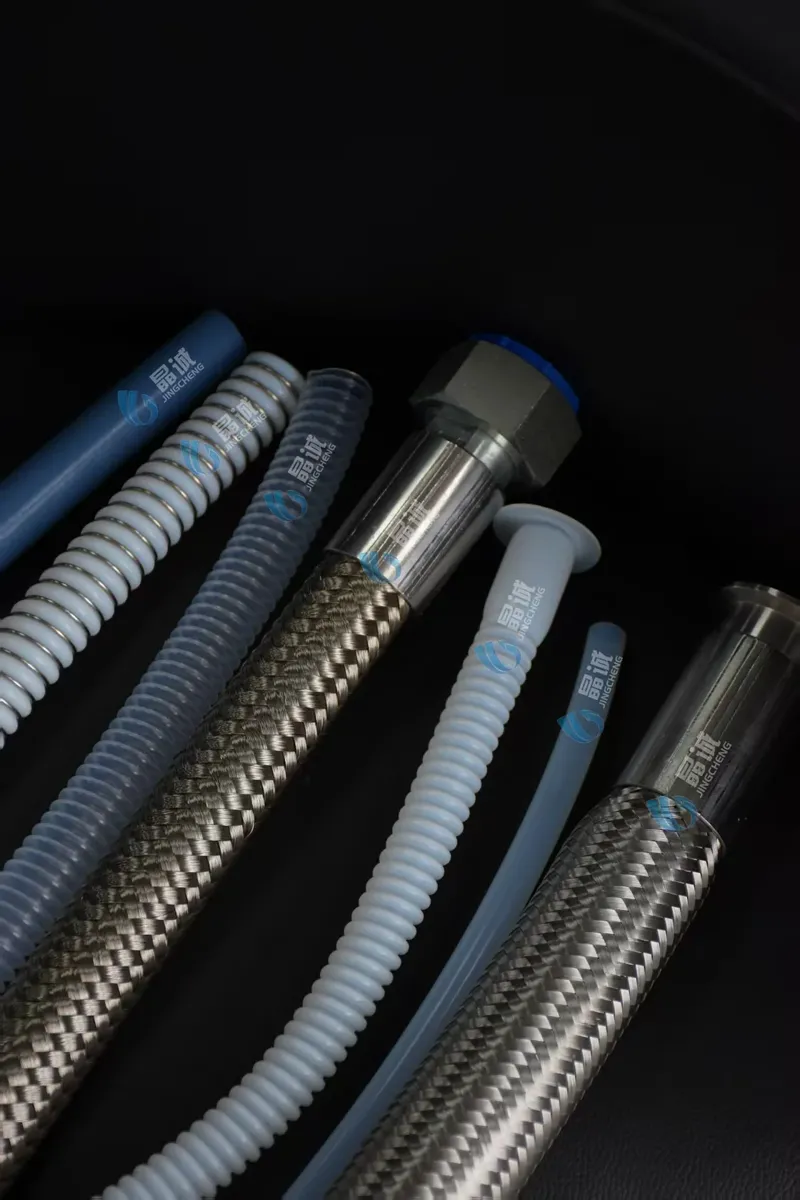
The failure pattern I see most often
The typical complaint goes like this. A braided PTFE line between a diaphragm pump and a mixer starts to weep at one ferrule a few weeks after installation. The first assumption is that the hose is under-rated for the pressure.
Usually it is not. The pump pressure sits well inside the rating for that bore, the braid has no broken wires and there is no bulge. What the line does have is a tight bend starting right at the back of the ferrule and a long unsupported span at the pump end, so every pump stroke moves the hose slightly inside the fitting. PTFE cold-flows. It does not crack like rubber; it creeps. Weeks of small movement at the back of the crimp can open a path between liner and ferrule body.
The fix in that pattern is routing, not more braid: a slightly longer assembly with a gentle sweep, clamps close to each end, and room for the line to move without bending at the fitting. A double-braided hose installed the same way would weep in the same place. That is general field experience, not a logged case, and it is why I check routing first.
What I check first, in order
When a braided line comes back with a leak or a short service life, I work through these before quoting anything. Twenty minutes usually shows which part of the assembly is at fault.
- Where exactly is the leak? A wet ferrule and a dry braid means the termination. Fluid emerging mid-length, often as a fine mist, means the liner has been perforated and the braid is now the only barrier. Different failures, different fixes.
- Look at the braid at the ferrule. Polished or fretted wires, an opened weave, or a few broken strands next to the collar all point to movement at the connection, not over-pressure.
- Measure the straight length out of the ferrule. If the bend starts within one or two hose diameters of the collar, the braid is being worked every cycle. This is the most common cause I see.
- Check the supports. An unsupported run between two vibrating machines, or a hose hanging its own weight plus the fluid, puts a permanent axial load into the crimp.
- Ask what the line actually sees. Not the pump's rated pressure: the peak. A dead-headed pump, a fast-closing valve or water hammer can double the steady reading for a fraction of a second, and that peak is what fatigues the braid and the crimp.
- Check temperature at the hose, not at the tank. A line near a heated vessel or inside a cabinet can run noticeably hotter than the process drawing says, and PTFE loses strength as it heats up.
- Ask about the assembly. Who crimped it, with what die, and was the liner cut square? A liner that is not square leaves an uneven seat and will weep whatever the braid is.
Root cause: the braid takes the load, the liner only seals
The PTFE liner is the wetted surface. It is chemically almost inert and handles the temperature, but on its own it has modest mechanical strength and creeps under sustained load. The stainless braid carries the hoop stress and the axial load, and takes the abrasion that would otherwise reach the liner. Neither layer is a spare for the other.
That is why a pinhole mid-length and a weep at the ferrule are not the same conversation. A pinhole usually means the liner was damaged during installation, or the line was flexed beyond what the construction allows. A ferrule weep almost always means the termination or the routing. Replace a leaking assembly with a higher-pressure series and change nothing else, and you will usually get the same leak back on a more expensive hose.
Most catalog ratings for braided PTFE hose are quoted at room temperature and at the largest bore in the series. Both move the wrong way for real installations: smaller bores carry more pressure, and a hot line carries less. Anyone selecting from the series headline instead of the per-size row is guessing.
Single braid, double braid or jacketed
Our three smooth-bore braided series share the same PTFE liner and 304 stainless braid, so the choice is about load, environment and what the outside has to survive. The figures below are the large-bore ends, where each series is weakest. Ask for the per-size table before you finalise a design.
| Series | Construction | Temperature | Bores | Working pressure (largest bore) | Burst (largest bore) |
|---|---|---|---|---|---|
| JCC-01100 | Smooth PTFE liner, one 304 stainless braid | -70 to +260 °C (-94 to 500 °F) | 5/32" to 1" | 10 MPa (1,450 psi) | 31 MPa (4,500 psi) |
| JCC-01200 | Smooth PTFE liner, two 304 stainless braids | -70 to +260 °C (-94 to 500 °F) | 1/4" to 1-1/4" | 14 MPa (2,030 psi) | 6,090 psi |
| JCC-61100 | Smooth PTFE liner, 304 braid, smooth polyurethane (PU) outer sheath in black, red or blue | Set by the liner and by the PU sheath; confirm the assembly rating for your line temperature | 5/32" to 1" | 10 MPa (1,450 psi) | Ask for the per-size table |
Single braid (JCC-01100) is the right default for static transfer: solvent lines, chemical dosing, ink and coating supply, instrument air, and short runs inside machinery. It is lighter, bends more easily and has a smaller outside diameter. On a 1" bore it holds 10 MPa (1,450 psi) working, which covers most plant transfer lines that are not hydraulic.
Double braid (JCC-01200) adds a second braid layer. It does not double the pressure rating, but it does raise it: at the large end of each series the catalogue gives 14 MPa (2,030 psi) for double braid at 1-1/4", against 10 MPa (1,450 psi) for single braid at 1", so the double-braided hose holds more pressure even at a larger bore. What it reliably buys more of is fatigue life. Two layers share the load, so each sees less movement per pressure cycle, and the assembly holds up better on lines with pump pulsation, repeated pressure swings or vibration from a nearby compressor. It is also available to 1-1/4", one size beyond single braid, which is why larger transfer lines often land there by default.
PU-jacketed braided hose (JCC-61100) is the same idea with a smooth polyurethane outer sheath. Pick it because the braid does not snag on a sharp edge, the outside can be wiped down, there is no mesh to trap product in a washdown area, and a coloured jacket identifies a line at a glance. The trade-offs are real. The jacket hides the braid, so you cannot see fretting or broken wires, and it adds stiffness and weight. It also has its own temperature limit, normally below that of the PTFE liner. If the line runs hot, tell us the temperature and we will confirm the assembly rating rather than quoting the liner figure.
Three other series cover cases this comparison does not. JCC-02100 uses a wire bundle and reaches 17 MPa (2,466 psi) at 2" bore. JCC-11100 is convoluted, with catalogued bend radii from 10 to 200 mm and working pressures from 13.8 MPa (2,000 psi) down to 3.1 MPa (450 psi). JCC-21100 is smooth-bore and convoluted outside, described as vacuum-resistant, at 8.8 MPa (1,276 psi) down to 2.5 MPa (363 psi).
Pressure and temperature: the rating that applies
Two numbers on any braided hose datasheet matter more than the rest: the working pressure at your bore, and the temperature at which that working pressure still holds.
Working pressure is the continuous figure. Burst is what the hose survives once, and the ratio between them is your safety margin; on the series above it is roughly three to one, a normal and conservative basis for PTFE hose. Do not use burst as a target. If a line needs more than the working figure, the answer is a different construction or a larger bore.
Temperature is where the margin quietly disappears. PTFE keeps its chemical resistance across the catalogued range, but its mechanical strength falls as it heats. A hose rated at 10 MPa cold is not a 10 MPa hose at 200 °C (392 °F). Manufacturers handle this with derating factors that differ by construction and by bore. This is general practice, not one of our published tables, so ask it on any project: what is the working pressure of this exact size at this exact temperature, continuous and peak? If a supplier cannot answer that in writing for the size you are buying, the headline number is not usable.
Vacuum needs its own line in the RFQ. Braided hose resists internal pressure, and the braid does nothing to stop a liner collapsing inward. If your line is pulled under vacuum for cleaning or transfer, say so at the start. Our JCC-21100 is described as vacuum-resistant; whether a smooth-bore braided hose works in your case depends on bore, temperature and vacuum level, and it needs confirming rather than assuming.
Fittings and assembly
Almost every early failure I have seen was decided in the last 50 mm at each end. The liner has to be cut square and seated fully before the ferrule is crimped; a liner that stops short leaves a void that fluid fills, and the leak appears weeks later looking like a pressure problem. The crimp has to match the hose and fitting with the right die, because a crimp that is slightly under passes a bench test and fails in service.
On connections, tell us the thread family you need (US, imperial or metric) and the mating equipment, and we will confirm the exact connector on the drawing. We do not ask you to pick a part number from a picture, and we do ask that the drawing comes back signed before crimping: a braided assembly cannot be re-terminated in the field without the right press and die.
Common mistakes in braided hose enquiries
- Specifying burst instead of working pressure. The burst figure gets written on the RFQ because it is the biggest number on the page. It is the wrong one to design to.
- Choosing the series from the headline, not the size row. A 1" line and a 1/4" line in the same series do not share a rating, and the gap is large.
- Adding a second braid to fix a ferrule leak. If the leak comes from movement at the crimp, the extra braid changes nothing except the invoice.
- Ignoring the bend at the connection. A hose that leaves the ferrule and turns immediately is being fatigued at the weakest point in the assembly.
- Forgetting derating. A line rated for the pressure but not for the temperature will fail at the temperature.
- Never asking about vacuum or cleaning. A CIP or vacuum cycle changes the construction requirement, and it is cheap to design in and expensive to discover later.
What to send for a quotation
We quote faster when the enquiry carries the six things that set the price and the rating: bore and length, end connections at each end, fluid and concentration, continuous and peak temperature, steady and peak pressure (plus any vacuum), and enough about routing to know whether you need a jacket or a tighter bend.
If you are comparing constructions rather than replacing a known size, start with our PTFE hose selection guide. The specification checklist is written for heated hose, but the same input list applies. The full braided family is listed under PTFE high pressure hose.
Frequently asked questions
Is double braided PTFE hose twice as strong as single braid?
No. It is rated higher, but not twice as high: at the large end of each series, JCC-01200 is catalogued at 14 MPa (2,030 psi) working at 1-1/4", against 10 MPa (1,450 psi) for JCC-01100 at 1". For your exact bore, ask for the per-size table. The bigger benefit is fatigue life on pulsating or vibrating lines, because the load is shared across two braid layers.
Which pressure should I put on the enquiry?
The highest pressure the hose will see, not the pump's rated discharge. Include peaks from dead-heading, fast valve closure or water hammer, and say whether the line runs under vacuum. Working pressure is the continuous figure; burst is a one-time survival number and should not be the design target.
Can I bend a braided PTFE hose tighter than the catalogued radius?
Not safely, and not at the ferrule. The catalogued bend radius is the minimum for the hose body in a static install and says nothing about starting the bend behind the crimp. Leave a straight length out of each ferrule and support the run; if space is tight, a convoluted construction such as JCC-11100 with its 10 to 200 mm bend radii is the better starting point.
Does the outer jacket reduce how hot the hose can run?
The jacket has its own temperature limit, normally below that of the PTFE liner. Give us the line temperature and we will confirm the assembly rating for JCC-61100 rather than quoting the liner figure.
Can the braid be inspected once a hose is installed?
On an open braid, yes, and it is worth doing at each shutdown: look for fretting, a distorted weave or broken wires next to the ferrules. On a jacketed hose the braid is hidden, so you inspect the jacket and fittings and pressure-test instead. That is the trade-off for the abrasion protection.
Send your braided hose details
Bore, length, end connections, fluid, temperature, peak pressure and routing are enough for us to come back with a specific size and a drawing. If you are still choosing between single braid, double braid and a jacketed hose, send the duty and we will tell you which one we would put on the line.
Request a braided PTFE hose quotationSoren Miles, Marketing Manager | JC
Mobile: +86 13087118553 / +1 (757) 733-8947
WhatsApp: +86 185 6950 4906
Email: soren.miles@shenzhenjingcheng.com
Company (Canada): JINCHEN ELECTRIC TRACING CO., LTD.
Company (Hong Kong, China): HK JINGCHENG HIGH TECH CO., Ltd
Company (China): SHENZHEN JINGCHENG HIGH TECH CO., Ltd / Jingcheng Fluoroplastic (Guangdong) Co., Ltd.
Website: https://www.jingchenghose.com | https://www.electricallyheatedhose.com
Factory address: No. 7 Qiguan East Road, Torch Development Zone, Zhongshan City (Jingcheng Industrial Park)
Sources: Jingcheng PTFE hose brochure (JCC series data), and our published business policies. The diagnostic sequence, derating discussion and installation guidance are general engineering practice, not Jingcheng test data. Final ratings for each project are confirmed in the quotation and drawing.