
A heated hose specification is the operating data a manufacturer needs to design an electrically heated hose assembly: the medium, its temperatures, the working and peak pressure, the inner diameter and length, the supply voltage, the temperature sensor and controller, the end fittings, and how the hose moves in service. When one of these is missing, the design has to rest on an assumption.
This checklist goes through each input, explains what it changes in the build, and shows the options listed in Jingcheng's 2025 electrically heated hose catalog. A plain-text RFQ template you can paste into an email or our inquiry form is near the end.
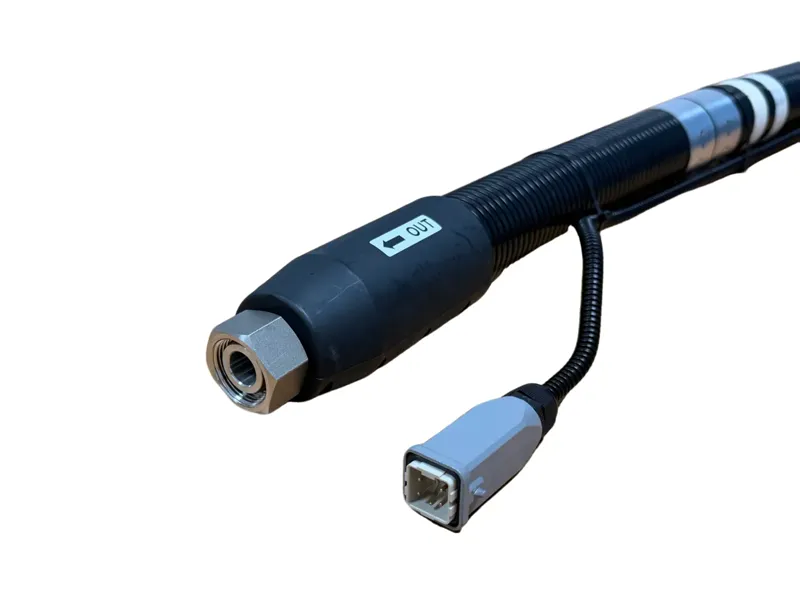
Why a complete heated hose specification matters
An electrically heated hose is not a stock part with one universal rating. It keeps resins, fats, oils and other viscous media from solidifying, freezing or thickening on the way from a tank, melter or pump to the point of use. To do that reliably, the inner tube, the heater output per metre, the insulation, the sensor and the fittings are selected together for one set of operating conditions.
Change one condition and the others may have to change too. A longer hose needs more total heater power. A higher setpoint needs different insulation. A controller set up for a PT100 input will not read a thermocouple correctly. That is why our business policies state that product-family names do not create a universal pressure or temperature rating: final ratings depend on the construction, reinforcement, fittings, media, temperature and installation. A complete specification lets the engineering review start straight away, without a round of questions.
The checklist, input by input
1. Conveyed medium
Send: the name and grade of the medium; what it does as it cools (solidifies, thickens, crystallizes); its viscosity at process temperature if you know it; and any fillers, solvents or aggressive chemicals.
Why it matters: the medium decides the inner tube and the temperature that must be held along the whole length. Jingcheng builds heated hoses on a stainless-steel corrugated tube, a PTFE hose with stainless-steel braid, a plain PTFE hose, or a special material when none of these is compatible.
2. Temperatures: setpoint, maximum, minimum and ambient
Send: the temperature the medium must have at the outlet (the setpoint), the highest temperature the hose will see, the lowest start-up temperature, and the ambient range around the hose.
Why it matters: the setpoint, maximum, minimum and ambient temperatures size the heater, the insulation and the sensor of a heated hose. On Jingcheng's order form the maximum working temperature is chosen from 100 °C, 120 °C, 200 °C or 400 °C (212, 248, 392 or 752 °F), or set to your value. Most application hoses in the 2025 catalog are rated to 230 °C (446 °F); the extruder connection hose reaches 250 °C (482 °F), and higher temperatures are built on request.
3. Working pressure and peak pressure
Send: the normal working pressure and the highest pressure the hose will see, for example at pump start-up or when a dispensing valve closes. State the pressure at operating temperature, not only at room temperature.
Why it matters: pressure sets the reinforcement and the fittings of a heated hose, and the working pressure becomes part of the model code. The standard working-pressure classes on Jingcheng's order form are:
| MPa | bar | psi (approx.) |
|---|---|---|
| 4 | 40 | 580 |
| 10 | 100 | 1,450 |
| 20 | 200 | 2,901 |
| 35 | 350 | 5,076 |
For high-pressure equipment, the extruder connection hose handles up to 35 MPa at 250 °C, and the special-industry connection hose is made for 40 MPa or more on request.
4. Inner diameter
Send: the bore you need for flow, and the size of the ports the hose connects to.
Why it matters: the bore of a heated hose sets flow resistance and the amount of medium that must be kept warm. Jingcheng's standard inner diameters are 8, 12, 16, 19 and 25 mm; other sizes are made to order.
5. Hose length
Send: the length between the two connection points, including the slack the routing needs.
Why it matters: heated hose output is rated per metre (110, 150, 170 or 200 W/m as standard at Jingcheng), so length sets the total electrical load that your controller and supply circuit must carry. For example, a 6 m heated hose rated at 150 W/m draws 900 W. Standard lengths are 3, 4.5, 5, 6 and 10 m; other lengths are made to order.
6. Movement and installation
Send: whether the hose is static or moves (on a robot arm, a hand-held gun or in a cable chain), how tightly it bends in the installation, and how it is supported.
Why it matters: repeated flexing and tight routing change the construction. Whatever the design, a heated hose must not be twisted about its own axis during or after installation, and it should be installed by trained personnel. Unauthorized modification voids the warranty.
7. Supply voltage
Send: the supply voltage and the number of phases available at the machine.
Why it matters: the heating element of a heated hose is designed for one supply. Jingcheng builds heated hoses for 380 V AC, 220 V AC, 110 V AC and 12 V DC as standard; other voltages are available. A 220 V three-phase, four-wire supply is also an option and appears in the model code as 3X220.
8. Temperature sensor
Send: the sensor type your controller reads. If the hose replaces one on existing equipment, copy the sensor type from the old hose or its label.
Why it matters: a heated hose sensor that does not match the controller input gives wrong readings, or none at all. Jingcheng's 2025 catalog lists type J and type K thermocouples, Ni120, PT100 (2-wire or 3-wire) and PT1000. A hose can also be built without a sensor.
9. Controller and wiring
Send: whether you will use your own controller (make, model and sensor input) or need one from us; the connector type at each end; and the pin assignment at the host end (the melter or controller) and at the gun end.
Why it matters: the wiring is recorded pin by pin (pin number, wire colour and function) for both ends, so the hose plugs straight into your equipment. If you need a controller, Jingcheng supplies PID temperature controllers with SSR or thyristor output, with options for a waterproof enclosure and a voltmeter or ammeter, as well as separate control boxes with two, three or more channels.
10. End fittings
Send: for each end, the thread standard and size, male or female, straight or angled, and how it seals. A photo or drawing of the mating port removes most doubt.
Why it matters: fittings are specified separately for each end, and they are part of the pressure and temperature rating of the whole assembly.
11. Installation environment
Send: anything outside the standard operating environment below, such as outdoor use, splash water or chemical vapours.
Why it matters: a standard build is designed for:
- an ambient temperature of −40 °C to +55 °C (−40 °F to 131 °F)
- relative humidity of 85 % or less
- atmospheric pressure of 86–106 kPa
- surroundings free of gases that corrode metal or damage insulation, conductive media and severe mould
Other environments are handled as custom builds.
12. Quantity, documents and standards
Send: prototype and production quantities; the inspection and test documents you need (pressure, electrical, thermal, dimensional or material); any standards that apply; and your target delivery date.
Why it matters: documentation requirements must be agreed before the order is confirmed. Minimum order quantity, sample cost and lead time are confirmed in the quotation.
How the checklist maps to a Jingcheng model code
Most of the checklist ends up in the model code. A code built from the fields below reads JCH-200-16-B-3X220-P2-8:
| Field | Meaning | Other values | Checklist input |
|---|---|---|---|
| 200 | Working temperature, °C | As specified | 2 |
| 16 | Inner diameter, 16 mm | As specified | 4 |
| B | Inner tube: stainless-steel corrugated tube | TB = PTFE hose with stainless-steel braid; T = PTFE hose; X = special material | 1, 3 |
| 3X220 | Supply: 220 V three-phase, four-wire | 220 = 220 V | 7 |
| P2 | Sensor: PT100, 2-wire | P3 = PT100 3-wire; K = type K; J = type J; W = no sensor; T = special sensor | 8 |
| 8 | Working pressure, 8 MPa | As specified | 3 |
Length, fittings, wiring and controller are recorded on the order form alongside the code.
Copy-and-paste heated hose RFQ template
Fill in what you know and leave the rest blank. Our engineers will ask about the gaps.
HEATED HOSE INQUIRY
Company / contact / country:
Application and equipment (machine type, melter or pump):

1. Medium (name, grade, behaviour when cooling):
2. Temperatures, °C: setpoint ___ / max ___ / min start-up ___ / ambient ___ to ___
3. Pressure: working ___ / peak ___ (unit: MPa, bar or psi)
4. Inner diameter: ___ mm
5. Length between connection points: ___ m
6. Movement: static / robot / hand-held / cable chain; tightest bend: ___
7. Supply voltage and phases: ___ V AC/DC, ___ phase
8. Sensor: J / K / Ni120 / PT100 2-wire / PT100 3-wire / PT1000 / none
9. Controller: own (make, model) ___ / need controller (channels: ___)
   Connector and pin assignment, host end: ___  gun end: ___
10. Fittings, end A: ___  end B: ___ (thread, size, male/female, straight/angled)
11. Environment (if not standard indoor):
12. Quantity: prototype ___ / production ___; documents and standards needed:
Target delivery date:
Common mistakes that slow down a quotation
- Sending only the setpoint. Without the maximum, the cold start-up temperature and the ambient range, the heater and insulation are sized on guesses.
- Giving working pressure without the peak. Pressure peaks at pump start-up or valve closing often decide the reinforcement.
- Leaving out the sensor type and pin assignment on a replacement. The new hose has to match the controller already on the machine.
- Not mentioning that the hose moves. A hose on a robot or a hand-held gun needs a different construction from a static line.
- Treating a product name as a rating. A family or series name is a starting point. The rating is set for your construction, fittings, medium, temperature and installation.
- Raising documentation after the order. Pressure, electrical, thermal, dimensional or material documents must be agreed before the order is confirmed.
What happens after you send it
- You send the inquiry through the web form, by email or by phone.
- Our engineers review the specification and propose the construction that the quotation will be based on.
- We issue the quotation, and you confirm it with a purchase order. Where a drawing or technical specification applies, it is approved before production starts.
- The hose is produced to the confirmed specification.
- It is inspected and packed.
- It is shipped to your address.
Our team typically responds to inquiries within one business day.
Frequently asked questions
Which voltages can a heated hose be built for?
Standard options are 380 V AC, 220 V AC, 110 V AC and 12 V DC, including a 220 V three-phase, four-wire version. Other voltages are available on request.
Which temperature sensors are available?
Type J and type K thermocouples, Ni120, PT100 (2-wire or 3-wire) and PT1000. A hose can also be supplied without a sensor.
How hot can a Jingcheng heated hose run?
Most application hoses in the 2025 catalog are rated to 230 °C (446 °F), and the extruder connection hose to 250 °C (482 °F). Higher temperatures are built on request.
Do I have to buy the controller from you?
No. Tell us the make, model and sensor input of your controller and we will match the hose to it. If you need one, we supply PID controllers with SSR or thyristor output and multi-channel control boxes.
Can you build a replacement for a hose on existing equipment?
Send the voltage, sensor type, connector and pin assignment at both ends, fittings, inner diameter, length and setpoint, taken from the existing hose or its label. Our engineers review the data before quoting.
Send your specification
Paste the completed template into our inquiry form or email it to soren.miles@shenzhenjingcheng.com. You can also browse our electrically heated hose families first.
Send your specificationSources: Jingcheng 2025 electrically heated hose catalog, and our published business policies. Final ratings for each project are confirmed in the quotation and drawing.