
Choosing between a smooth bore and a convoluted PTFE hose comes down to what the line must do. A smooth bore PTFE hose gives the cleanest flow path and the lowest pressure drop. A convoluted PTFE hose bends far tighter. Where neither reaches your pressure, stainless steel braid is added.
Already know you need a smooth bore line?
See the smooth bore PTFE hose page for sizes, temperature and pressure, or convoluted PTFE hose for tight bends and suction. Send your bore, length, medium, temperature and pressure and we will quote the assembly.
Get a PTFE hose quote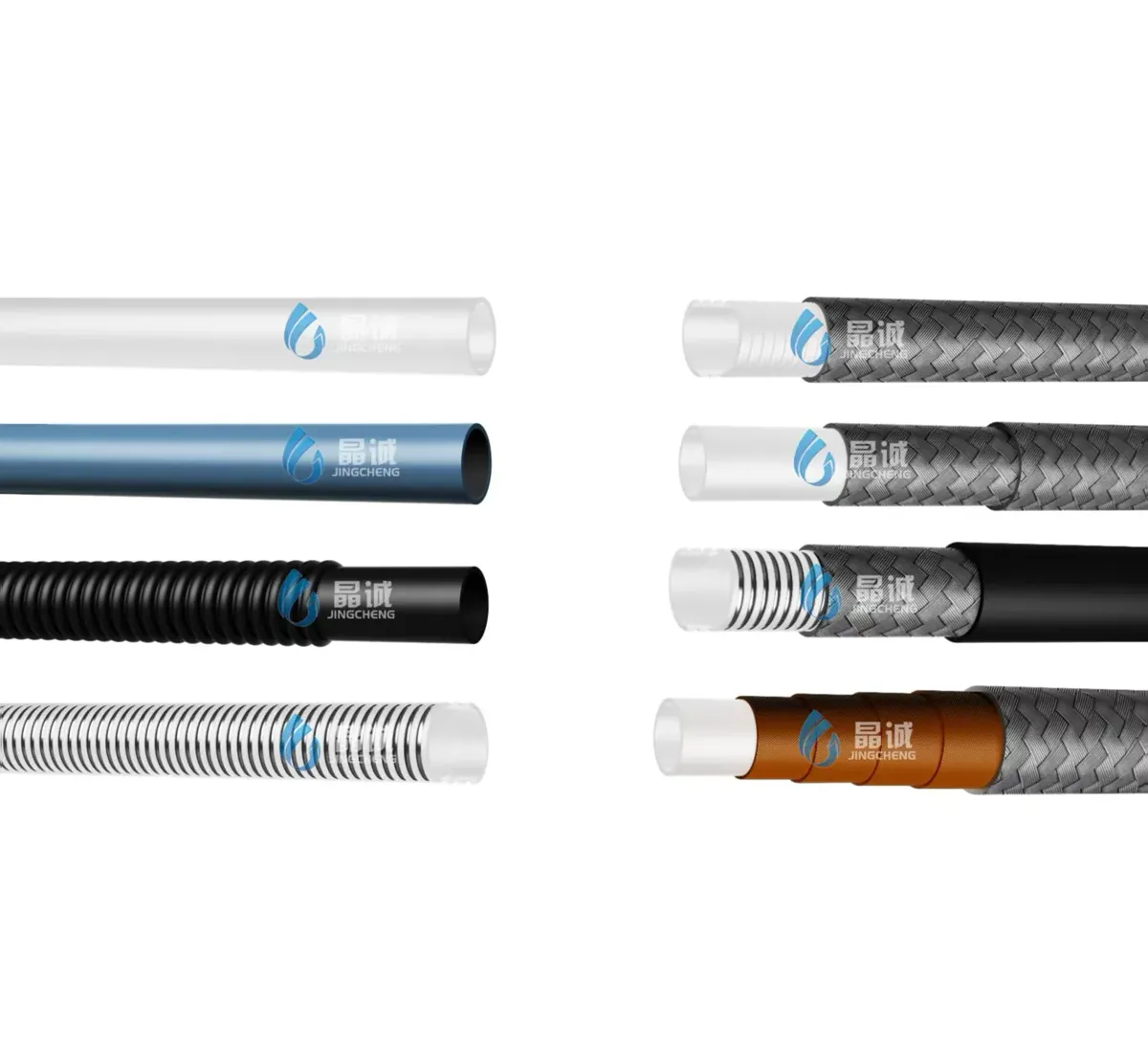
What decides a PTFE hose construction
A PTFE hose is defined by three choices: the shape of the bore, the reinforcement wound over the tube, and any outside protection. Working pressure, bend radius and cleanability all follow from those three.
The medium rarely decides the construction, because PTFE resists most aggressive chemicals by itself. Jingcheng's PTFE hose brochure lists strong acids and alkalis, oxidizers, reducing agents and organic solvents for the smooth-bore series, and pharmaceutical, food and chemical service for the convoluted series as well. Two hoses handling the same chemical can sit at opposite ends of the pressure table.
The three properties pull against each other. A straight extruded tube flows and cleans well but resists bending and holds the least pressure. Corrugating it buys a tighter bend, at the cost of flow area and product left in the corrugations. Braid restores the pressure rating but takes flexibility and adds weight.
The three base constructions
Smooth bore PTFE hose
A smooth bore PTFE hose is an extruded PTFE tube with a straight inner surface, dried, sintered and shaped to size, with a wall between 1.0 mm and 2.0 mm. Jingcheng's smooth-bore series, JCC-00000, covers 5/32 inch to 2 inches, or 4.5 mm to 51 mm inside diameter, from −70 °C to +260 °C (−94 °F to +500 °F).
The straight wall gives this construction its two advantages. It presents the least resistance to flow, so pressure drop is lower than in a corrugated hose of the same bore, and there is nowhere for product to lodge, so the hose can be flushed and drained without dismantling. The cost is flexibility and pressure: the brochure rates JCC-00000 from 1.73 MPa down to 0.40 MPa (251 psi down to 58 psi) as the bore grows, the lowest-pressure family in the PTFE range.
Convoluted PTFE hose
A convoluted PTFE hose has a corrugated wall, formed inside and outside so the tube flexes along its whole length instead of bending at a few points. Jingcheng's convoluted series, JCC-10000, covers 1/4 inch to 2 inches over the same −70 °C to +260 °C (−94 °F to +500 °F) range, and the brochure describes it as very flexible rather than quoting a bend radius.
The corrugations buy three things. A convoluted hose bends tightly, which suits a machine where the hose turns inside a small envelope or travels with a moving arm. The folded wall resists collapse under vacuum better than a thin smooth wall. And the extra wall length absorbs movement, so the hose tolerates repeated flexing.
The same corrugations cost flow and cleanliness, and this is the part most catalogue pages leave out. A corrugated bore has a larger wetted surface and a rippled profile, so pressure drop is higher than in a smooth hose of the same nominal bore, and product collects in the grooves, which makes complete drainage and cleaning harder. The listed rating reflects the trade-off: JCC-10000 runs from 0.4 MPa down to 0.2 MPa (58 psi down to 29 psi), below the smooth-bore series at every comparable bore.
Two further series combine the two bore shapes instead of choosing between them. JCC-20000 has a smooth bore with a convoluted outside under a 304 stainless spiral spring, rated 2.64 MPa down to 1.2 MPa (383 psi down to 174 psi) from 1/4 inch to 1 inch. JCC-21100 does the same with a 304 stainless braid instead of a spring, rated 8.8 MPa down to 2.5 MPa (1,276 psi down to 363 psi). The brochure describes JCC-21100 as vacuum-resistant, easy to clean and bending to a small radius.
Stainless steel braided PTFE hose
A braided PTFE hose wraps wire braid over the PTFE tube. The tube contains the medium; the braid carries the hoop stress that internal pressure puts on the wall. Adding braid is the largest single change available, and it is why the braided series reach pressures the unbraided families cannot.
Jingcheng builds the braid over both bore shapes. Single-braid JCC-01100 uses one 304 stainless braid over a smooth tube from 5/32 inch to 1 inch. Convoluted braided JCC-11100 pairs a corrugated tube with a 304 braid from 1/4 inch to 2 inches, at a bend radius the brochure gives as 10 mm to 200 mm depending on bore.
Braid raises the working pressure by an order of magnitude or more, at the cost of flexibility, weight and a little free bore. It also changes how a hose fails: an over-pressurised braided hose usually leaks at a fitting before the tube bursts, which is one reason the fittings carry part of the assembly rating.
All twelve Jingcheng series compared
The table lists every construction in Jingcheng's PTFE hose brochure. Pressure falls as the bore grows, so each range runs from the smallest bore to the largest. Sizes are inside diameters.
| Model | Construction | Temperature | Size range | Working pressure | Typical service |
|---|---|---|---|---|---|
| JCC-00000 | Smooth bore, extruded PTFE, wall 1.0–2.0 mm | −70 to +260 °C (−94 to +500 °F) | 5/32"–2" (4.5–51 mm) | 1.73 → 0.40 MPa (251 → 58 psi) | Acids, alkalis, oxidizers, organic solvents, high-purity chemicals |
| JCC-10000 | Convoluted inside and outside | −70 to +260 °C (−94 to +500 °F) | 1/4"–2" | 0.4 → 0.2 MPa (58 → 29 psi) | Pharmaceutical, food, chemical |
| JCC-20000 | Smooth bore, convoluted outside, 304 stainless spiral spring | −65 to +260 °C (−85 to +500 °F) | 1/4"–1" | 2.64 → 1.2 MPa (383 → 174 psi) | Corrosive chemicals, hot air, hot oil, steam; food and pharmaceutical |
| JCC-01100 | Smooth PTFE, one 304 stainless braid | −70 to +260 °C (−94 to +500 °F) | 5/32"–1" | 10 MPa (1,450 psi) at 1"; higher at smaller bores | Machinery, automotive, medical, chemical, energy, aerospace |
| JCC-11100 | Convoluted PTFE, 304 stainless braid | −70 to +200 °C (−94 to +392 °F) | 1/4"–2" | 13.8 → 3.1 MPa (2,002 → 450 psi) | Pharmaceutical, food, chemical |
| JCC-21100 | Smooth bore, convoluted outside, 304 stainless braid | −70 to +260 °C (−94 to +500 °F) | 1/4"–1-1/4" | 8.8 → 2.5 MPa (1,276 → 363 psi) | Food, cosmetics, chemical, pharmaceutical |
| JCC-02100 | Smooth PTFE, 304 braid, outer 304 wire-bundle braid | −70 to +260 °C (−94 to +500 °F) | 3/8"–2" | 41 → 17 MPa (5,947 → 2,466 psi) | High-pressure spraying, gluing and transfer, steam, oil, brake lines |
| JCC-01200 | Smooth PTFE, two 304 stainless braids | −70 to +260 °C (−94 to +500 °F) | 1/4"–1-1/4" | 40 → 14 MPa (5,802 → 2,031 psi) | Hydraulic transmission of gas-, oil- and water-based fluids |
| JCC-03100 | PTFE tube, 1–2 spiral layers of copper-plated steel wire, 304 braid | −65 to +220 °C (−85 to +428 °F) | 1/2"–1" | 44 → 27 MPa (6,382 → 3,916 psi) | Fuel, gas, acids, alkalis, solvents, coolant and lubricant lines |
| JCC-04100 | PTFE tube, aramid braid | −65 to +220 °C (−85 to +428 °F) | 3/8"–1" | 40 → 24.5 MPa (5,802 → 3,553 psi) | As JCC-03100, where weight matters |
| JCC-61100 | Smooth PTFE, 304 braid, smooth PU jacket in black, red or blue | −70 °C (−94 °F); upper limit confirmed with the quotation | 5/32"–1" | 27 → 10 MPa (3,916 → 1,450 psi) | Pharmaceutical, food, beverages, paint and adhesive |
| Anti-static series | Anti-static smooth, convoluted and smooth-bore convoluted, plus an all-black conductive convoluted version | −60 to +260 °C (−76 to +500 °F) | Follows the base construction | Follows the base construction | Chemical and flammable liquids, electrostatic coating, food |
Jingcheng's PTFE hoses carry the prefix JCC-xxxxx-PTFE, and every series is customisable to specification.
Working pressure and burst pressure are not the same number
Four series in the brochure are published with both figures. JCC-02100 is listed at 41 MPa working against 122.2 MPa burst, JCC-01200 at 40 against 120.9 MPa, JCC-03100 at 44 against 176.4 MPa, and JCC-04100 at 40 against 160 MPa. Burst is roughly three to four times working, and it is a safety margin, not an operating limit.
Working pressure is what the assembly is designed to see continuously, at the stated temperature, with its listed fittings; burst pressure is where it fails in a destructive test. Sizing a hose so normal process pressure sits near the burst figure leaves no margin for water hammer, valve closure or a pump start-up spike.
Reinforcement and special constructions
Wire-bundle braid (JCC-02100)
JCC-02100 covers a smooth PTFE tube with a 304 stainless braid, then adds a heavier outer braid of stainless wire bundles, which pushes the series to 41 MPa down to 17 MPa (5,947 psi down to 2,466 psi) from 3/8 inch to 2 inches, the widest high-pressure size range in the table.
Double braid (JCC-01200)
JCC-01200 uses two standard 304 stainless braids over a smooth tube, 40 MPa down to 14 MPa (5,802 psi down to 2,031 psi) from 1/4 inch to 1-1/4 inch. Two standard braids reach a similar pressure class as one heavy braid, with a more uniform bend.
Spiral-wound steel wire (JCC-03100)
JCC-03100 wraps one or two spiral layers of copper-plated steel wire around the PTFE tube under a 304 stainless braid. Its 44 MPa down to 27 MPa (6,382 psi down to 3,916 psi) between 1/2 inch and 1 inch is the highest working pressure in the table.
Aramid braid (JCC-04100)
JCC-04100 replaces the steel braid with aramid fibre over the PTFE tube, at 40 MPa down to 24.5 MPa (5,802 psi down to 3,553 psi) from 3/8 inch to 1 inch. The reason to choose it is weight: aramid weighs far less than equivalent steel.
PU-covered braid (JCC-61100)
JCC-61100 adds a smooth polyurethane jacket over a single-braided smooth tube, in black, red or blue, rated 27 MPa down to 10 MPa (3,916 psi down to 1,450 psi) from 5/32 inch to 1 inch. The jacket protects the braid and gives a wipe-clean surface, but it also sets the upper temperature limit, so the working temperature is confirmed per project.
Anti-static versions
The twelfth series is a set of conductive variants rather than a construction of its own: anti-static smooth, anti-static convoluted, anti-static smooth-bore convoluted, and an all-black conductive convoluted hose, all rated −60 °C to +260 °C (−76 °F to +500 °F). Flow through a PTFE hose builds up static charge, because PTFE does not conduct, so where the medium is flammable, a solvent or a powder, that charge has to be carried away.
A decision path from medium to construction
Work through these steps in order; the first few usually settle the choice.
- Maximum continuous temperature. Braided smooth-bore series run to +260 °C (+500 °F), convoluted braided to +200 °C (+392 °F), and spiral-wound and aramid to +220 °C (+428 °F).
- Working pressure at that temperature. Choose the lowest-pressure series that still covers your highest normal pressure. This decides whether braid is needed at all.
- Peak pressure. Add water hammer, valve-closure and pump-start spikes. If the peak approaches the burst figure of the series you picked, move up one construction.
- Bend radius and movement. A hose that bends tightly or travels with a moving part needs a convoluted construction. A fixed, supported line is better served by a smooth bore.
- Vacuum. On an evacuated line a plain smooth wall can collapse; a convoluted bore, or spring-reinforced JCC-20000, holds its shape.
- Cleaning and drainage. Where the line is flushed between batches or changes media, the smooth bores of JCC-00000 and JCC-21100 avoid trapped product.
- Static and outside protection. Move to the anti-static range for a flammable medium or electrostatic coating, add a PU jacket where the hose is wiped down, and aramid braid where weight matters.
Common mistakes
- Choosing a convoluted hose for cleanliness reasons. The corrugations that let it bend are the corrugations that trap product. A line that must drain completely usually wants a smooth bore.
- Comparing working pressure across different bores. Every range in the table falls as the bore grows, so a 1 inch hose and a 3/8 inch hose from one series do not share a rating.
- Sizing against the burst pressure. Burst is a destructive-test result, roughly three to four times working, and leaves no room for pressure spikes.
- Ignoring the limit of the braid or jacket rather than the tube. PTFE tolerates +260 °C (+500 °F), but the convoluted braided series are listed to +200 °C (+392 °F) and a polymer jacket sets its own ceiling.
- Leaving the fittings out of the pressure discussion. The working pressure applies to the finished assembly, including its end connections, not to the tube alone.
What to send for a construction recommendation
Send the medium, the maximum continuous temperature, the normal and peak pressures, the bore you need for flow, the tightest bend in the installation, whether the line sees vacuum, and whether the medium is flammable. The heated hose specification checklist sets out the same inputs in the order our engineers review them, and applies equally to an unheated PTFE hose.
For pressure classes by bore, see the PTFE high-pressure hose series; for the unbraided and spring-reinforced families, see the PTFE low-pressure hose series. The business policies explain how a family name relates to the rating of a finished assembly.
Frequently asked questions
Is a convoluted PTFE hose as strong as a smooth bore hose?
Unbraided, no. Jingcheng's brochure rates convoluted JCC-10000 from 0.4 MPa down to 0.2 MPa (58 psi down to 29 psi), below smooth-bore JCC-00000 at every comparable bore. With braid: convoluted braided JCC-11100 is rated 13.8 MPa down to 3.1 MPa (2,002 psi down to 450 psi).
Which PTFE hose construction bends the tightest?
Convoluted braided JCC-11100, which the brochure gives a bend radius of 10 mm to 200 mm depending on bore.
Can a PTFE hose be used under vacuum?
A convoluted bore resists collapse better than a plain smooth wall, and Jingcheng's brochure describes JCC-21100 as vacuum-resistant. Spring-reinforced JCC-20000 also protects the tube from the outside.
Do I need an anti-static PTFE hose?
Review an anti-static construction whenever the medium is flammable, a solvent or a powder, or where the process is electrostatic coating.
Send your application details
Tell us the medium, the temperature and the pressure range, and our engineers will recommend the construction for your line and quote the finished assembly. For a single construction, see smooth bore PTFE hose, convoluted PTFE hose or stainless steel braided PTFE hose. You can also review the electrically heated hose families if the line also needs heat tracing.
Request a PTFE hose quotationSoren Miles, Marketing Manager | JC
Mobile: +86 13087118553 / +1 (757) 733-8947
WhatsApp: +86 185 6950 4906
Email: soren.miles@shenzhenjingcheng.com
Company (Canada): JINCHEN ELECTRIC TRACING CO., LTD.
Company (Hong Kong, China): HK JINGCHENG HIGH TECH CO., Ltd
Company (China): SHENZHEN JINGCHENG HIGH TECH CO., Ltd / Jingcheng Fluoroplastic (Guangdong) Co., Ltd.
Website: https://www.jingchenghose.com | https://www.electricallyheatedhose.com
Factory address: No. 7 Qiguan East Road, Torch Development Zone, Zhongshan City (Jingcheng Industrial Park)
Sources: Jingcheng PTFE hose brochure (JCC series data), and our published business policies. General engineering statements about pressure drop, drainage and static are not product ratings. Final ratings for each project are confirmed in the quotation and drawing.