
A convoluted PTFE hose solves routing problems that smooth bore tubing cannot, but it is also the hose we most often see taken off a suction line after a few months with a flat spot just past the bend. The answer is rarely a better hose. It is usually a different construction.
The symptom: a flat spot just past the bend
The call usually starts the same way. A transfer line has to make a tight turn in a space too small for rigid pipe, so a convoluted PTFE hose goes in because it bends where nothing else will. A few weeks into service the pump is cavitating, the flow rate has dropped, and someone has found a section of hose that looks oval instead of round.
Sometimes the hose is not oval but pinched, with the corrugations folded against each other on the inside of the bend. Sometimes it looks fine until you run a hand along it and feel a soft spot near the fitting. In both cases the line is failing at what nobody checked before installation: the pressure on the outside of the wall relative to the inside.
The second symptom turns up in a different department. The hose is fine, the flow is fine, but a changeover rinse leaves product in the line. Swabs come back dirty, and the cleaning validation takes a week longer than planned. That one is also a construction choice, and it is the easier of the two to put right.
Root cause: a corrugation is a hoop, not a rib
A corrugated wall gets its flexibility by folding. Each convolution is a ring around the bore, and a ring is stiff in the direction that matters here. It resists bending along the hose axis well enough to spring back, which is why the hose stays open and flexible, but it has very little resistance to a pressure difference pushing from the outside in. This is general hose engineering, not a Jingcheng test result: the same thing happens to any thin corrugated metal or polymer wall under vacuum.
Once the pump pulls a vacuum, the wall has to carry that load somehow. On a smooth bore PTFE tube the wall is a cylinder in compression and it holds a modest vacuum without help. On a convoluted tube the load sits on the folds, and an unbraided wall starts to flatten at the point of least support, which is almost always just downstream of a bend or at the transition into the fitting where the corrugation has been compressed.
A stainless braid changes the picture. The braid is a set of wires laid at an angle over the corrugations. Under internal pressure it tightens and resists growth; under external pressure it does the opposite job and stops the corrugations folding inward. That is why the braided convoluted series exist at all, and why swapping an unbraided hose for a braided one fixes a collapse that no amount of thicker wall would fix.
Of the four convoluted builds we publish data for, only JCC-21100 is described as vacuum-resistant. That is a statement about its construction, not a rating you can scale: the vacuum a line will hold depends on bore, temperature, bend radius and how the assembly is supported. Send us the vacuum level and we will confirm it for the size you need.
What I check first: five steps
Before quoting a replacement, I want to know why the first hose failed. A new hose of the same construction will fail the same way, and the second failure usually costs more than the first because the line is down during a production run.
- Split the vacuum reading. Put a gauge at the pump inlet and a second one at the far end of the hose. A large difference between them means the hose is restricting flow, and on a suction line that usually means the bore has already collapsed somewhere in the middle.
- Find the flat with a straight edge. Lay a steel rule along the hose. A round hose touches at one point; an oval section touches along a line and rocks. Check both sides of every bend, and the 100 mm either side of each fitting.
- Cut a sample and look at the wall. A 100 mm section from the failed area tells you whether the corrugations have folded, cracked at the root of the fold, or been crushed by something mechanical. Cracking at the root points to repeated flexing. Folding points to pressure.
- Ask how it was installed. A hose cut to the exact distance between two fixed ports goes in under tension. Under vacuum it straightens, the bend moves, and the load lands on the crimp. A little slack, routed in a gentle curve, is worth more than a longer hose.
- For cleanout, run a rinse test with the real product. Fill the hose, drain it, rinse to your normal procedure, then swab the bore with a white cloth or a bore scope. If the cloth picks up product from the valleys between corrugations, no amount of rinse time will fix it, because the flow follows the groove rather than scrubbing the wall.
The four convoluted constructions
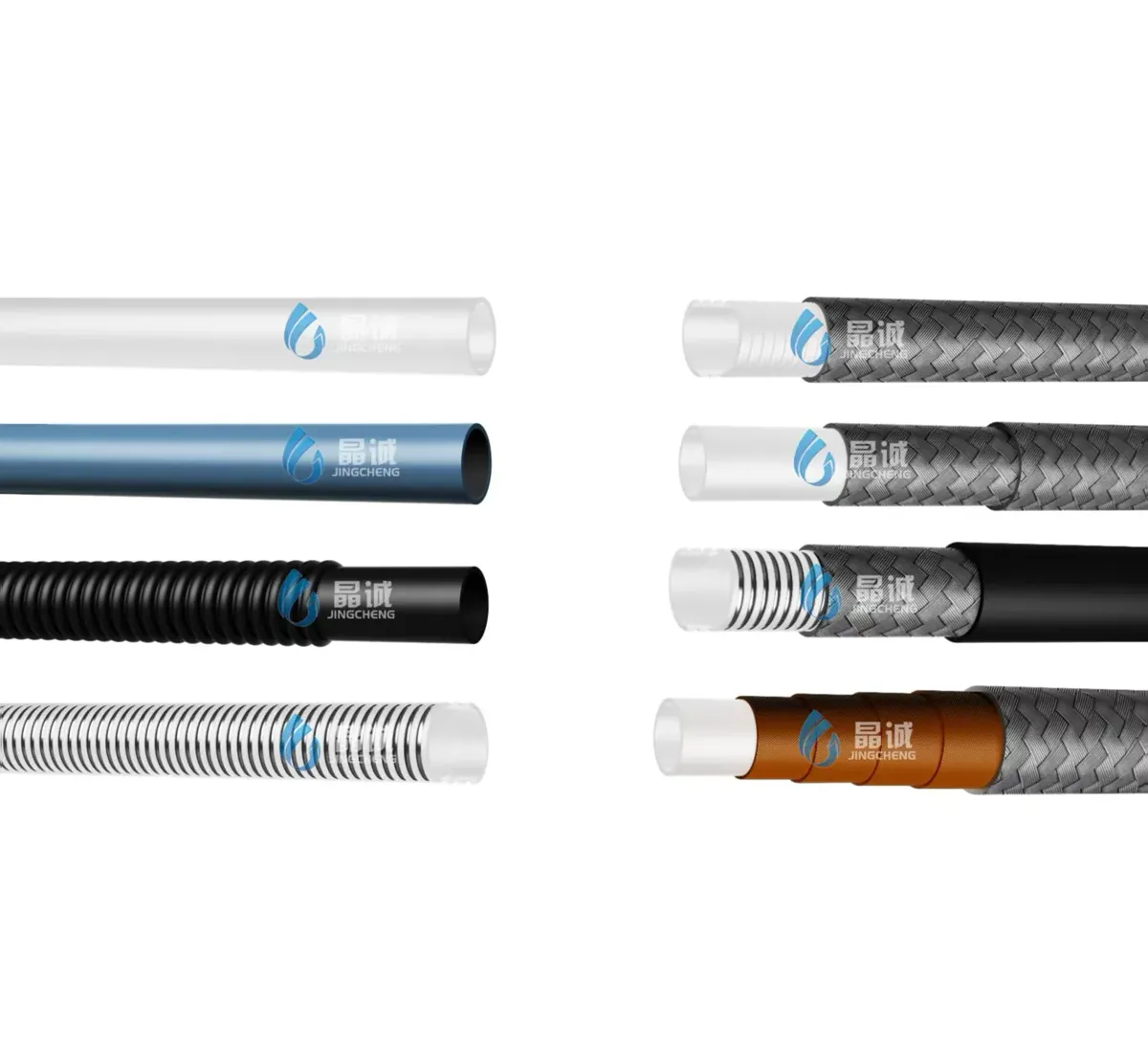
We build four convoluted PTFE hoses, and they are not interchangeable. Two sit in our low pressure PTFE range without a braid, and two carry a 304 stainless braid in our high pressure PTFE range.
| Series | Construction | Temperature | Sizes | Working pressure | Best fit |
|---|---|---|---|---|---|
| JCC-10000 | Corrugated inside and outside, no braid | -70 to +260 °C (-94 to +500 °F) | 1/4" to 2" | 0.4 MPa (58 psi) down to 0.2 MPa (29 psi) | Tight routing, gravity or low-pressure transfer, no vacuum |
| JCC-20000 | Smooth bore, corrugated outside, 304 stainless spiral spring | -65 to +260 °C (-85 to +500 °F) | 1/4" to 1" | 2.64 MPa (383 psi) down to 1.2 MPa (174 psi) | Corrosive chemicals, hot air, hot oil, steam; food and pharma where the bore must clean |
| JCC-11100 | Corrugated PTFE with 304 braid, bend radius 10 to 200 mm | -70 to +200 °C (-94 to +392 °F) | 1/4" to 2" | 13.8 MPa (2,002 psi) down to 3.1 MPa (450 psi) | Pressure plus tight bends; pharma, food and chemical transfer |
| JCC-21100 | Smooth bore, corrugated outside with 304 braid, vacuum-resistant | -70 to +260 °C (-94 to +500 °F) | 1/4" to 1-1/4" | 8.8 MPa (1,276 psi) down to 2.5 MPa (363 psi) | Suction lines, small bend radius, easy cleaning between products |
The working pressure figures are ranges because they fall as the bore grows. A 2 inch convoluted hose and a 1/4 inch convoluted hose do not share a rating, and we do not publish a single number for a series. The same applies to bend radius: JCC-11100 is quoted across the whole series as 10 to 200 mm, roughly 0.39 to 7.9 inches, and the figure for your size is fixed on the drawing before we build.
Bore profile: the decision that decides cleanout
If the line carries product that has to leave the hose clean, the bore profile matters more than the braid. A fully convoluted bore, JCC-10000 or JCC-11100, gives a long helical path for flow and a set of valleys the rinse cannot reach. Viscous media, creams, slurries and anything with a yield stress will sit in those valleys. A swab test will find it, and a changeover will take longer than the line was designed for.
JCC-20000 and JCC-21100 solve that by putting the corrugations on the outside. The product touches a smooth PTFE wall, which drains and wipes the way smooth tubing does, while the corrugated profile underneath keeps the hose flexible and the spring or braid keeps it round. Both are listed for food, cosmetics or pharmaceutical service, which is where the cleaning question is asked most often.
Where the convoluted bore still earns its place is routing with no cleaning requirement: a fixed chemical feed, a low-pressure drain, a line that is purged rather than cleaned. In those jobs the fully convoluted hose is the cheapest way to make a tight bend in a small space.
Temperature: watch the braided series limit
Three of the four builds go to +260 °C (500 °F). The braided convoluted series, JCC-11100, is rated to +200 °C (392 °F). That 60 degree gap catches people out, because the braid and the corrugation look like an upgrade in every direction. It is not. If your process runs at 230 °C, JCC-11100 is out of range and you need to look at JCC-21100, which keeps the braid and the smooth bore but is rated higher, or at a braided smooth bore hose from the high pressure range.
Rated temperature is the fluid temperature at continuous operation, not the peak a line sees during a steam-out. If the hose is steamed between batches, say so in the inquiry. Cleaning steam is often hotter than the process, and a hose that is fine in production can be the one that fails during sanitation.
Which convoluted hose for which job
In practice the choice usually falls out of three questions: is there vacuum, does the bore have to clean, and what is the temperature.
A suction line on a small bore, with frequent product changes, is JCC-21100. It is the only one of the four we describe as vacuum-resistant, it has a small bend radius, and the smooth bore cleans. A pressure line that has to bend tightly in a machine frame is JCC-11100, provided the temperature stays at or below 200 °C. A corrosive chemical or hot oil line with a moderate pressure and no vacuum is JCC-20000, where the spring supports the corrugated outside and the smooth bore keeps the flow path simple. A low-pressure drain or a gravity feed that just needs to get round a corner is JCC-10000.
For flammable liquids and solvents there are anti-static versions of the convoluted builds, including an all-black conductive convoluted hose, rated -60 to +260 °C (-76 to +500 °F). Those are a separate conversation about earthing and the fluid's conductivity, and we would rather discuss it than guess at it. Ask for the anti-static series when you send the inquiry.
Common mistakes we see on convoluted lines
- Choosing convoluted for flexibility alone. Flexibility is the point of the corrugation, but a suction line needs collapse strength, and the two are not the same property. Say the word vacuum in the inquiry and the shortlist changes.
- Assuming braid means higher temperature. On the convoluted series it does not. JCC-11100 stops at +200 °C (392 °F) while the unbraided JCC-10000 goes to +260 °C (500 °F).
- Cutting the hose to the exact port distance. A hose installed under tension loses its shape the first time it sees vacuum or heat. Leave slack and route a curve.
- Bending tighter than the quoted radius during installation. The radius is a working limit, not a target. A hose forced round a tighter corner at fitting time has already used up part of its fatigue life before the first batch.
- Using a fully convoluted bore where cleaning is validated. Rinse time cannot compensate for geometry. If the swab has to pass, use a smooth bore.
- Clamping the hose hard right at the fitting. A rigid clamp next to the crimp moves all the flex into a short length of hose. Support the hose a little further along the run and let the bend happen over a longer arc.
What to send for an accurate quotation
For a convoluted PTFE hose the useful inquiry is short but specific: bore, overall length, fluid, continuous temperature, working pressure or vacuum level, the tightest bend the installation allows, and how the line is cleaned. Add the connection type you need and we will confirm the detail on the drawing rather than in an email. The heated hose specification checklist covers the same ground for trace-heated lines, and the PTFE hose selection guide puts the convoluted builds next to the rest of the range if you are still deciding between families.
If the answer turns out to be a braided smooth bore rather than a convoluted hose, the braided PTFE hose guide compares the single braid, double braid and jacketed options.
Frequently asked questions
Can a convoluted PTFE hose be used on a suction line?
Only if the construction is built for it. An unbraided convoluted wall has little resistance to external pressure and will flatten at a bend. JCC-21100 is the braided, smooth bore, vacuum-resistant build in our range, and we confirm the vacuum level against the bore and temperature before the assembly is made.
What is the bend radius of a convoluted PTFE hose?
It depends on the series and the size. JCC-11100 is published across the series as 10 to 200 mm, about 0.39 to 7.9 inches, with the actual figure for a given bore set on the drawing. The other three series are quoted per size in the same way. Give us the space you have to bend in and we will tell you whether the hose fits.
Why did my convoluted PTFE hose crack at the fitting?
Usually repeated flexing concentrated in a short length next to the crimp, often because the hose was installed under tension or clamped hard at the fitting. The corrugation root is the thinnest part of the wall and cracks first. A longer assembly, better support and a braid to share the load all help; a thicker wall on its own does not.
Is a convoluted PTFE hose better than smooth bore?
It is better at bending in a small space, and that is all. Smooth bore gives a straighter flow path and a bore that cleans, which matters on viscous media and on any line with a changeover. Choose by what the line has to survive, not by which hose looks more flexible in the catalogue.
Can a convoluted PTFE hose carry steam?
JCC-20000 is listed for steam, hot oil and hot air, up to +260 °C (500 °F). Steam service also means pressure, so the temperature and the pressure have to be checked together, and a steam-out between batches is a separate condition from the process temperature. Tell us both numbers.
Send your convoluted hose details
Tell us the bore, length, fluid, temperature, pressure or vacuum, and the tightest bend the installation allows. We will come back with the construction that suits the line, not the one that happens to be in stock.
Request a convoluted PTFE hose quotationSoren Miles, Marketing Manager | JC
Mobile: +86 13087118553 / +1 (757) 733-8947
WhatsApp: +86 185 6950 4906
Email: soren.miles@shenzhenjingcheng.com
Company (Canada): JINCHEN ELECTRIC TRACING CO., LTD.
Company (Hong Kong, China): HK JINGCHENG HIGH TECH CO., Ltd
Company (China): SHENZHEN JINGCHENG HIGH TECH CO., Ltd / Jingcheng Fluoroplastic (Guangdong) Co., Ltd.
Website: https://www.jingchenghose.com | https://www.electricallyheatedhose.com
Factory address: No. 7 Qiguan East Road, Torch Development Zone, Zhongshan City (Jingcheng Industrial Park)
Sources: Jingcheng PTFE hose brochure, convoluted and convoluted braided series pages, and our published business policies. Statements about how a corrugated wall behaves under external pressure, and the troubleshooting steps in this article, are general hose engineering practice rather than test data from our factory. Final ratings for each project are confirmed in the quotation and drawing.