
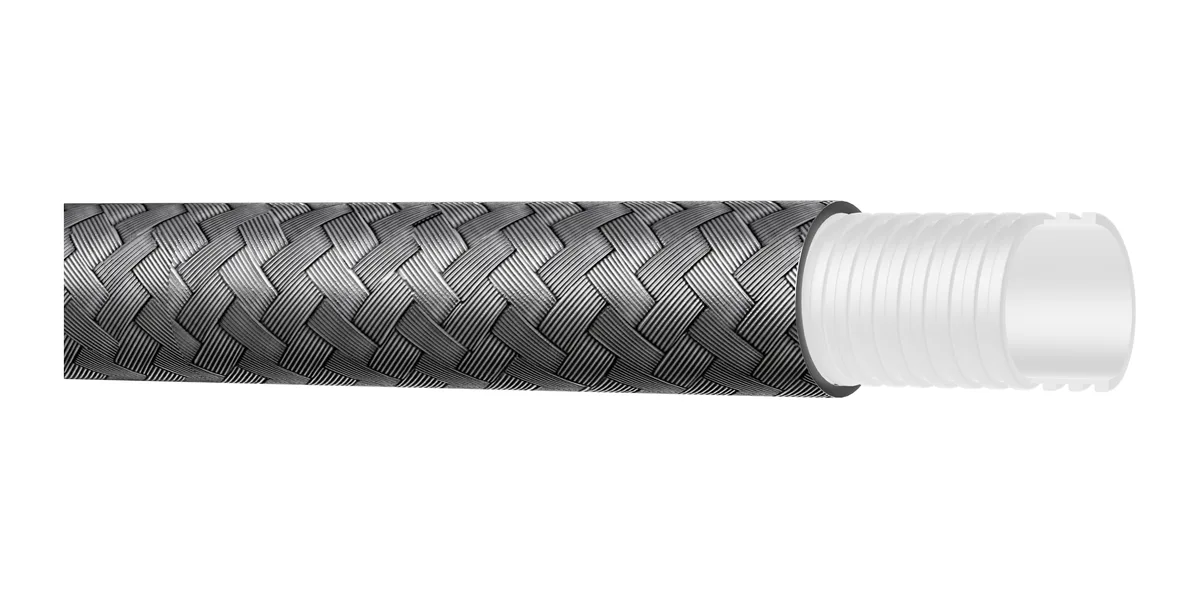
JCC-21100 is the PTFE hose with a smooth inner wall, a corrugated outer wall and one layer of 304 stainless steel braid over it. It is the build we recommend when a line has to be cleaned between batches, has to hold vacuum, and has to bend in a space too tight for a straight braided hose. The inside is a plain cylinder; only the outside is ringed.
- Temperature−70 to +260 °C / −94 to +500 °F
- Bore6.8–31.75 mm (1/4"–1-1/4")
- Working pressure8.8 → 2.5 MPa by size
- Bend radius19–80 mm
Overview
The reason this series exists is a fairly common complaint: a plant is running a smooth braided PTFE hose on a transfer line, and the hose keeps failing right at the bend just behind the fitting. The bore is fine, the pressure is fine, but the routing needs a radius the straight tube cannot take, so somebody pulls it tighter than they should and the tube creases. Once a PTFE tube creases, that fold is permanent and it eventually cracks.
JCC-21100 solves the routing problem without giving up the clean bore. The tube is formed with rings on the outside, which lets the wall flex without creasing, while the inside stays a smooth cylinder. The 304 braid over the corrugation carries the pressure and stops the rings from opening up under load, which is also what makes the hose resist negative pressure. In the catalog this series is listed as vacuum-resistant, easy to clean and with a small bend radius, in sizes from 1/4" to 1-1/4".
What it is good at: washdown and cleaning cycles where product must not sit in the bore, suction-side lines, short jumpers to a moving head, and any run where the hose has to loop inside a machine frame. What it is not: a high-pressure hydraulic hose, and not the cheapest way to move fluid on a straight run. If the routing is generous and the line never sees vacuum, the plain smooth bore tube or a single-braid hose costs less and does the same job.
Specifications
| Model | Nominal size | ID mm ±0.3 |
OD mm ±0.3 |
Braided OD mm ±0.2 |
Working psi |
Working MPa |
Burst psi |
Burst MPa |
Min bend radius in |
Min bend radius mm |
|---|---|---|---|---|---|---|---|---|---|---|
| JCC-21106-PTFE | 1/4" | 6.8 | 8.35 | 9.6 | 1276 | 8.8 | 5104 | 35.2 | 0.75 | 19 |
| JCC-21108-PTFE | 5/16" | 7.9 | 10.3 | 10.6 | 1218 | 8.4 | 4872 | 33.6 | 0.75 | 19 |
| JCC-21110-PTFE | 3/8" | 10 | 11.93 | 13.5 | 1305 | 9 | 5220 | 36 | 0.98 | 25 |
| JCC-21113-PTFE | 1/2" | 13.6 | 15.1 | 17.5 | 870 | 6 | 3480 | 24 | 1.50 | 38 |
| JCC-21116-PTFE | 5/8" | 16.7 | 18.3 | 21.4 | 725 | 5 | 2900 | 20 | 1.97 | 50 |
| JCC-21119-PTFE | 3/4" | 19.8 | 22 | 24.2 | 609 | 4.2 | 2436 | 16.8 | 2.48 | 63 |
| JCC-21125-PTFE | 1" | 26.4 | 29.4 | 31.7 | 580 | 4 | 2320 | 16 | 2.95 | 75 |
| JCC-21132-PTFE | 1-1/4" | 31.75 | 35.5 | 37 | 362.5 | 2.5 | 1450 | 10 | 3.15 | 80 |
All values as printed in the Jingcheng PTFE hose catalog. Product certification stated in the catalog: ISO 9001:2015 / US FDA 21 CFR 177.1550 / SGS. Custom sizes and lengths are made to your drawing on request.
Materials and construction
- Inner layer: PTFE (polytetrafluoroethylene) tube, smooth on the inside, corrugated on the outside wall. The medium only touches solid PTFE, not a liner bonded into rubber or metal.
- Reinforcement: one layer of high-strength 304 stainless steel wire braid over the corrugated tube. The braid takes the hoop load and holds the rings closed.
- Bore: smooth and cylindrical end to end. The corrugation is on the outside only, so there is no ridged internal profile to trap product or add pressure drop.
- Bends: the corrugation plus the braid give the short bend radii in the table, 19 mm at 1/4" up to 80 mm at 1-1/4".
- Vacuum: the catalog lists this series as resistant to negative pressure, unlike a plain corrugated tube without a braid or spring.
- End connections: not part of the catalog sizes. Send the thread, flange or compression fitting used on the equipment and the assembly is built to that.
Temperature and pressure notes
The catalog range is −70 to +260 °C (−94 to +500 °F) for this series. That is the widest of the convoluted builds: the braided convoluted hose JCC-11100 is listed to +200 °C, so if the line runs hot, check which of the two you are ordering rather than assuming they are the same hose with a different bore.
Working pressure falls with bore, from 8.8 MPa at 1/4" to 2.5 MPa at 1-1/4". That is the braid and the ring geometry together: the same braid carries less as the diameter grows. The table figures are at room temperature. Derating for temperature is standard practice for polymer hose and we do not publish a single curve for it, because the right figure depends on medium, cycle count and how long the hose has to last. Send the operating temperature and the line pressure and the rating is confirmed in writing with the quotation.
Two things worth checking before ordering: how often the hose is bent in service, and whether it is ever pulled on. A corrugated tube flexes well but it is not a rope; if the run is used as a handling line that gets dragged, add a spring guard or route it so the load goes on the fitting, not the braid.
Applications
The catalog lists this series for food, cosmetics, chemical and pharmaceutical delivery. In practice we see it used where those three requirements meet — a clean bore, a tight bend and a line that is pulled under vacuum:
- Filling and dosing jumpers on food and cosmetic lines, where the hose is flushed or cleaned between batches and must drain fully.
- Suction-side transfer from drums and tanks, where a smooth-bore unbraided tube would collapse.
- Chemical transfer of corrosive media, after a compatibility check on the specific fluid and concentration.
- Pharmaceutical delivery lines where the product path has to be smooth and free of crevices.
- Short connections to a moving head or a vibrating skid, where a straight braided hose would fatigue at the crimp.
Options and related builds
How to order
Send these points and the quotation can be built without a second round of email:
- Bore in mm or inches, and the nominal size if you already know it.
- Length per piece and the number of pieces.
- End fittings at each end: thread standard and size, flange or compression fitting, with a photo or part number if you have one.
- Medium and concentration, so compatibility is checked against the actual fluid.
- Operating temperature, including cleaning or steam-in-place peaks.
- Working and peak pressure, and whether the line runs under vacuum.
- Routing: the tightest bend radius in the installation, so the size is not chosen on bore alone.
- Quantity for the first order and expected annual use.
Frequently asked questions
What does "smooth bore, corrugated outside" actually mean?
The inner wall of the tube is a plain cylinder and the outer wall has rings formed into it. Only one wall is corrugated, so the fluid sees a smooth path while the hose still bends tightly. It is a different build from JCC-11100, where the wall is corrugated on both the inside and the outside.
Why braid a corrugated hose?
Corrugation gives flexibility but weakens the tube against pressure, and an unbraided corrugated PTFE tube will collapse inward under vacuum. The 304 braid sits over the rings, carries the hoop load and stops them opening or closing. That is what turns the tube into a hose with a working pressure and a vacuum rating.
Will the smooth bore reduce pressure drop compared with JCC-11100?
Yes, in general terms: a smooth internal wall has less friction than a corrugated one, and there are no ridges to hold liquid when the line drains. We do not publish a calculated pressure-drop figure for either series. If the line is sensitive to it, tell us the flow rate and medium and we will discuss the practical options.
What is the minimum bend radius?
19 mm at 1/4" and 5/16", 25 mm at 3/8", 38 mm at 1/2", rising to 80 mm at 1-1/4". The table lists both inches and millimetres. Bend to the radius, not below it, and do not bend right at the fitting — leave a straight length at each end so the crimp is not worked.
Can it be used on suction or vacuum service?
The catalog lists this series as resistant to negative pressure and easy to clean, which is one of the reasons it exists. Give us the vacuum level and the temperature it is pulled at, because the rating has to be confirmed for your conditions rather than assumed from the table.
Is a wall thickness available?
The catalog prints ID, tube OD and braided OD for this series, but no wall thickness. We do not derive one from those figures because the OD is measured over the corrugation rings, so subtracting gives a ring height, not a wall. Ask and we will put the wall on the quotation drawing for the size you need.
Send your smooth-bore convoluted hose details
Bore, length, bend radius, fittings, medium, temperature and pressure is all we need to come back with a specification and a price.
Request a quoteSoren Miles, Marketing Manager | JC
Mobile: +86 13087118553 / +1 (757) 733-8947
WhatsApp: +86 185 6950 4906
Email: soren.miles@shenzhenjingcheng.com
Company (Canada): JINCHEN ELECTRIC TRACING CO., LTD.
Company (Hong Kong, China): HK JINGCHENG HIGH TECH CO., Ltd
Company (China): SHENZHEN JINGCHENG HIGH TECH CO., Ltd / Jingcheng Fluoroplastic (Guangdong) Co., Ltd.
Website: https://www.jingchenghose.com | https://www.electricallyheatedhose.com
Factory address: No. 7 Qiguan East Road, Torch Development Zone, Zhongshan City (Jingcheng Industrial Park)
Source: Jingcheng PTFE hose catalog, JCC-21100 page, and our published business policies. Pressure derating with temperature and the effect of corrugation on pressure drop are general engineering practice; the rating for each project is confirmed on the quotation and drawing.