
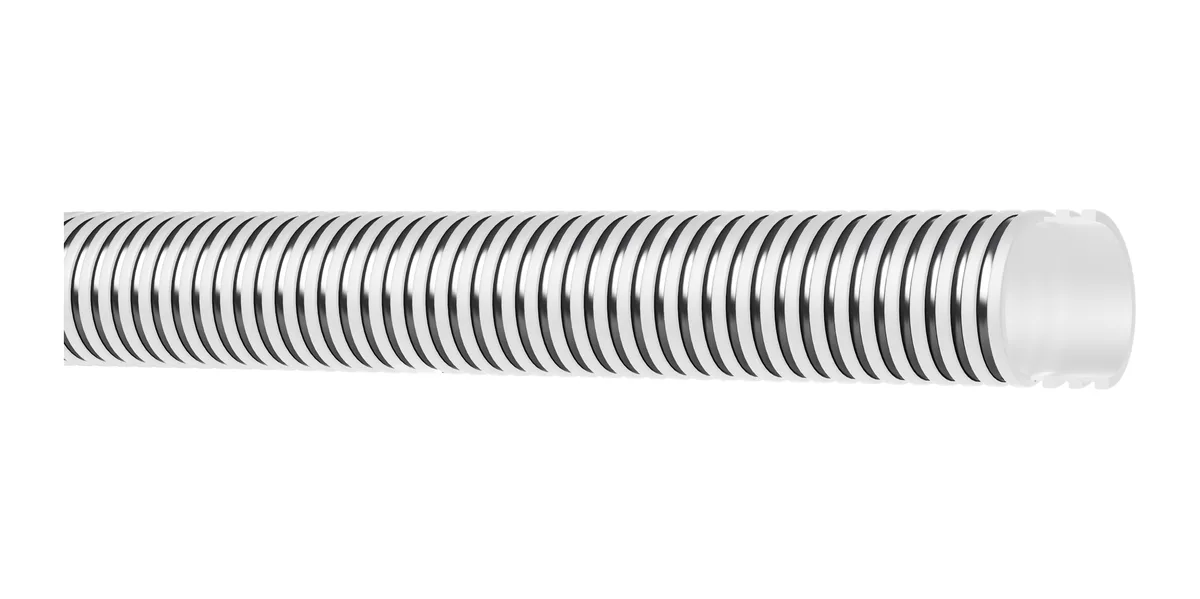
JCC-20000 is the PTFE hose we send when a line has to stay clean inside but be beaten up outside. The bore is smooth and the outside wall is corrugated, and a 304 stainless spiral spring is wound over the corrugation. The smooth bore keeps pressure drop and cleaning time down; the corrugation lets the hose bend tighter than a plain tube; the spring takes the abrasion, the crush and the repeated flexing that would otherwise wear through PTFE in a few months.
- Temperature−65 to +260 °C / −85 to +500 °F
- Bore6.8–26.4 mm (1/4"–1")
- Working pressure2.64 → 1.2 MPa (396 → 180 psi)
- Outside304 stainless spiral spring
Overview
Three layers do three different jobs. The inner tube is PTFE with a flat, cylindrical bore, so the product sees the same clean wall it would in a plain smooth bore tube. The wall outside that is corrugated, which is what allows the hose to take a bend radius of 19 mm at 1/4" instead of the 130 mm a plain smooth bore tube of the same size needs. The 304 spring sits on the outside of the corrugation and is the part that touches the floor, the clamps, the machine frame and anything else the line rubs against.
The spring is there for mechanical protection, not pressure. It keeps the corrugation from flattening when the hose is stepped on or pulled round a tight corner, and it spreads the load where the hose is clamped. That is the failure we get called about most: not a burst, but a corrugated PTFE hose that has gone oval at a clamp after a few months and starts to leak at the fitting. A spring-wound build resists that, and it also takes the small abrasive motion of a hose that moves a little every cycle.
What it is not: this is a low-pressure hose. Working pressure is 2.64 MPa at 1/4" and 1.2 MPa at 1". If the line runs at 1 MPa and higher, is subject to water hammer, or needs a vacuum rating, the braided builds are the right family — the spring will not carry pressure for you.
Specifications
| Model | Nominal size | ID mm ±0.3 |
OD mm ±0.3 |
Working psi |
Working MPa |
Burst psi |
Burst MPa |
Min bend radius in |
Min bend radius mm |
|---|---|---|---|---|---|---|---|---|---|
| JCC-20006-PTFE | 1/4" | 6.8 | 8.35 | 396 | 2.64 | 1276 | 8.8 | 0.75 | 19 |
| JCC-20008-PTFE | 5/16" | 7.9 | 10.3 | 378 | 2.52 | 1218 | 8.4 | 0.75 | 19 |
| JCC-20010-PTFE | 3/8" | 10 | 11.93 | 360 | 2.4 | 1160 | 8 | 0.98 | 25 |
| JCC-20013-PTFE | 1/2" | 13.6 | 15.1 | 270 | 1.8 | 870 | 6 | 1.50 | 38 |
| JCC-20016-PTFE | 5/8" | 16.7 | 18.3 | 236.83 | 1.63 | 725 | 5 | 1.97 | 50 |
| JCC-20019-PTFE | 3/4" | 19.8 | 22 | 203 | 1.4 | 609 | 4.2 | 2.48 | 63 |
| JCC-20025-PTFE | 1" | 26.4 | 29.4 | 180 | 1.2 | 580 | 4 | 2.95 | 75 |
All values as printed in the Jingcheng PTFE hose catalog. Product certification stated in the catalog: ISO 9001:2015 / US FDA 21 CFR 177.1550 / SGS. Custom sizes and lengths are made to your drawing on request.
Materials and construction
- Inner tube: PTFE, smooth bore, flat and cylindrical end to end, so the flow path is the same as a plain smooth bore tube.
- Outer wall: corrugated PTFE over the same tube. The corrugations are what give the 19–75 mm bend radii in the table.
- Guard: 304 stainless steel spiral spring wound over the corrugation. It protects against abrasion, crushing and repeated flexing; it does not carry internal pressure.
- Temperature: −65 to +260 °C (−85 to +500 °F) as listed. Note the lower limit is 5 °C above the plain PTFE series, which we assume is set by the spring and the corrugation, not the resin.
- End connections: not part of the catalog sizes. Send the thread, flange or compression fitting on the equipment and the assembly is specified to it.
Temperature and pressure notes
The catalog range is −65 to +260 °C. Working pressure falls steadily with bore: 2.64 MPa at 1/4" down to 1.2 MPa at 1". Burst is roughly three times working across the table. Treat that as a safety margin, never as an operating target.
Rated pressure at room temperature is not what you design to at 200 °C. Reducing allowable pressure as temperature climbs is standard practice for polymer hose and PTFE is no exception. We do not publish a single derating curve, because the answer depends on medium, cycle count and expected service life, so send the real temperature and pressure and the rating for your assembly is confirmed in writing with the quotation.
Two checks before a high-temperature order. First, is the medium a gas? Gases are less forgiving than liquids in a non-braided hose. Second, does the line ever pull vacuum? The spring protects the outside of the hose; it does not stop a corrugation collapsing inward. If the process needs vacuum, ask for a braided convoluted build instead.
Applications
This hose is specified where the medium is aggressive or the routing is rough:
- Highly corrosive chemicals
- Hot air and hot oil
- Steam lines
- Food, cosmetics, chemical and pharmaceutical transfer, where a smooth cleanable bore is wanted and the hose is handled or routed tightly
It is a good fit for a line that is dragged, clamped, or run round a machine frame rather than fixed in a tray, and for a hose that gets steam-cleaned between batches.
Options and related builds
How to order
Send these seven points and the quotation can be built without another round of email:
- Bore you need, in mm or inches, and the nominal size if you already know it.
- Length per piece and the number of pieces.
- End fittings at each end: thread standard and size, flange, or compression fitting, with a photo or part number if you have one.
- Medium and its concentration. This decides compatibility and whether PTFE is enough.
- Operating temperature, including cleaning or steam-in-place peaks.
- Working and peak pressure, and whether the line ever runs under vacuum.
- Quantity for the first order and the expected annual use, so the price reflects the real volume.
If a drawing already exists, send it. We work to the customer's drawing when one is supplied.
Frequently asked questions
What does the spring actually do?
It protects the outside of the hose. The 304 spiral keeps the corrugated wall from flattening under a foot, a clamp bar or a machine frame, and it takes the abrasion where the hose rubs. It does not carry internal pressure and it does not add a vacuum rating. If you need pressure or vacuum, the braid is the layer that does that work.
How is this different from the convoluted JCC-10000?
JCC-10000 is corrugated inside and outside with no guard. JCC-20000 keeps a smooth bore and corrugates only the outside, then wraps a spring over it. The smooth bore gives lower pressure drop and easier cleaning; the spring gives mechanical protection. JCC-10000 is the more flexible of the two in the hand, JCC-20000 is the tougher one on a machine.
Can it bend tighter than a plain smooth bore hose?
Yes. At 1/4" the minimum bend radius is 19 mm, against 130 mm for the plain JCC-00000 tube of the same bore. Most of that comes from the corrugation, not the spring. Bend the hose to the radius in the table, not tighter, and do not twist it during installation.
Is there a vacuum rating?
None is published for this series. The spring protects against external load, not against a corrugation collapsing inward. If the process pulls vacuum, tell us — the braided convoluted builds are made for that.
Can I get other sizes or a custom length?
Yes. Sizes outside the table are made to your drawing on request, and lengths are cut per order. Send the dimensions and the end connection details and we will confirm what is practical before quoting.
Send your spring guarded PTFE hose details
Bore, length, fittings, medium, temperature and pressure is all we need to come back with a specification and a price.
Request a quoteSoren Miles, Marketing Manager | JC
Mobile: +86 13087118553 / +1 (757) 733-8947
WhatsApp: +86 185 6950 4906
Email: soren.miles@shenzhenjingcheng.com
Company (Canada): JINCHEN ELECTRIC TRACING CO., LTD.
Company (Hong Kong, China): HK JINGCHENG HIGH TECH CO., Ltd
Company (China): SHENZHEN JINGCHENG HIGH TECH CO., Ltd / Jingcheng Fluoroplastic (Guangdong) Co., Ltd.
Website: https://www.jingchenghose.com | https://www.electricallyheatedhose.com
Factory address: No. 7 Qiguan East Road, Torch Development Zone, Zhongshan City (Jingcheng Industrial Park)
Source: Jingcheng PTFE hose catalog, JCC-20000 page, and our published business policies. Pressure derating with temperature is general engineering practice; the rating for each project is confirmed on the quotation and drawing.