
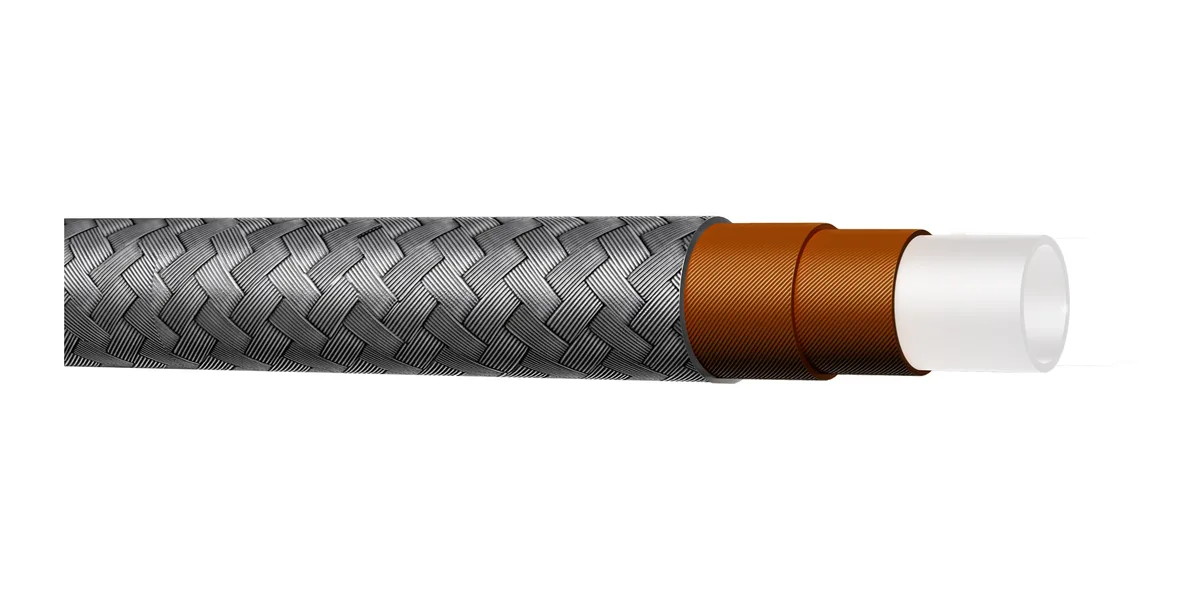
JCC-03100 is our spiral-wound high-pressure PTFE hose: a straight PTFE tube, one or two layers of copper-plated steel wire wound around it in a spiral, and a 304 stainless steel braid over the outside. The wire spiral carries the hoop load and the braid holds the assembly together, which is why this build reaches 44 MPa at 1/2" while staying flexible enough to route by hand.
- Temperature−65 to +220 °C / −85 to +428 °F
- Bore12.7–25.0 mm (1/2"–1")
- Working pressure44 → 27 MPa
- Reinforcement1–2 wire spiral layers + 304 braid
- ReinforcementWire spiral + 304 braid
Overview
Most PTFE high-pressure hose is braided: one or two stainless layers over the tube. JCC-03100 adds a different idea. Before the braid goes on, copper-plated steel wire is wound around the tube in a spiral, in one or two layers depending on the size and rating. The spiral takes the burst load as a continuous coil; the 304 braid on top keeps the coil in place and protects it.
The build is light for its pressure class and bends more freely than a double-braided hose of the same bore. That is the point of the spiral: the load path runs along a wound wire rather than relying on the braid alone, so you get 44 MPa at 1/2" from a hose that still handles like a 1/2" line. Pressure falls as the bore grows — 44 MPa at 1/2", 27 MPa at 1" — because the same wall cross-section sees more area.
Where it stops being the right answer: the temperature ceiling is +220 °C, lower than the all-stainless series, and the copper-plated wire is a steel core with a coating, not a stainless component. If the line runs hot, sits in washdown or offshore salt spray, or the medium could reach the reinforcement through a damaged cover, choose the all-304 builds instead. Both are listed under options and related builds.
Specifications
| Model | Nominal size | ID mm ±0.2 |
OD mm ±0.2 |
Braided OD mm ±0.2 |
Working psi |
Working MPa |
Burst psi |
Burst MPa |
Min bend radius in |
Min bend radius mm |
|---|---|---|---|---|---|---|---|---|---|---|
| JCC-03113-PTFE | 1/2" | 12.7 | 15.1 | 19.3 | 6394.5 | 44 | 25578 | 176.4 | 3.54 | 90 |
| JCC-03116-PTFE | 5/8" | 15.8 | 18.8 | 22.8 | 5165.6 | 36 | 20663 | 142.5 | 4.72 | 120 |
| JCC-03119-PTFE | 3/4" | 18.8 | 21.8 | 26.2 | 4756 | 33 | 19024 | 131.2 | 5.91 | 150 |
| JCC-03125-PTFE | 1" | 25.0 | 29 | 33.0 | 3918.6 | 27 | 15675 | 108.1 | 8.86 | 225 |
All values as printed in the Jingcheng PTFE hose catalog. Product certification stated in the catalog: ISO 9001:2015 / US FDA 21 CFR 177.1550 / SGS. Custom sizes and lengths are made to your drawing on request.
Materials and construction
- Inner tube: straight PTFE, extruded and sintered. Smooth bore, no corrugation.
- Reinforcement: one or two layers of copper-plated steel wire wound in a spiral around the tube. The layer count follows the size and the pressure rating.
- Outer cover: 304 stainless steel braid over the wire spiral. It carries handling and abrasion and keeps the spiral in place.
- Temperature: −65 to +220 °C (−85 to +428 °F) as published. Note that this is narrower than the all-stainless braided series, which run to +260 °C.
- End connections: not part of the catalog sizes. Tell us the threads, flanges or compression fittings on the equipment and the assembly is specified and drawn for approval.
- Weight and bending: the catalog describes the series as lightweight with flexible bending, which is the reason it is often chosen over a double-braided build at the same bore.
Temperature and pressure notes
The catalog rating is −65 to +220 °C (−85 to +428 °F) with working pressures from 44 MPa at 1/2" down to 27 MPa at 1", and a burst figure of roughly four times working in every row. Those numbers are for the hose at room temperature, before fittings are crimped on.
Do not design to the room-temperature figure at the top of the range. Derating allowable pressure as temperature climbs is standard practice for polymer hose with a metal reinforcement, and PTFE is no exception. We do not publish a single derating curve because the right one depends on medium, cycle count and service life, so send the real temperature and pressure and the rating for your assembly is confirmed in writing with the quotation.
Two things worth checking early. First, the bend radius in the table is the minimum for a static installation; if the hose flexes in service, plan a larger radius. Second, this series has no published vacuum rating — if the line is pulled under vacuum, ask for a spring-guarded or convoluted build instead.
Applications
The catalog lists this series for:
- Fuel, gas, strong acids, strong alkalis and a range of organic solvents
- Fuel, coolant and lubricant delivery lines
- Hydraulic machinery and hydraulic lines
- Transport equipment: rail, automotive, marine, aircraft and spacecraft piping
In practice it comes up where a line needs more pressure than a single braid can give but the routing is too tight for a stiff double-braided hose. Confirm media compatibility with us before ordering: the reinforcement is not the wetted part, but the tube is, and a solvent that swells or permeates PTFE changes the answer.
Options and related builds
How to order
Send these seven points and the quotation can be built without another round of email:
- Bore you need, in mm or inches, and the nominal size if you already know it.
- Length per piece and the number of pieces.
- End fittings at each end: thread standard and size, flange, or compression fitting, with a photo or part number if you have one.
- Medium and its concentration, so compatibility and permeation are checked before the build is fixed.
- Operating temperature, including cleaning or steam-in-place peaks. Anything near or above 220 °C moves the order to a stainless-reinforced series.
- Working and peak pressure, and whether the line ever runs under vacuum.
- Quantity for the first order and the expected annual use, so the price reflects the real volume.
If a drawing already exists, send it. We work to the customer's drawing when one is supplied.
Frequently asked questions
What does "spiral-wound" mean on this hose?
It describes the reinforcement, not the bore. Copper-plated steel wire is wound around the PTFE tube in a continuous spiral, in one or two layers, and a 304 stainless braid is applied over it. The spiral handles the pressure load; the braid holds it down and protects it. The bore itself is straight and smooth.
How is this different from a double-braided PTFE hose?
Double braid uses two layers of woven stainless wire. JCC-03100 uses a wound wire spiral plus one braid, which the catalog describes as lighter and more flexible for the same class of work, with 44 MPa at 1/2". The trade-off is temperature: this series is rated to +220 °C, where the all-stainless builds run to +260 °C.
Why does the pressure rating drop from 44 MPa to 27 MPa across the size range?
Because the wall area under pressure grows with bore while the reinforcement stays broadly the same construction. A 1" bore has four times the internal area of a 1/2" bore at the same pressure, so the allowable pressure falls. The table gives the real figure per size; do not scale one size from another.
Can I use this hose outdoors or in washdown?
The braid is 304 stainless, but the pressure-carrying spiral underneath is copper-plated steel wire. In a wet, salty or chemically aggressive environment, corrosion of the spiral is the failure to think about, and a damaged braid exposes it. For those sites we would quote an all-stainless reinforced build; tell us the environment and we will say which one fits.
Is the bore smooth or convoluted?
Smooth. This is a straight PTFE tube with the wire spiral on the outside, so the bore is a clean cylinder with nothing to trap product and the lowest pressure drop. If you need a tighter bend radius than 90–225 mm, a convoluted build is the alternative.
Can I get a custom size or a different wire layer count?
Sizes outside the table are made to your drawing on request, and the catalog states the series is customizable to specification. Send the dimensions, the pressure and the end connection details, and we will confirm what is practical before quoting.
Send your spiral-wound PTFE hose details
Bore, length, fittings, medium, temperature and pressure is all we need to come back with a specification and a price.
Request a quoteSoren Miles, Marketing Manager | JC
Mobile: +86 13087118553 / +1 (757) 733-8947
WhatsApp: +86 185 6950 4906
Email: soren.miles@shenzhenjingcheng.com
Company (Canada): JINCHEN ELECTRIC TRACING CO., LTD.
Company (Hong Kong, China): HK JINGCHENG HIGH TECH CO., Ltd
Company (China): SHENZHEN JINGCHENG HIGH TECH CO., Ltd / Jingcheng Fluoroplastic (Guangdong) Co., Ltd.
Website: https://www.jingchenghose.com | https://www.electricallyheatedhose.com
Factory address: No. 7 Qiguan East Road, Torch Development Zone, Zhongshan City (Jingcheng Industrial Park)
Source: Jingcheng PTFE hose catalog, JCC-03100 page, and our published business policies. Pressure derating with temperature and minimum static bend radius are general engineering practice; the rating for each project is confirmed on the quotation and drawing.