
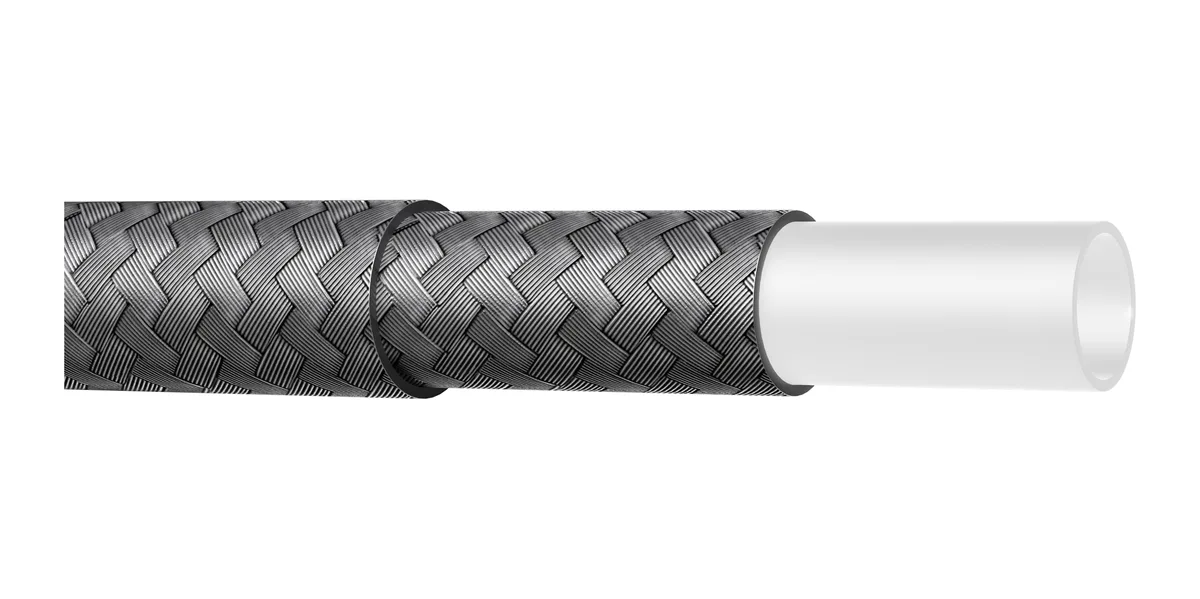
JCC-01200 is a smooth bore PTFE hose with two layers of 304 stainless steel braid wound over the tube. The tube gives the chemical resistance and the clean bore; the two braids take the pressure load. It is the build we quote for hydraulic transfer of gas-, oil- and water-based fluids and of chemical raw materials, where a single braid is not enough and the line still has to bend.
- Temperature−70 to +260 °C / −94 to +500 °F
- Bore6.3–31.5 mm (1/4"–1-1/4")
- Working pressure40 → 14 MPa
- ReinforcementTwo 304 stainless braids
Overview
The construction is simple to describe and easy to get wrong in use. Inside is an extruded, sintered PTFE tube with a smooth cylindrical bore, the same core we use in the rest of the braided range. Outside that, 304 stainless wire is braided twice. The first braid sits directly on the tube and the second rides over it, so the pressure load is shared by two wire layers instead of one.
That second layer is what buys the pressure. The catalog gives 40 MPa working pressure at 1/4" and 14 MPa at 1-1/4", with burst around three times those figures. A single-braided hose covers a similar size range at lower ratings, so the question is usually not whether double braid works but whether the line actually needs it. If your pump discharge, relief setting or test pressure sits above what a single braid is rated for at your bore, this is the next step up.
What you give up is flexibility and money. Two braids make the hose stiffer, so the minimum bend radius grows and the routing has to be planned rather than improvised. If the line is a tight drop or a short jump between two fixed ports, a smoother routing job or a convoluted build may serve you better than forcing a double-braided hose into a radius it does not want. Both options are listed below.
Specifications
| Model | Nominal size | ID mm ±0.2 |
OD mm ±0.2 |
Braided OD mm ±0.2 |
Working MPa |
Burst MPa |
Min bend radius in |
Min bend radius mm |
|---|---|---|---|---|---|---|---|---|
| JCC-01206-PTFE | 1/4" | 6.3 | 8.3 | 10.6 | 40 | 120.9 | 3.27 | 83 |
| JCC-01208-PTFE | 5/16" | 7.9 | 10.3 | 12.8 | 35 | 105 | 3.27 | 83 |
| JCC-01210-PTFE | 3/8" | 9.5 | 11.9 | 15 | 32 | 96.9 | 4.13 | 105 |
| JCC-01213-PTFE | 1/2" | 12.6 | 15 | 18.3 | 27 | 79.8 | 5.51 | 140 |
| JCC-01216-PTFE | 5/8" | 16.3 | 20.3 | 22 | 21 | 62.7 | 6.93 | 176 |
| JCC-01219-PTFE | 3/4" | 19.5 | 23.5 | 26.4 | 20 | 58.5 | 8.27 | 210 |
| JCC-01225-PTFE | 1" | 25 | 29 | 32.6 | 17 | 51.6 | 11.22 | 285 |
| JCC-01232-PTFE | 1-1/4" | 31.5 | 35.5 | 39.5 | 14 | 42 | 13.39 | 340 |
All values as printed in the Jingcheng PTFE hose catalog. Product certification stated in the catalog: ISO 9001:2015 / US FDA 21 CFR 177.1550 / SGS. Custom sizes and lengths are made to your drawing on request.
Materials and construction
- Inner tube: smooth bore PTFE, extruded, dried, sintered and shaped. The bore is a continuous cylinder with no corrugation, so there is nowhere for product to sit.
- Reinforcement: two layers of high-strength 304 stainless steel braid, applied one over the other directly on the tube.
- Cover: none. The outer braid is the outside of the hose, so the stainless wires are exposed and should be supported or sleeved where they rub against steel structures.
- End connections: not part of the catalog sizes. Tell us the threads, flanges or crimp fittings on the equipment and the assembly is specified per order.
Temperature and pressure notes
The catalog temperature range is −70 to +260 °C (−94 to +500 °F). The pressures in the table are the catalog's ratings at room temperature, and they fall as the bore grows because the same wire load is spread over a larger diameter.
At 200 °C you should not design to the room-temperature figure. Reducing allowable working pressure as temperature rises is standard practice for polymer hose, and PTFE is no exception. We do not publish a single derating curve for this series because it depends on the medium, the cycle count and the service life you expect, so send the actual temperature and pressure and the rating for your assembly is confirmed in writing with the quotation.
Two things we check before quoting a high-pressure line: whether the medium is a gas, which stores more energy if the hose fails, and whether the line moves or vibrates in service. Both push the decision toward a shorter unsupported span and a properly restrained routing.
Applications
The catalog lists this series for hydraulic transmission of gas-, oil- and water-based fluids and of chemical raw materials. In practice that means:
- Hydraulic lines carrying oil-based fluids at pressures above single-braid ratings
- Water-based hydraulic and transfer circuits
- Chemical raw material transfer where PTFE contact is required and the line is pressurised
- Gas service on a hydraulic transmission line, with the extra caution that implies
It is not the right choice for a tight bend, a short flexible jumper, or a line that has to be dragged around. The two braids make it stiff, and a hose forced into a radius tighter than the table will fatigue at the fittings long before it bursts.
Options and related builds
How to order
Send these seven points and the quotation can be built without another round of email:
- Bore you need, in mm or inches, and the nominal size if you already know it.
- Length per piece and the number of pieces.
- End fittings at each end: thread standard and size, flange, or crimp fitting, with a photo or part number if you have one.
- Medium and its concentration. This decides compatibility and whether PTFE is the right liner.
- Operating temperature, including cleaning or flush peaks.
- Working and peak pressure, plus the relief valve setting and whether the line ever runs under vacuum.
- Routing: the bends the hose has to take in service, so we can check them against the minimum bend radius.
If a drawing already exists, send it. We work to the customer's drawing when one is supplied.
Frequently asked questions
What is the difference between single-braid and double-braid PTFE hose?
The tube is the same smooth bore PTFE. Double braid puts two layers of 304 stainless wire over it instead of one. The extra layer raises the working pressure — 40 MPa at 1/4" here against the lower single-braid rating — and makes the hose stiffer, with a larger minimum bend radius.
Why is there no psi column in the table?
Because the catalog page for this series prints pressure in MPa only. We transcribe what the catalog states and do not convert a figure into a unit it does not publish. If you need psi, the MPa value converts directly; we confirm the rating you should design to on the quotation.
Can the hose be used for gas?
The catalog lists gas-based fluid transmission among the applications. A gas line stores far more energy than a liquid line at the same pressure, so we check the fitting, the restraint and the relief setting before recommending a size rather than quoting from the table alone.
Is the minimum bend radius the same for both 1/4" and 5/16"?
In the catalog, yes — both sizes are printed at 3.27" (83 mm).
Can I get a custom length or a different fitting?
Yes. Lengths are cut per order and fittings are specified per order. Sizes outside the table are made to your drawing on request; send the dimensions and the end connection details and we will confirm what is practical before quoting.
Send your double-braid PTFE hose details
Bore, length, fittings, medium, temperature, pressure and the routing bends is all we need to come back with a specification and a price.
Request a quoteSoren Miles, Marketing Manager | JC
Mobile: +86 13087118553 / +1 (757) 733-8947
WhatsApp: +86 185 6950 4906
Email: soren.miles@shenzhenjingcheng.com
Company (Canada): JINCHEN ELECTRIC TRACING CO., LTD.
Company (Hong Kong, China): HK JINGCHENG HIGH TECH CO., Ltd
Company (China): SHENZHEN JINGCHENG HIGH TECH CO., Ltd / Jingcheng Fluoroplastic (Guangdong) Co., Ltd.
Website: https://www.jingchenghose.com | https://www.electricallyheatedhose.com
Factory address: No. 7 Qiguan East Road, Torch Development Zone, Zhongshan City (Jingcheng Industrial Park)
Source: Jingcheng PTFE hose catalog, JCC-01200 page, and our published business policies. Pressure derating with temperature is general engineering practice; the rating for each project is confirmed on the quotation and drawing.