
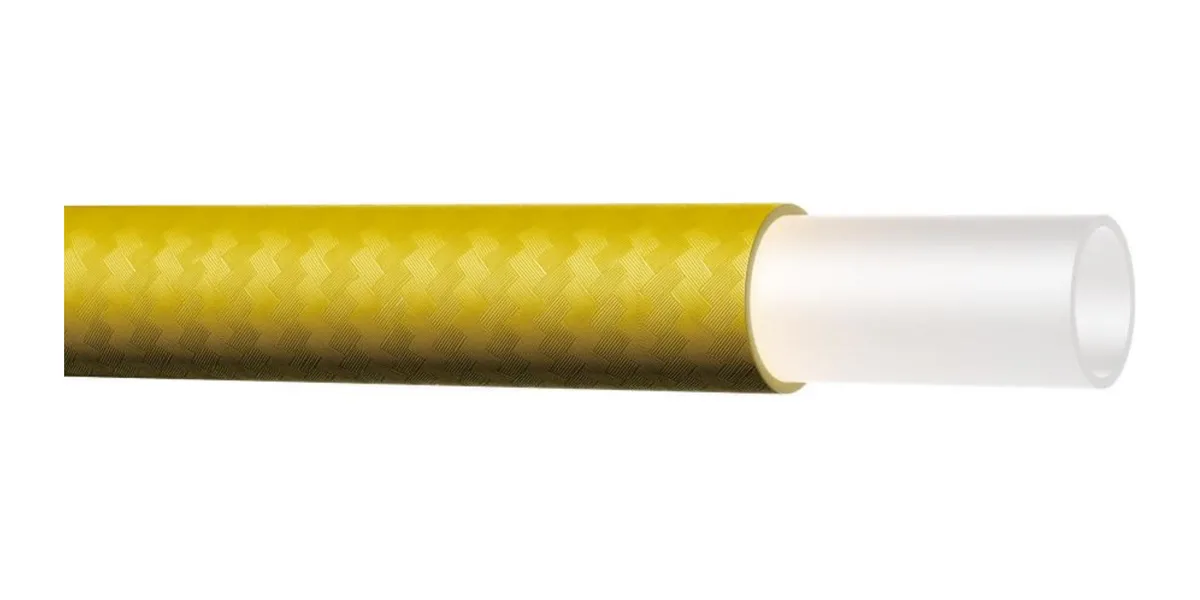
JCC-04100 is the lightweight member of our braided PTFE range: a smooth PTFE tube with an aramid fibre braid over it instead of stainless steel. Same pressure class as the steel-braided builds, at a fraction of the braid weight. It carries fuel, gas, strong acids and alkalis and other organic solvents, and it is the build we quote when the hose hangs in motion, runs on a vehicle or a machine that has to be lifted, or is handled by an operator all shift.
- Temperature−65 to +220 °C / −85 to +428 °F
- Bore10–25.4 mm (3/8"–1")
- Working pressure40 → 24.5 MPa
- Braided OD15.6–33 mm
Overview
The construction is two layers and nothing else. Inside is a straight PTFE tube, the same sintered white polymer as our low-pressure series, so the bore is smooth end to end and the chemical resistance covers the usual aggressive list: fuels, gases, strong acids, strong alkalis, organic solvents. Outside is a braid wound from aramid fibre, tight enough to take the hoop load the way a stainless braid does.
The reason aramid exists in this catalog is weight. Aramid fibre is far lighter than 304 stainless wire for the same tensile duty, so the finished hose comes out light enough to be routed by hand, clipped to a moving arm, or carried on a machine where every kilogram counts. The catalog also states that this braid gives the hose an anti-static effect; we treat that as the catalog's material description and confirm what is required on the order rather than publishing a resistance value.
The trade-off is on the outside, not the inside. Aramid is a fibre, not a wire: it does not take abrasion, chafing against a steel bracket or a drag chain the way stainless braid does, and it does not shield against heat the way a metal cover will. If the hose is dragged across a deck, weld spatter falls on it, or it sits next to something at 300 °C, this is the wrong braid and the single-braid or wire-bundle build is the answer.
Specifications
| Model | Nominal size | ID mm ±0.2 |
OD mm ±0.2 |
Braided OD mm ±0.2 |
Working psi |
Working MPa |
Burst psi |
Burst MPa |
Min bend radius in |
Min bend radius mm |
|---|---|---|---|---|---|---|---|---|---|---|
| JCC-04110-PTFE | 3/8" | 10 | 13.1 | 15.6 | 5800 | 40.0 | 23200.0 | 160 | 3.15 | 80 |
| JCC-04113-PTFE | 1/2" | 13 | 16.5 | 18.6 | 5437.5 | 37.5 | 21750.0 | 150 | 5.91 | 150 |
| JCC-04116-PTFE | 5/8" | 16 | 19.4 | 23.2 | 4785 | 33.0 | 19140.0 | 132 | 7.09 | 180 |
| JCC-04119-PTFE | 3/4" | 19 | 23.1 | 26.6 | 4241.3 | 29.25 | 16965.0 | 117 | 11.81 | 300 |
| JCC-04125-PTFE | 1" | 25.4 | 30.5 | 33 | 3552.5 | 24.5 | 14210.0 | 98 | 15.75 | 400 |
All values as printed in the Jingcheng PTFE hose catalog. Product certification stated in the catalog: ISO 9001:2015 / US FDA 21 CFR 177.1550 / SGS. Custom sizes and lengths are made to your drawing on request.
Materials and construction
- Inner tube: smooth straight PTFE, the same sintered tube used across our braided range. Chemically inert against fuels, gases, strong acids, strong alkalis and organic solvents, with a non-stick bore that drains and flushes clean.
- Braid: aramid fibre, wound over the tube as the pressure-carrying layer. Aramid is the same family of fibre used in ballistic and high-strength textile work: high tensile strength per unit weight, low density, no corrosion.
- Anti-static: the catalog states that the aramid braided build gives an excellent anti-static effect. If your installation has a grounding requirement, say so on the inquiry and the earthing path is specified with the assembly.
- Bore profile: smooth and cylindrical, no corrugation, no liner step.
- End connections: not part of the catalog sizes. Fittings are selected per order once we know the thread, flange or compression connection on the equipment.
Temperature and pressure notes
The catalog temperature range is −65 to +220 °C (−85 to +428 °F). That ceiling is 40 °C lower than the −70 to +260 °C of the stainless-braided smooth bore series, and the difference is the braid, not the PTFE: the aramid fibre is the part that limits the top end. Plan around +220 °C, not around what the tube alone could take.
The pressure column falls from 40 MPa at 3/8" to 24.5 MPa at 1", which is the normal behaviour of any braided hose: a larger bore puts more area under the same internal pressure and needs more braid to hold it. Burst is printed at four times working pressure on every row, which is a safety margin and not an operating target.
All figures are for ambient temperature and the hose alone. Running a polymer hose hotter than ambient means reducing the allowable pressure, and that holds here as it does for the steel-braided series. We do not publish a single derating curve because it depends on the medium, the cycle count and the service life you expect. Send the real temperature and pressure and the rating for your assembly is confirmed in writing on the quotation.
Two checks we make before quoting this series: whether the line is subject to external abrasion (if it is, aramid is usually the wrong choice), and whether the hose is pulled under vacuum. The catalog gives no vacuum rating for JCC-04100; where vacuum is involved we quote a convoluted or spring-guarded build instead.
Applications
The catalog lists the transmission media and the equipment this series is used on:
- Fuel, gas, strong acids, strong alkalis and various organic solvents
- Fuel, coolant and lubricant delivery lines
- Hydraulic machinery
- Rail, automotive, marine, aircraft and aerospace lines, including rockets, spacecraft and satellites, where the weight of the hose matters
The common thread in that list is not the chemistry, it is the platform: anything that moves, flies, floats or gets carried benefits from a braid that weighs a fraction of stainless. For a static plant line at the same pressure, the stainless braided build usually makes more sense on cost and on abrasion resistance.
Options and related builds
How to order
Send these points and the quotation can be built without another round of email:
- Bore you need, in mm or inches, and the nominal size if you already know it.
- Length per piece and the number of pieces.
- End fittings at each end: thread standard and size, flange, or compression fitting, with a photo or part number if you have one.
- Medium and its concentration, so compatibility is checked before the braid is chosen.
- Operating temperature, including any cleaning or purge peak, and whether it stays under +220 °C.
- Working and peak pressure, and whether the line ever runs under vacuum.
- Installation: static or moving, and whether the outside of the hose rubs against anything.
- Quantity for the first order and the expected annual use, so the price reflects the real volume.
Frequently asked questions
What is an aramid braid, and why use it instead of stainless?
Aramid is a high-strength synthetic fibre. Wound as a braid over the PTFE tube it takes the same kind of hoop load a stainless braid does, at a much lower weight. The reason to specify it is weight and handling: a hose that has to move, be carried or fly is the obvious case. The reason not to is abrasion and outside heat, where stainless wins.
Can JCC-04100 take as much pressure as the steel-braided hose?
In this catalog, yes, at the same nominal sizes: 40 MPa at 3/8" down to 24.5 MPa at 1", which matches the spiral-wound series and is in the same class as the single and double braid builds. Always check the row for your size rather than assuming from the top of the table.
What is the temperature limit?
−65 to +220 °C (−85 to +428 °F) as printed in the catalog. The PTFE tube itself could go higher; the aramid braid is what sets this ceiling. If the line runs at 230–260 °C, look at the stainless-braided series instead.
Is it anti-static?
The catalog describes this build as having an excellent anti-static effect. We do not publish a surface or volume resistance value for it, because we have not verified one against a standard. Tell us the grounding requirement on your side and we will confirm what the assembly can be built to.
How tight can it bend?
Minimum bend radius per the catalog runs from 80 mm (3.15") at 3/8" to 400 mm (15.75") at 1". Those are the radii for the hose alone; once fittings are crimped on, keep the bend out of the fitting area and support the hose where it turns.
Will it work with fittings I already stock?
Usually. Send the thread or flange and we will match the fitting to the braided OD for your size and issue a drawing for approval before production. The catalog itself lists sizes only, with no fitting table.
Send your aramid-braided hose details
Bore, length, fittings, medium, temperature and pressure is all we need to come back with a specification and a price.
Request a quoteSoren Miles, Marketing Manager | JC
Mobile: +86 13087118553 / +1 (757) 733-8947
WhatsApp: +86 185 6950 4906
Email: soren.miles@shenzhenjingcheng.com
Company (Canada): JINCHEN ELECTRIC TRACING CO., LTD.
Company (Hong Kong, China): HK JINGCHENG HIGH TECH CO., Ltd
Company (China): SHENZHEN JINGCHENG HIGH TECH CO., Ltd / Jingcheng Fluoroplastic (Guangdong) Co., Ltd.
Website: https://www.jingchenghose.com | https://www.electricallyheatedhose.com
Factory address: No. 7 Qiguan East Road, Torch Development Zone, Zhongshan City (Jingcheng Industrial Park)
Source: Jingcheng PTFE hose catalog, JCC-04100 page, and our published business policies. Pressure derating with temperature and the abrasion behaviour of aramid versus stainless braid are general engineering practice; the rating for each project is confirmed on the quotation and drawing.