
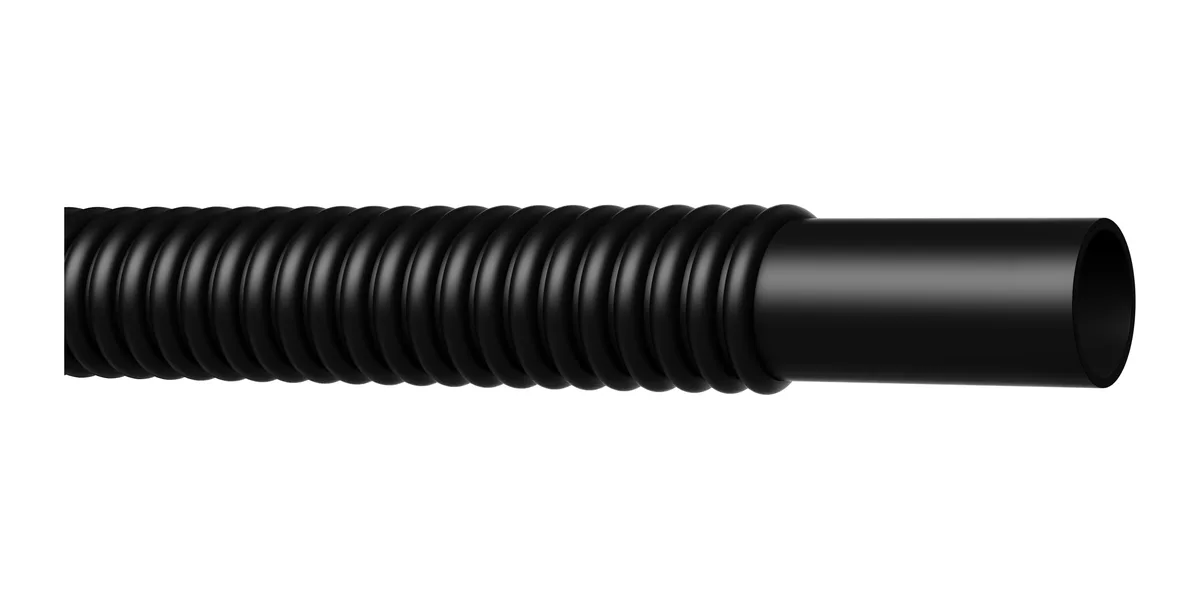
The anti-static PTFE series is the conductive version of our PTFE tube range: the same extruded, sintered PTFE wall, but made in a grade that lets static charge drain away instead of sitting on the wall. It comes in four builds — anti-static smooth, anti-static convoluted, anti-static smooth-bore convoluted and all-black conductive convoluted — so the same material can be specified with a straight bore, a full corrugation, or a smooth bore with a corrugated outside.
- Temperature−60 to +260 °C / −76 to +500 °F
- Builds4 constructions
- Bore profileSmooth / convoluted
- Dielectric strength50 V to 120 kV
- Friction coefficient0.1
Overview
The problem this series exists for is not chemical attack. Plain PTFE is excellent at that. The problem is charge. When a non-conductive solvent, powder or coating runs through an insulating tube at speed, static builds on the wall and on the fluid, and it has nowhere to go until it discharges — through a fitting, a clamp, or the operator reaching for the line. On a flammable-liquid line or in a solvent-based coating booth, that discharge is the ignition source you spend the rest of the design trying to rule out.
A conductive PTFE grade gives the charge a path to ground instead. The material is still PTFE: it still resists acids, alkalis, solvents and oxidizers, still has a very low-friction, water-repellent surface, and still runs from −60 to +260 °C. What changes is that the wall is no longer an insulator, so the assembly can be bonded and earthed as part of the machine's static-control scheme.
Be clear about what this does not do. It is not a pressure hose on its own. The catalog lists the series by build and application, not by a per-size pressure table, so if the line carries pump discharge head, water hammer or vacuum, tell us and we will recommend a braided or spring-guarded construction around the conductive core rather than a bare wall. It is also not a substitute for proper earthing: a conductive tube only works if both ends are bonded to ground through the fittings.
Specifications
| Build | Bore profile | Outside | Temperature |
|---|---|---|---|
| Anti-static smooth PTFE hose | Smooth, cylindrical | Smooth | −60 to +260 °C −76 to +500 °F |
| Anti-static convoluted PTFE hose | Corrugated | Corrugated | −60 to +260 °C −76 to +500 °F |
| Anti-static smooth-bore convoluted PTFE hose | Smooth bore | Corrugated | −60 to +260 °C −76 to +500 °F |
| All-black conductive convoluted PTFE hose | Corrugated | Corrugated, black | −60 to +260 °C −76 to +500 °F |
All four builds share the series properties printed in the catalog: temperature −60 to +260 °C, dielectric strength 50 V to 120 kV, friction coefficient 0.1 with static and dynamic coefficients almost the same, natural lubricity, light weight, shock absorption and impact resistance. Product certification stated in the catalog: ISO 9001:2015 / US FDA 21 CFR 177.1550 / SGS. Sizes are made to your drawing.
Materials and construction
- Base polymer: PTFE (polytetrafluoroethylene), compounded in a conductive grade so the tube wall is no longer a pure insulator. The all-black conductive build uses the black compound on the outside as well.
- Process: the same route as our standard PTFE tube — extrusion, drying, high-temperature sintering, then shaping to the final bore profile.
- Bore profiles: smooth (straight cylindrical wall), convoluted (corrugated inside and out) and smooth-bore convoluted (smooth inner wall, corrugated outside). The convoluted builds bend tighter; the smooth bore drains and cleans more completely.
- Surface: PTFE's very low friction and water repellency are unchanged by the conductive grade, so sticky media and aqueous solutions still release from the wall.
- Earthing: the conductivity has to be carried through the end fittings to the machine earth. Specify the fittings with the hose, and test the finished assembly for continuity rather than assuming the tube alone is grounded.
Temperature and pressure notes
The catalog temperature range for this series is −60 to +260 °C (−76 to +500 °F). The lower limit is slightly higher than our standard PTFE tube series, which starts at −70 °C, so do not carry that figure across to the anti-static material by habit.
On pressure: the catalog describes the anti-static series as able to withstand high temperature and high pressure, and gives its electrical properties (50 V to 120 kV dielectric strength) rather than a per-size pressure table. Send your bore, build and duty and we quote the assembly. Reducing allowable pressure as temperature rises is standard practice for polymer hose.
Two points worth settling before the order: whether the line runs under vacuum (the convoluted builds handle it better, but confirm it with us) and whether the medium is a gas. Gases are more demanding than liquids in any non-reinforced tube, and the anti-static requirement is usually sharper on gas and solvent-vapour lines.
Applications
The catalog names four application areas for this series:
- Chemical liquid handling
- Transfer of flammable liquids
- Static-load coating industry — solvent-based coating and paint supply lines
- Food industry
In practice we see it ordered where two things are true at once: the medium is aggressive or high-purity enough to need PTFE, and the installation has a static-control requirement that plain PTFE cannot meet. Powder and solvent coating booths, tanker and drum unloading, and small-batch chemical dosing are the typical shapes of that job.
Options and related builds
How to order
Send these points and the quotation can be built without another round of email:
- Build you want: smooth, convoluted, smooth-bore convoluted or all-black conductive.
- Bore in mm or inches, and length per piece with the number of pieces.
- End fittings at each end: thread standard and size, flange or compression fitting, with a photo or part number if you have one. This is also where the earthing path is decided.
- Medium and its concentration, and whether it is flammable.
- Operating temperature, including cleaning or steam-in-place peaks.
- Working and peak pressure, and whether the line ever runs under vacuum.
- Static requirement: the resistance or continuity limit your site or insurer applies, so we can confirm the assembly against it rather than guessing.
- Quantity for the first order and the expected annual use.
Frequently asked questions
What makes PTFE hose anti-static?
The tube is made from a conductive PTFE compound instead of the standard resin, so charge that builds on the wall can flow to the end fittings and from there to the machine earth. The chemical resistance, temperature range and low-friction surface stay essentially the same as standard PTFE. The conductive grade is specified on the order; the standard natural and blue tubes in the photo above are not anti-static.
Which of the four builds should I choose?
Smooth for the cleanest flow and the easiest draining, convoluted for tight routing in a compact machine, smooth-bore convoluted where you need a tight bend but must keep the bore clean, and the all-black conductive convoluted build where the whole outside surface also has to be conductive. If the routing and pressure are not yet fixed, send a sketch and we will say which one fits.
Do you publish a resistance value for the anti-static material?
No. We have not verified a surface or volume resistance figure against a recognised test standard, so we will not put a number on the page. Tell us the limit your installation has to meet and we will confirm what the assembly can be built to, in writing, with the quotation.
Is the anti-static series a pressure hose?
Treat it as a tube family first. The catalog does not give per-size working or burst ratings for these four builds. Where the line carries pressure, hammer or vacuum, we specify a braided or spring-guarded construction around the conductive core, and the rating is confirmed for that assembly.
What temperature range does it cover?
−60 to +260 °C, which is −76 to +500 °F. Note the cold end: it is 10 °C above the −70 °C limit of our standard PTFE tube series, so a line that runs very cold should be checked against the anti-static figure, not the standard one.
Can I get custom sizes and lengths?
Yes. All builds are made to your drawing on request, and lengths are cut per order. Send the bore, length and end connection and we will confirm what is practical before quoting.
Send your anti-static PTFE hose details
Build, bore, length, fittings, medium, temperature, pressure and the static limit your site applies is all we need to come back with a specification and a price.
Request a quoteSoren Miles, Marketing Manager | JC
Mobile: +86 13087118553 / +1 (757) 733-8947
WhatsApp: +86 185 6950 4906
Email: soren.miles@shenzhenjingcheng.com
Company (Canada): JINCHEN ELECTRIC TRACING CO., LTD.
Company (Hong Kong, China): HK JINGCHENG HIGH TECH CO., Ltd
Company (China): SHENZHEN JINGCHENG HIGH TECH CO., Ltd / Jingcheng Fluoroplastic (Guangdong) Co., Ltd.
Website: https://www.jingchenghose.com | https://www.electricallyheatedhose.com
Factory address: No. 7 Qiguan East Road, Torch Development Zone, Zhongshan City (Jingcheng Industrial Park)
Source: Jingcheng PTFE hose catalog, anti-static series page, and our published business policies. Pressure derating with temperature is general engineering practice; the rating for each project is confirmed on the quotation and drawing.