
An aramid braided PTFE hose is what I look at when a correctly rated high-pressure PTFE assembly is too heavy or stiff to hang, follow a moving arm, or be handled all shift. The catalog lists JCC-04100 as a lightweight PTFE tube with an aramid fibre braid.
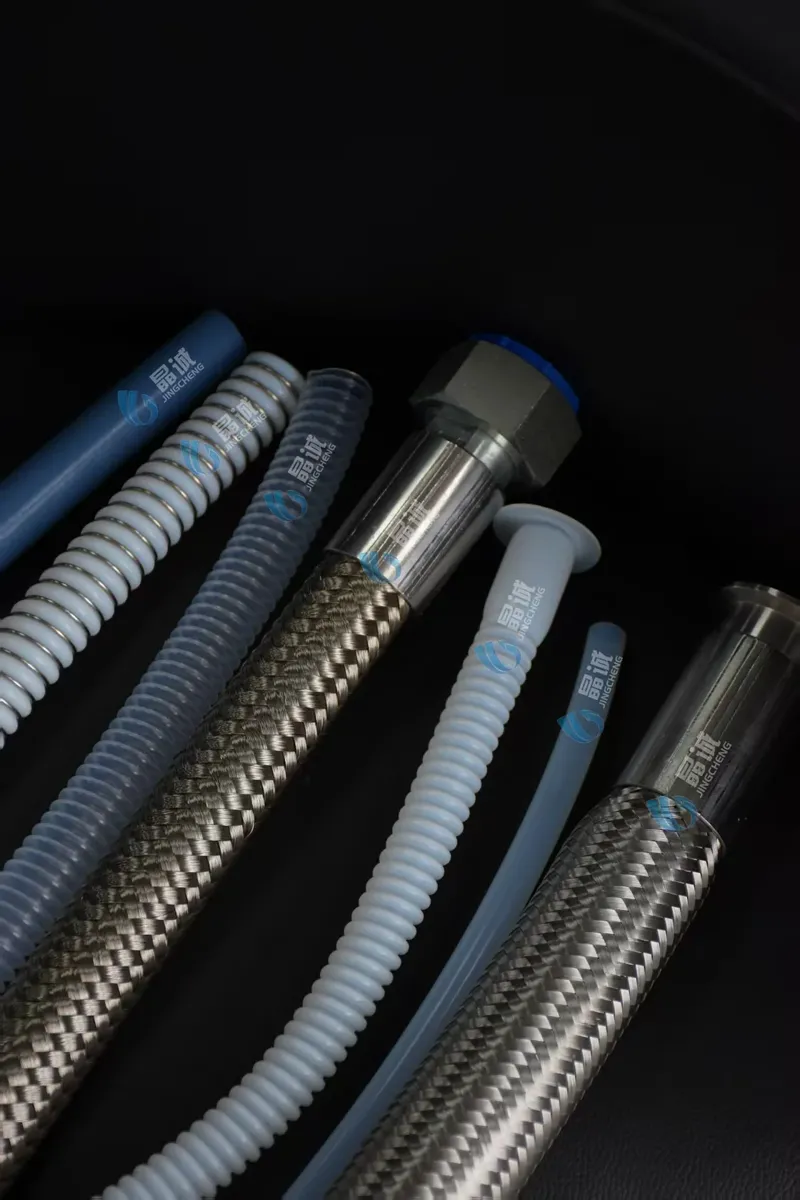
The symptom: the assembly meets the pressure row, then pulls on the fitting
The enquiry I see most often on this series does not start with a burst. It starts with a hose that was sized from a working-pressure table, then proved awkward once it was in the bay. A hanging length between a tank and a moving joint puts a steady load on the end fitting. A vehicle-mounted or machine-mounted line adds that mass to something that already has to be lifted or swung. An operator who handles the hose all shift feels the stiffness at every couple.
None of that shows up if you only ask whether the working-pressure figure is high enough. The line can be correctly rated for pressure and still be the wrong assembly for the way it is supported. I treat that as a routing and handling problem first, then I check whether the catalog's lightweight aramid braid is the build that belongs on the enquiry.
Root cause: why a steel braid can be the wrong layer for the route
As a general engineering matter, a braid over a PTFE tube is there to take hoop load. A steel braid does that job well, and it also adds mass and a stiffer cover. On a static plant line that is clipped at short intervals, that extra mass rarely matters, and the steel cover is often the better choice because it stands up to abrasion and outside heat.
On a hanging, moving, vehicle-mounted or hand-handled route, the same mass becomes the thing you are fighting. The fitting sees a larger hanging load. The hose is harder to pull into a bay. An operator feels it at the end of a shift. I do not have a published weight for JCC-04100, and the catalog does not give a mass or a reduction figure, so I do not invent one. What the catalog does say is that this series is a lightweight aramid-braided hose. That is the reason it is in the brochure, and that is the reason I open this page when the complaint is about handling rather than about a shortfall on the pressure row.
Diagnosis: what I check first before I quote JCC-04100
I work through the same list every time, and I keep it to this series. The product page for the aramid-braided lightweight PTFE hose JCC-04100 already covers construction; this is the field check I run against that page.
1. Working pressure against the JCC-04100 row for that bore. The catalog table starts at 40.0 MPa on the 3/8" line and falls to 24.5 MPa on the 1" line, which is normal behaviour for a braided hose as the bore opens. I read the row for the size we will actually run. I do not copy a working-pressure figure from another braided or spiral-wound series and assume it applies here. If the real working pressure, including any peak the line sees, is above the printed row, this is not the hose.
2. Temperature against the +220 °C ceiling. The catalog range is −65 to +220 °C (−85 to +428 °F). A common mistake is to take 260 °C from the PTFE tube and apply it to this assembly. The braid is what sets the top end. The stainless-braided smooth-bore series in the same brochure is listed at −70 to +260 °C (−94 to +500 °F); that figure does not travel with the tube onto JCC-04100. If the line, or a cleaning or purge peak, goes above 220 °C, I look elsewhere.
3. The route, not just the length. I want to know whether the hose hangs, moves, sits on a vehicle or a machine that is lifted, or is handled all shift. I also want the tightest bend and how the hose is supported at each end. The catalog gives a minimum bend radius per size, from 80 mm at 3/8" to 400 mm at 1". Those figures are for the hose alone; once fittings are fitted, I keep the bend out of the fitting area and I support the hose where it turns.
4. External abrasion and heat on the cover. Aramid is a fibre braid, not a wire braid. If the hose is dragged across a deck, rides in a cable chain, rubs on a steel bracket, or sits next to weld spatter or a hot surface, this is usually the wrong braid. I would look at a stainless-braided build such as the single-braid PTFE hose or, where the pressure row requires it, a heavier reinforced series. That is already the trade-off stated on the product page, and I do not contradict it.
5. Vacuum. The catalog gives no vacuum rating for JCC-04100. If the line is pulled under vacuum, I say so on the quotation and I do not treat this series as a vacuum hose. We would look at a convoluted or spring-guarded build for that duty.
6. Do not confuse this with the anti-static PTFE series. The catalog states that the aramid-braided build has an anti-static effect. That is catalog wording. We do not publish a resistance value for it, and this article is not about static discharge in a solvent line. If pinholes, dark tracks or shocks at the fitting are the problem, start with the anti-static PTFE hose article and the conductive PTFE series, not with JCC-04100.
What JCC-04100 is
The construction is a smooth PTFE tube with an aramid fibre braid over it. The catalog describes the inner tube as a straight PTFE tube and the outer layer as an aramid woven layer. Temperature resistance is printed as −65 to +220 °C. Transmission media are listed as fuel, gas, strong acids, strong alkalis and other organic solvents. The application list is the same family of work as the spiral-wound page beside it in the brochure: fuel, coolant and lubricant lines; hydraulic machinery; rail, automotive, marine, aircraft, rockets, spacecraft and satellites, and other pipelines.
The series covers five sizes, 3/8" to 1". The figures below are transcribed from the Jingcheng PTFE hose brochure, printed page 16 (catalog sheet 9, right), and they match the live JCC-04100 specifications table.
| Model | Size | ID mm ±0.2 | OD mm ±0.2 | Braided OD mm ±0.2 | Working psi | Working MPa | Burst psi | Burst MPa | Min bend in | Min bend mm |
|---|---|---|---|---|---|---|---|---|---|---|
| JCC-04110-PTFE | 3/8" | 10 | 13.1 | 15.6 | 5800 | 40.0 | 23200.0 | 160 | 3.15 | 80 |
| JCC-04113-PTFE | 1/2" | 13 | 16.5 | 18.6 | 5437.5 | 37.5 | 21750.0 | 150 | 5.91 | 150 |
| JCC-04116-PTFE | 5/8" | 16 | 19.4 | 23.2 | 4785 | 33.0 | 19140.0 | 132 | 7.09 | 180 |
| JCC-04119-PTFE | 3/4" | 19 | 23.1 | 26.6 | 4241.3 | 29.25 | 16965.0 | 117 | 11.81 | 300 |
| JCC-04125-PTFE | 1" | 25.4 | 30.5 | 33 | 3552.5 | 24.5 | 14210.0 | 98 | 15.75 | 400 |
Custom sizes and lengths are made to the drawing. Fittings are not part of the catalog size table; they are selected once we know the connection on the equipment. The catalog gives no vacuum rating, and I do not treat the burst column as an operating target.
If the real problem is a tight bay rather than a heavy assembly, that is a different check: the spiral-wound PTFE hose article on tight routing covers JCC-03100 from the left-hand page of the same brochure sheet. If the problem is that a single braid's working pressure falls away at a larger bore, see the wire-braided PTFE hose working-pressure article. I keep those questions on their own pages so this one stays on JCC-04100.
Common mistakes I see on this enquiry
- Reading another series' pressure row and applying it here. Always use the JCC-04100 line for the bore you need. The catalog does not say the ratings are interchangeable.
- Assuming 260 °C because the inner tube is PTFE. The printed ceiling for this series is 220 °C (428 °F).
- Inventing a weight saving. The catalog says lightweight. It does not print a mass or a percentage, and I will not either.
- Putting an aramid braid where the cover will be abraded. If the hose rubs, drags or sits in a chain, ask for a steel braid first.
- Treating this as the anti-static PTFE series. An anti-static effect is catalog wording on this page; it is not a published resistance, and it is not a substitute for the conductive PTFE range.
- Ignoring vacuum or a hanging load at the fitting. There is no published vacuum rating. A hanging length still has to be supported, even when the braid is the lightweight one.
What to send for a JCC-04100 quotation
A short note is enough if it covers the route as well as the duty:
- Bore, or the nominal size if you already know it, and the length of each piece.
- How many pieces, and whether this is a first order or a repeat.
- End connections at each end: the thread, flange or compression fitting on the equipment, with a photo or part number if you have one.
- The medium and its concentration.
- Operating temperature, including any cleaning or purge peak, checked against the 220 °C limit.
- Working pressure and any peak, and whether the line ever runs under vacuum.
- The installation: static, hanging, moving, vehicle- or machine-mounted, or handled all shift; the tightest bend; and whether the outside of the hose rubs on anything.
We come back with a specification and a drawing for the assembly. Final ratings are confirmed on that quotation.
Frequently asked questions
When is an aramid braided PTFE hose the right build?
When the line has to hang, move, sit on a vehicle or a machine that is lifted, or be handled all shift, and the JCC-04100 row for that bore covers the real pressure and the temperature stays within −65 to +220 °C. If abrasion or outside heat on the cover comes first, I would not start here.
Does the catalog give a weight for JCC-04100?
No. It describes the series as lightweight. There is no printed mass and no reduction figure, so we do not publish one. If weight is a constraint on your design, send the route and the length and we will discuss the assembly on the quotation.
Can I use a working-pressure figure from another braided hose?
No. Use the JCC-04100 table for the size you need. The catalog does not tell you to treat the rows as interchangeable with another series.
What is the temperature limit?
−65 to +220 °C (−85 to +428 °F), as printed. Do not assume 260 °C from the PTFE tube. If the line runs hotter than 220 °C, this series is not the one to quote.
Is JCC-04100 an anti-static hose?
The catalog states that this build has an anti-static effect. We do not publish a resistance value, and we do not treat this page as the anti-static series. Tell us the grounding requirement on the enquiry if you have one.
Is there a vacuum rating?
The catalog does not print one. If vacuum is involved, say so and we will not assume this series can take it.
Send your JCC-04100 route and duty
Bore, length, fittings, medium, temperature, pressure and how the hose is supported is enough for us to come back with a specification and a price.
Request a quotationSoren Miles, Marketing Manager | JC
Mobile: +86 13087118553 / +1 (757) 733-8947
WhatsApp: +86 185 6950 4906
Email: soren.miles@shenzhenjingcheng.com
Company (Canada): JINCHEN ELECTRIC TRACING CO., LTD.
Company (Hong Kong, China): HK JINGCHENG HIGH TECH CO., Ltd
Company (China): SHENZHEN JINGCHENG HIGH TECH CO., Ltd / Jingcheng Fluoroplastic (Guangdong) Co., Ltd.
Website: https://www.jingchenghose.com | https://www.electricallyheatedhose.com
Factory address: No. 7 Qiguan East Road, Torch Development Zone, Zhongshan City (Jingcheng Industrial Park)
Sources: Jingcheng PTFE hose brochure, printed page 16 (catalog sheet 9, right), JCC-04100, and our published business policies. Notes on hanging load at a fitting, abrasion of a fibre braid, and not assuming 260 °C from the PTFE tube are general engineering practice. Final ratings for each project are confirmed in the quotation and drawing.