
A spiral wound PTFE hose is often what we quote when a high-pressure line has to fit a compact bay, and the enquiry usually starts the same way: the pressure rating was met, the hose would not follow the drawing, and someone has already pulled it into a bend tighter than the size allows.
The symptom: the hose fits the pressure but not the space
A common version of this problem looks like this. A PTFE line on a compact hydraulic or fuel skid has been in service for a few months. Close to one of the ferrules the hose has a hard kink, the bore at that point has gone oval, and the braid is visibly spread on the outside of the bend. Nothing has leaked yet, but flow through that section is down and the operator has started to notice it at the end of the line.
When we ask how the hose was chosen, the answer is nearly always the pressure rating. The drawing gave a working pressure, someone found a row in a table that met it, and the hose was ordered to length. Nobody measured the tightest bend in the bay, so the fitter made the hose fit by hand and clamped it down.
The cause: the hose was chosen on one number
Nobody on these jobs ignores the pressure rating. The mistake is treating the bend radius as something the installation can absorb. It is a limit printed next to the pressure on the same row of the table, and it belongs on the drawing just as much as the pressure does. A hose that meets the pressure but is bent tighter than its listed radius is outside its rating, the same as a hose that is under-rated on pressure.
So the fix is not a different way of clamping. It is going back to the table and choosing a size where pressure, bend radius and temperature all fit the job at the same time, then laying the line out inside the listed radius. On a tight bay that usually means the routing gets designed first and the hose length follows from it, rather than the other way round.
Diagnosis: four numbers settle it
When a customer sends us a routing problem, I do not start with the bend radius. I start with the pressure row for the actual bore, because an under-rated hose is not a routing question at all. Then the bend, then temperature, then vacuum, in that order, because each one can rule a size out before we spend time on the next.
1. Required working pressure at the actual bore
Take the peak pressure, not the nominal. A spike on valve closure is what the hose has to hold. Then read the row for the bore you need rather than scaling from a smaller size. On this series the working pressure falls from 44 MPa (6394.5 psi) at 1/2 in to 27 MPa (3918.6 psi) at 1 in, so a figure carried over from the smallest size will mislead you on the largest. If the peak is above the row for your bore, that size is out before routing is even discussed.
2. Minimum bend radius against the space you actually have
Measure the space, do not estimate it from the drawing. The number that matters is the centreline radius of the tightest bend the installed hose will take, including any bend it makes on the way into a fitting rather than in free air. A bend that starts right at a ferrule is still a bend, and it is often the one that kinks.
Compare that measured radius with the minimum bend radius in the table for the bore you have chosen: 90 mm at 1/2 in, 120 mm at 5/8 in, 150 mm at 3/4 in and 225 mm at 1 in. A compact layout has to stay within the listed radius for its size at every point along the run. If the bay cannot give that radius, the answer is a different route or a different size, not a tighter bend. If the line moves in service, for example on a moving machine part or a line that is pulled aside during maintenance, describe the movement and how often it happens, and we will confirm the build for it.
| Model | Nominal size | ID mm | Working MPa | Working psi | Burst MPa | Min bend radius mm |
|---|---|---|---|---|---|---|
| JCC-03113-PTFE | 1/2" | 12.7 | 44 | 6394.5 | 176.4 | 90 |
| JCC-03116-PTFE | 5/8" | 15.8 | 36 | 5165.6 | 142.5 | 120 |
| JCC-03119-PTFE | 3/4" | 18.8 | 33 | 4756 | 131.2 | 150 |
| JCC-03125-PTFE | 1" | 25.0 | 27 | 3918.6 | 108.1 | 225 |
3. Temperature against the +220 °C ceiling
This is the check people miss. The spiral-wound series is rated from -65 °C to +220 °C (-85 °F to 428 °F). If the line runs hotter than 220 °C, this build is outside its rating no matter how well it fits the bay, and we will look at another build from the range with you.
Count the peaks, not just the running temperature. Cleaning cycles, steam-in-place and short excursions all count against the ceiling, so give us the highest temperature the line will see and how long it lasts, not only the normal operating figure. If the line runs hot and near the top of its pressure row at the same time, give us both figures and we confirm the allowable pressure for that combination in the quotation.
4. Media, environment and vacuum
The PTFE inner tube is the wetted part, so the wire winding is not in contact with the fluid in normal service. It is, however, copper-plated steel rather than stainless, and it sits under the braid. If the site is wet, salty or a washdown area, or the outer braid is likely to be damaged, tell us at the enquiry so we can check the build against that environment before we quote it.
Vacuum is the other question to settle early. JCC-03100 has no published vacuum rating, so we do not assume one. If any part of the duty runs under vacuum, send the vacuum level, the temperature and the medium, and we will confirm what we can offer for that line.
What the JCC-03100 build is
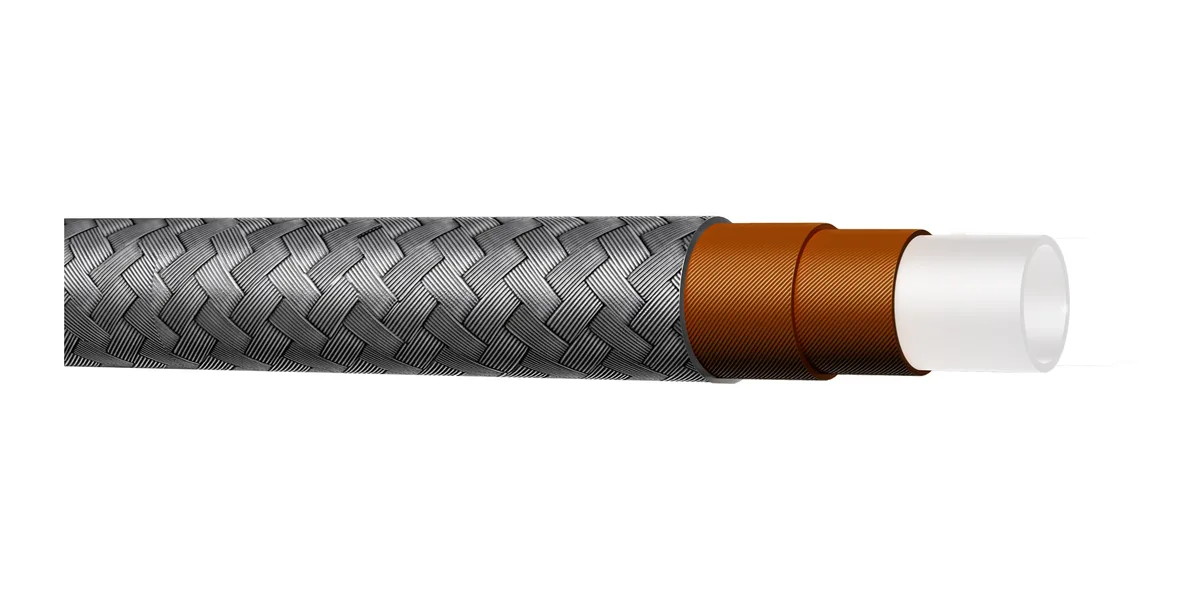
The spiral-wound braided PTFE hose is a straight PTFE inner tube, reinforced in the middle layer with one or two layers of copper-plated steel wire winding, with a 304 stainless steel braided wire outer layer. The catalog describes it as lightweight with flexible bending performance, and rates it from -65 °C to +220 °C.
Sizes run 1/2 in to 1 in. Working pressure runs from 44 MPa at 1/2 in down to 27 MPa at 1 in, with the burst figure on every row at about four times the working pressure. The minimum bend radius runs from 90 mm at 1/2 in to 225 mm at 1 in. The full table, including outside diameter and braided outside diameter, is on the product page under JCC-03100 specifications.
The catalog lists the series for fuel, gas, strong acids, strong alkalis and other organic solvents. Applications named for it are the transfer of hazardous chemicals; fuel, coolant and lubricant delivery lines; hydraulic machinery; and piping on trains, automobiles, ships, aircraft, rockets, spacecraft and satellites. Sizes and parameters can also be made to order.
Where this build is the wrong answer
I would rather say this here than have someone find out on site. There are four cases where we look at another build with the customer.
- Above +220 °C. Including cleaning peaks. The series is not rated above that temperature, however well it fits the bay.
- At 1 in where the pressure stays high. The 1 in row is rated 27 MPa. If a 1 in line needs more than that, this build does not have the rating. Our note on braided working pressure at larger bores covers how we handle that case.
- Under vacuum. There is no published vacuum rating for JCC-03100. Send the vacuum conditions and we will confirm the build for that duty.
- Where the bay cannot give the listed radius. If the tightest bend in the space is below the minimum bend radius for the bore you need, the route or the size has to change. A tighter bend is not an option.
Common mistakes we see on these lines
- Scaling pressure from a smaller bore. A 1 in spiral hose is rated 27 MPa, not 44 MPa. The rating is per size and the table is the place to read it.
- Reading +220 °C as an ambient limit. It is the hose temperature rating. A hot bay with a cool fluid is a different question from a hot fluid, and the hose still sees the local temperature at the fitting.
- Bending tighter than the listed radius to save length. The minimum bend radius for the size applies at every point on the run, including the first bend out of a fitting.
- Leaving out the movement. If the line moves in service, say so on the enquiry. We confirm the build for moving lines case by case.
- Judging the wire by its colour. The copper-coloured winding you may see at a cut end is copper-plated steel wire. It is not a corrosion-resistant layer, so the environment still matters.
What to send for a quotation
Eight inputs let us specify and draw the assembly without another round of email. Bore in mm or inches, and the nominal size if you know it. Length per piece and the number of pieces. The end connections at each end, described as the thread, flange or compression fitting on the equipment, with a photo or part number if you have one. The medium and its concentration. The operating temperature including cleaning peaks. Working and peak pressure, and whether the line ever runs under vacuum. The environment, if it is wet, salty or washdown, and whether the line moves in service. And the quantity for the first order with the expected annual use.
If a drawing already exists, send it and we work to it, with the tightest bend marked. The specification checklist covers the same inputs in more detail, and the routing constraints belong on it too.
Frequently asked questions
What does spiral wound mean on a PTFE hose?
It describes the reinforcement, not the bore. On JCC-03100, copper-plated steel wire is wound over the straight PTFE inner tube, and a 304 stainless steel braid goes over the outside. The bore itself is the straight, smooth PTFE tube.
Can I bend it tighter than the table if the bay is small?
No. Lay the hose out so no bend is tighter than the minimum bend radius for its size: 90 mm at 1/2 in, 120 mm at 5/8 in, 150 mm at 3/4 in and 225 mm at 1 in. If the line moves in service, describe the movement and we will confirm the build for it.
Is the copper-plated wire in contact with the fluid?
No. The PTFE tube is the wetted part and the wire winding sits outside it. We still ask about the environment because the wire is copper-plated steel rather than stainless, so a damaged braid in a wet or salty bay matters.
Can JCC-03100 run under vacuum?
There is no published vacuum rating for this series. Send the vacuum level, temperature and medium with your enquiry and we will confirm what we can supply for that line.
What temperature can it take?
-65 °C to +220 °C (-85 °F to 428 °F). If your line runs above 220 °C, including cleaning peaks, tell us and we will propose a build that is rated for it.
Send your routing problem with the numbers
Bore, pressure, temperature, medium and the tightest bend in the run is enough for us to say whether the spiral-wound build fits, or which build from our range we would quote instead.
Request a spiral wound PTFE hose quotationSoren Miles, Marketing Manager | JC
Mobile: +86 13087118553 / +1 (757) 733-8947
WhatsApp: +86 185 6950 4906
Email: soren.miles@shenzhenjingcheng.com
Company (Canada): JINCHEN ELECTRIC TRACING CO., LTD.
Company (Hong Kong, China): HK JINGCHENG HIGH TECH CO., Ltd
Company (China): SHENZHEN JINGCHENG HIGH TECH CO., Ltd / Jingcheng Fluoroplastic (Guangdong) Co., Ltd.
Website: https://www.jingchenghose.com | https://www.electricallyheatedhose.com
Factory address: No. 7 Qiguan East Road, Torch Development Zone, Zhongshan City (Jingcheng Industrial Park)
Source: Jingcheng PTFE hose brochure, JCC-03100 page. Final ratings for each project are confirmed in the quotation and drawing.