
A wire braided PTFE hose is often specified after a single-braid line runs too close to its catalog working pressure once the bore opens up for flow. I see that on high-pressure chemical spray, gluing and transfer: the pump setpoint stayed put, the bore grew, and the margin vanished. The fix is usually a heavier braid, not a different tube.
The field problem I keep seeing
The call usually starts the same way. A spray or transfer line was fine at 3/8" or 1/2". Flow was short, so the plant opened the bore to 3/4" or 1" to cut pressure drop. The pump and the fluid did not change. A few weeks later someone notices the working pressure on the hose tag is only a few MPa above the relief setting, or a replacement quote shows the old single-braid size is no longer rated for that pump at the new bore.
That is not a fitting weep and it is not a crimp problem. It is a catalog row problem. I treat it as a rating mismatch between the bore you need for flow and the braid construction you kept from the smaller line.
On high-pressure chemical spraying, high-pressure gluing and high-pressure transfer, the pump often sits in a band where a single 304 braid is comfortable at small bore and short at large bore. Steam and oil lines show the same pattern when someone sizes for volume without re-checking the pressure table.
Root cause: bore grows, working pressure falls
In general, internal pressure acts on a larger projected wall area as bore increases, so the hoop load the braid must carry rises with diameter. Hose makers print that as a falling working-pressure curve against size. It is geometry, not a defect in the tube.
A single-braid PTFE hose (one 304 stainless braid over smooth PTFE) is the right answer for many medium-pressure jobs. At the sizes where it overlaps the wire-bundle series, though, its working pressure is well below what the heavier build publishes. Compare the overlapping catalog rows I use on site (single-braid JCC-01100 vs wire-bundle JCC-02100):
| Nominal bore | Single-braid WP (MPa) | Wire-bundle WP (MPa) | What I check first |
|---|---|---|---|
| 3/8" | 23 | 41 | Spray guns and small transfer at high setpoint |
| 1/2" | 23 | 39 | Common upsize from 3/8" for flow |
| 5/8" | 18 | 41 | Where single-braid margin often disappears |
| 3/4" | 15 | 41 | Typical glue and transfer upsizing step |
| 1" | 10 | 35 | High flow; single-braid often below pump WP |
Read that table the way I do on a walkdown. At 1" the single-braid row is 10 MPa. The wire-bundle row at the same nominal size is 35 MPa. If your pump is set anywhere near 15 to 25 MPa and you needed the larger bore for flow, keeping the single braid is how you end up with no useful margin. At 3/4" the gap is 15 MPa versus 41 MPa. That is the shortfall I am talking about.
JCC-02100 also continues past 1" to 1-1/4", 1-1/2" and 2", where the catalog working pressures are 26 MPa, 17 MPa and 18 MPa. Single-braid stops at 1" in our brochure, so those larger transfer lines never had a single-braid option to begin with.
What I check first
When a plant says the hose is "undersized for pressure," I do not start at the crimp. I walk this list in order:
- Required working pressure and surge. Pump setpoint, relief setting, and whether the line sees water hammer or fast valve closure. I want the number they actually run, not the nameplate maximum.
- Catalog row for the installed bore. Match the nominal size on the hose to the brochure table. Do not borrow the rating from the smaller hose you replaced.
- Single-braid vs wire-bundle at that size. If the single-braid row is close to the setpoint and the wire-bundle row restores margin, the construction change is the fix.
- Bend radius of the heavier build. Wire-bundle braid is stiffer. At 1" the JCC-02100 minimum bend radius is 248 mm; at 2" it is 900 mm. A tight cabinet that accepted a single braid may not accept the heavier hose.
- Fluid and temperature. The catalog temperature range for JCC-02100 is −70 to +260 °C (−94 to +500 °F). Pressure derating with temperature is general engineering practice; I still want the real fluid temperature on the quote, not only ambient.
- End connections and routing. Ends are made to order. Side load into a short radius will kill a high-pressure line whether the braid is single or wire-bundle.
If those six checks point to a rating gap at the bore you need, I stop looking for a "stronger single braid" and move to the wire-bundle series.
The fix: wire-bundle braided PTFE hose (JCC-02100)
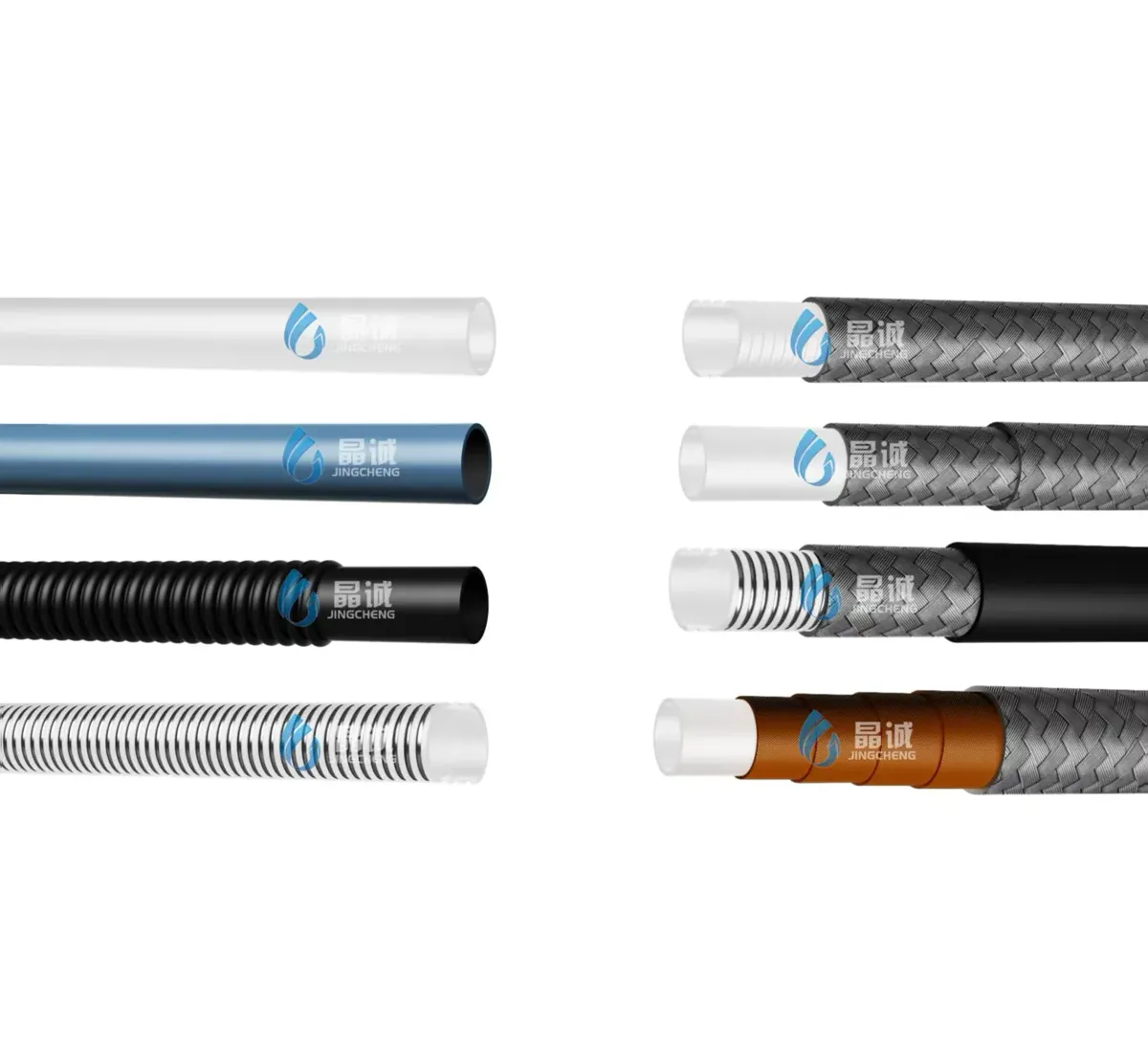
JCC-02100 is the build we send when a smooth-bore PTFE line has to hold high pressure and the single-braid series is not enough. The core is extruded, dried and sintered smooth PTFE. Over that sits a 304 stainless steel braid as the primary pressure layer, then an outer high-strength 304 stainless wire-bundle braid. That second, heavier jacket is what carries the extra load and what the catalog means by good mechanical resistance.
The published working-pressure band for the series is 41 MPa at the small end of the table down to 17 MPa on the large 1-1/2" row (with 18 MPa at 2" as printed). Burst figures on the same rows run from 122.2 MPa down to 49.5 MPa. Bore coverage is 3/8" to 2" (about 9.5 mm to 50.5 mm ID). Temperature is −70 to +260 °C (−94 to +500 °F). The catalog applications are high-pressure chemical spraying, high-pressure gluing, high-pressure transfer, steam, oil and brake hose.
The trade-off is honest. Two stainless layers make the hose heavier and less flexible than a single braid, and the minimum bend radius is larger. If your line runs well inside the single-braid table at a small bore with a comfortable bend, JCC-02100 is more reinforcement than you need. It earns its place when pressure at the bore you need for flow is the reason the line exists.
Full per-size numbers, braid OD and bend radii are on the product page wire-braided high-pressure PTFE hose specifications. This article is the diagnosis; that page is the table you quote from.
How this differs from other braided builds
I get asked to "just use double braid" or "use the spiral" without a pressure check. In short:
- Single-braid (JCC-01100): one 304 braid, lighter and more flexible, sized 5/32" to 1". Right when the catalog row for your bore already clears the pump with margin.
- Wire-bundle (JCC-02100): 304 braid plus outer 304 wire-bundle braid, 3/8" to 2". Right when you need the higher WP rows at larger bores.
- Double-braid (JCC-01200): two 304 braids on smooth PTFE, a different series aimed at hydraulic gas-, oil- and water-based fluids. Do not assume it is a drop-in substitute for wire-bundle without checking its own table.
- Spiral-wound braided (JCC-03100): copper-plated steel spiral plus 304 braid, for a different mix of flexibility and pressure. Use it when that construction matches the job, not as a generic upgrade path from single braid.
If you want a broader comparison of stainless braided PTFE builds, see our note on stainless steel braided PTFE hose. For this problem, the decision is usually single-braid versus wire-bundle at the bore your flow demands.
Common mistakes I still see
- Keeping the old braid when you open the bore. Flow needed 1"; the tag from the 1/2" single-braid hose was left on the spec sheet. Always re-read the row for the new size.
- Reading burst as an operating target. Catalog burst is a safety margin for a hose in good condition. It is not a surge rating and it is not a setpoint.
- Ignoring bend radius on the heavier build. Wire-bundle braid will fight a tight route. Measure the path before you order.
- Ordering by "high pressure" as a name instead of a number. Send the MPa you run. The series name does not replace the table.
- Mixing series on one skid without a reason. A single-braid jumper next to a wire-bundle main can be fine, but only if each row clears its own duty.
- Skipping fluid temperature. PTFE handles the catalog range, but derating with temperature is still general practice. Hot oil at the top of the range is not the same duty as cold solvent.
What to send for a quotation
I can usually answer from this list. If a drawing exists, send it too.
- Bore and length, with quantity and whether the run is fixed or handled.
- Working pressure you run, relief setting, and any known surge.
- Fluid (chemical spray media, adhesive, oil, steam, etc.) and maximum temperature.
- Ambient and whether the hose sees outdoor weather or washdown.
- End connections at each end: thread family as US, British or metric, size and angle, or a photo of the existing ends.
- Routing notes: minimum bend on the path, abrasion risk, clamps.
- Whether you are replacing a single-braid line and what size/pressure that line carried.
For a wider heated-hose intake list, the heated hose specification checklist is useful process discipline even on cold PTFE lines; for this series the product page and the list above are enough.
Frequently asked questions
What is a wire braided PTFE hose in this series?
For JCC-02100 it means smooth PTFE with a 304 stainless braid in the middle and a 304 stainless wire-bundle braid on the outside. The tube gives chemical resistance and a cleanable bore; the two stainless layers carry the pressure.
When is single-braid still enough?
When the single-braid catalog row for your bore already sits comfortably above the pump setpoint and the route is tight. Do not buy wire-bundle only because the name sounds stronger.
Why does working pressure drop at larger bores?
In general, hoop load scales with diameter. Catalog tables show that as lower working pressure on larger sizes. Upsizing for flow without re-checking the row is how high-pressure spray and transfer lines lose margin.
What temperature range does JCC-02100 cover?
−70 to +260 °C (−94 to +500 °F) as printed for the series. Confirm the fluid temperature on the quotation so derating, if any, is applied to your duty.
Can I use it above 1" bore?
Yes. The catalog prints sizes through 2". Working pressure at 1-1/4", 1-1/2" and 2" is 26 MPa, 17 MPa and 18 MPa as printed. Bend radius grows quickly, so check the route.
Where do I get the full size table?
On the JCC-02100 specifications section of the product page. Use those rows for the quotation, not the summary numbers in this article alone.
Send your high-pressure PTFE line details
Bore, length, working pressure, fluid, temperature and end connections is enough for us to check single-braid versus wire-bundle and come back with a specification.
Request a quoteSoren Miles, Marketing Manager | JC
Mobile: +86 13087118553 / +1 (757) 733-8947
WhatsApp: +86 185 6950 4906
Email: soren.miles@shenzhenjingcheng.com
Company (Canada): JINCHEN ELECTRIC TRACING CO., LTD.
Company (Hong Kong, China): HK JINGCHENG HIGH TECH CO., Ltd
Company (China): SHENZHEN JINGCHENG HIGH TECH CO., Ltd / Jingcheng Fluoroplastic (Guangdong) Co., Ltd.
Website: https://www.jingchenghose.com | https://www.electricallyheatedhose.com
Factory address: No. 7 Qiguan East Road, Torch Development Zone, Zhongshan City (Jingcheng Industrial Park)
Sources: Jingcheng PTFE hose brochure, JCC-02100 wire-bundle braided hose page (p8) and JCC-01100 single-braid page for the overlapping working-pressure rows, and our published business policies. Hoop-load scaling with bore and pressure derating with temperature are general engineering practice. Final ratings for each project are confirmed in the quotation and drawing.