
An anti-static PTFE hose is the fix for a problem most people misdiagnose as chemical attack: a plain PTFE solvent line that starts weeping through the wall, leaves dark tracks in the liner, and gives operators a shock at the fitting. This is what causes it and how I work back to the right build.
A weep that looks like a chemical failure
The call usually starts the same way. A line carrying solvent, fuel or a solvent-based coating has been in service for a few months, nothing has changed in the process, and then someone notices a damp patch on the hose or a smell in the enclosure.
They cut the hose out and look inside. Sometimes there is a pinhole with a brown or black mark around it as if someone had touched the wall with a hot pin. Occasionally a longer dark track runs along the bore. The braid underneath is stained at that point, and the wires near it may look slightly pitted.
On the same line, operators report a sharp snap when they touch a fitting, or a tingle through a glove. Most people put that down to the machine's drives. It is usually the line telling you what is wrong.
What is actually happening in the wall
This is general engineering knowledge, not a lab result from our own testing: PTFE is an excellent insulator, and that is the whole problem. When a fluid with low electrical conductivity, such as a dry solvent, a fuel, or a solvent-borne coating, flows through an insulating tube, charge separates at the wall. The fluid carries one sign away with it, and the wall keeps the other. On a short run at low speed the charge leaks away and nothing happens. On a long run, at higher velocity, through a filter, or at a bend where the flow separates, it accumulates faster than it can decay.
Sooner or later it discharges. The path it takes is the nearest conductor, and the nearest conductor is either the braid over the tube or the metal fitting at the end. To get there the discharge passes through the PTFE wall. That is a tiny, hot, concentrated event. Do it often enough in the same spot and you get a pinhole through the wall, a carbonised track in the liner, and a weep that starts as a smell and ends as a pool.
Four things make it worse, and they usually arrive together:
- Velocity. Charge generation rises sharply with flow rate. A line sized for a gentle transfer and then run at pump maximum is a different line.
- Filtration and restrictions. A filter, a small orifice, or a partly closed valve downstream of the hose concentrates charge.
- Two-phase flow. Air slugs, flashing solvent, or a partly empty line produce far more charge than liquid-full flow. A line that drains and refills every shift is a worse case than one that stays full.
- Dry running and blow-through. Purging a line with compressed air, or blowing the last of a batch out with nitrogen, is one of the most charge-heavy things you can do to a PTFE hose.
And the amplifier on top of all of it: an ungrounded fitting. If one end sits on an insulating bracket, or the fitting is sealed with a plastic washer, or a short section joins two isolated pipe stubs, the charge has no route to earth. A conductive liner there behaves almost like a plain one.
Symptom, likely cause, first check
| What you see | Most likely cause | Check first |
|---|---|---|
| Pinhole with a dark ring, braid stained at one point | Repeated discharge through the wall to the braid | Flow velocity and any filter or restriction upstream of that point |
| Weep along a length, no single hole | Charge tracking along the bore, often at a low spot or bend | Whether the line drains and refills, or runs partly empty |
| Shock or snap at the fitting | Fitting not bonded to machine earth | Continuity from fitting to earth with a meter, both ends |
| Failures always at the same elbow | Charge concentration at a tight bend, plus mechanical fatigue | Bend radius and whether the hose is supported at the bend |
| Nothing visible, but a solvent smell | Very slow permeation or a seep at a cut end | Cut quality and fitting assembly before blaming the tube |
What I check first, in order
- The medium and its conductivity. If it is a dry solvent, a fuel, a solvent-based coating, or a powder in air, static is on the table. If it is water-based and conductive, static is a much weaker explanation and I look at chemistry, temperature and mechanical damage first. Flammability matters here too: on a flammable liquid, a pinhole is not just a leak, it is a release path next to a possible ignition source, and the line should come out of service now rather than at the next shutdown.
- The removed liner, against a light. Cut a section out, hold it up to a bright lamp and look along the bore. A pinhole shows as a bright dot. Dark tracking shows as a brown or black line, often on one side only. Look at the braid at the same point: staining or pitting in one small area is a strong sign that the failure started from the inside out, not from the outside in.
- Continuity, end to end, and to earth. With the hose installed, measure from one fitting to the other, then from each fitting to a known machine earth. On a conductive assembly both readings should show continuity. If the hose is plain PTFE, this test tells you what the installation looks like today: open circuit everywhere, which is the condition that caused the damage.
- Fittings, clamps and isolated sections. Follow the path with your eyes, not just the meter. Plastic clamps, rubber-lined brackets, PTFE tape on a metal thread, an insulating gasket at a flange, a short jumper hose between two skids: each one breaks the bond. This is where most "the hose was anti-static and it still failed" stories come from.
- Routing and velocity. Look for a long straight run into a tight elbow, a hose that sags into a U, a filter directly upstream, or a line that is blown clear with air at the end of every batch. Any of those tells you the line is being run harder than the hose was chosen for.
The fix: a conductive wall, and a bonded assembly
The material fix is to stop using the wall as an insulator. In the anti-static PTFE series the tube is a conductive PTFE compound, so charge on the wall has a path through the material to the end fittings instead of through the wall to the braid. Chemical resistance, temperature range and the low-friction surface stay essentially as they were; what changes is where the charge goes.
The installation fix matters as much. Both ends have to be bonded to the machine earth through the fittings. Specify the fittings with the hose rather than reusing stores stock, tell us the earthing path you intend, and test the finished assembly for continuity before service. On a coating booth or flammable-liquid transfer, your site's static-control procedure decides the bonding and the check interval, not the hose data sheet.
If the line also carries pump discharge head, water hammer or vacuum, the conductive core can be specified inside a braided construction, and the pressure rating is then confirmed for that assembly.
Which of the four builds
All four are the same conductive material in different shapes, so the choice is mechanical, not electrical:
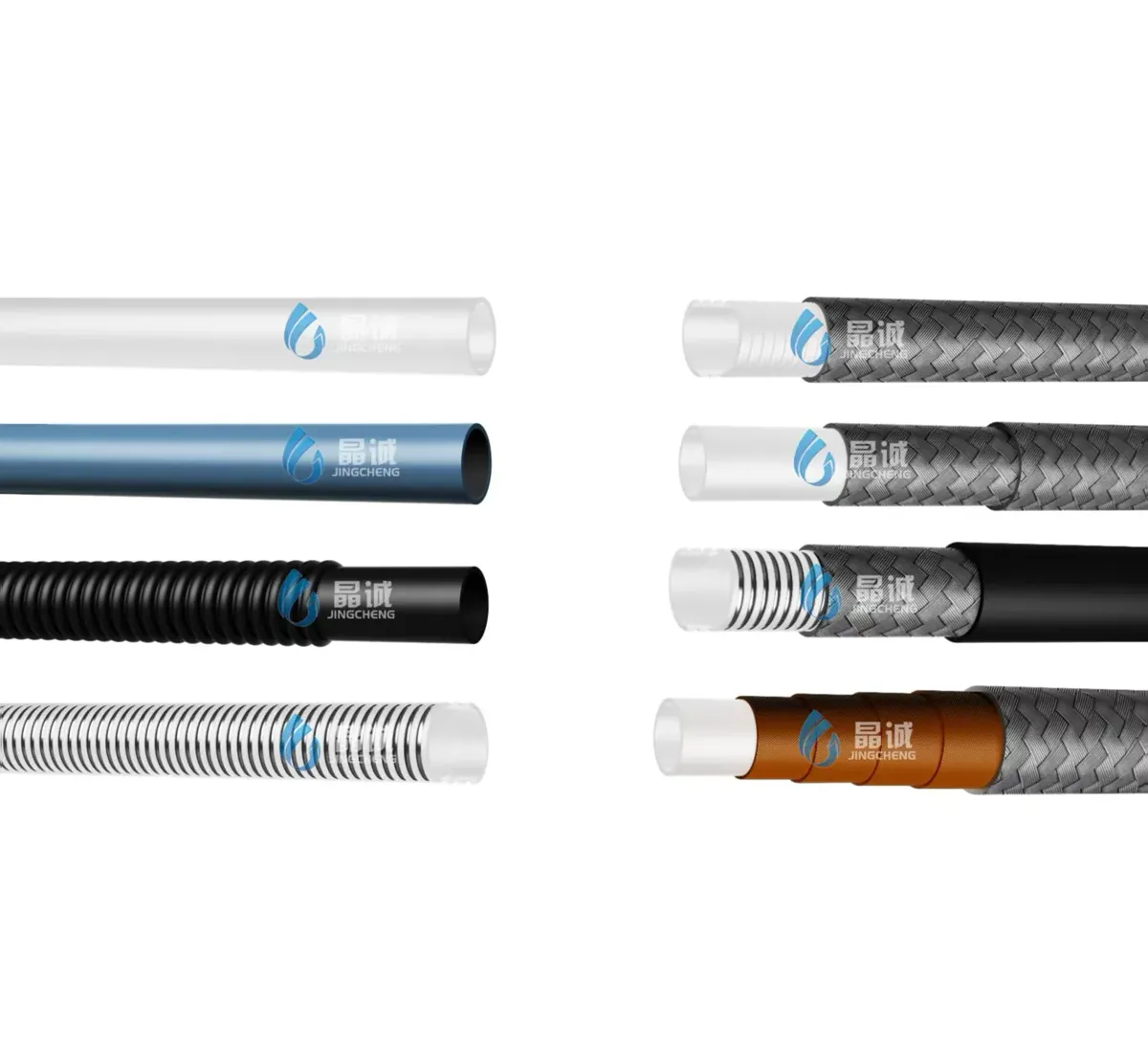
- Anti-static smooth. Straight bore, the cleanest flow and the easiest draining. My default for a straight run that is cleaned or drained between batches.
- Anti-static convoluted. Corrugated inside and out, for tight bends in a compact machine where a smooth tube would kink. The trade-off is a bore that holds liquid and is harder to flush; if the article on convoluted PTFE hose is relevant to your line, read the cleanout section before you choose it.
- Anti-static smooth-bore convoluted. Smooth inside, corrugated outside. You get the tight bend and still get a bore you can drain and clean. This is the build I suggest when a coating line has to be flushed between colours.
- All-black conductive convoluted. Corrugated, with the black conductive compound on the outside as well. Pick it when the outside surface also has to be conductive, for example where the hose runs through an area with its own static-control requirements.
What the anti-static series is
The series is the conductive version of our PTFE tube range, in four builds: anti-static smooth, anti-static convoluted, anti-static smooth-bore convoluted, and all-black conductive convoluted. The catalog temperature range is −60 to +260 °C (−76 to +500 °F). Note the cold end: it is not the −70 °C (−94 °F) of the standard PTFE tube series, so do not carry that figure across out of habit. The catalog names four application areas: chemical liquids, transfer of flammable liquids, electrostatic coating, and food.
Two limits are worth stating plainly. The catalog does not give a per-size working or burst pressure for these four builds, so treat the series as a tube family first and confirm pressure with us for the assembly. We do not quote a resistance figure here, and the catalog does not print one. If your site or insurer applies a continuity limit, send it with the inquiry and we will work to it. The build table and options are on the anti-static PTFE hose product page.
Common mistakes
- Buying the conductive tube and keeping the old fittings. The tube is half the circuit. If the fittings do not bond to earth, nothing has changed except the invoice.
- Assuming a braid is an earth path. A stainless braid is a conductor, but it is only earthed if something at each end actually connects it to earth. A braided hose on plastic brackets is still an isolated line.
- Fixing the hose and not the process. If the line is still blown clear with air every shift, or still runs at double its design velocity, the new hose is working harder than the old one did.
- Using the standard −70 °C figure. The anti-static material starts at −60 °C. A cold-trapped line needs checking against the right number.
- Treating the series as a pressure hose. No per-size pressure table is published for these builds; specify pressure with us and take the braided or spring-guarded route where the line needs it.
- Skipping the continuity test. A visual check tells you the hose is installed. Only a meter tells you it is bonded.
What to send for a quotation
With these points I can come back with a build and a price without another round of email: the build you want, or the routing if you would rather I suggest one; bore in mm or inches, length per piece and quantity; fittings at each end with thread standard and size, plus the earthing path; the medium and whether it is flammable; operating temperature including cleaning peaks; working and peak pressure and whether the line sees vacuum; flow rate if known; and the continuity limit your site applies. A photo of the failed liner usually settles the diagnosis faster than a description. The anti-static PTFE hose series page lists the same points with the build options.
Frequently asked questions
Can static electricity really put a hole in PTFE hose?
Yes. It is a recognised failure mode on low-conductivity fluid lines. The discharge is small in energy but concentrated and happens in the same place repeatedly, so you get a pinhole through the wall and a weep that starts slowly.
How do I know the leak is static damage and not a chemical attack?
Look at the shape of the damage. Chemical attack usually thins or discolours a broad area. Static damage is local: one pinhole, one dark track, braid staining at a single point, and often a history of shocks near the fittings. If the medium is a dry solvent and the line runs fast or drains between batches, static is the first thing I check.
Will an anti-static hose stop the shocks on its own?
Only if both ends are bonded to earth. The conductive wall gives the charge a path; the fittings and the installation have to complete it. An anti-static hose on insulated brackets will still shock people.
Do I need to replace the whole line or just the failed section?
On a static failure, replace the line. The damage you can see is where the discharge happened last, not the only place charge has been accumulating, and a conductive section spliced into a plain line gives you an unpredictable earthing path.
Which build do you recommend for a solvent coating supply line?
Usually anti-static smooth-bore convoluted, because a coating line tends to need a tight bend and a bore that can be flushed between colours. If the routing is straight, anti-static smooth is simpler and drains better. If the outside of the hose also has to be conductive, use the all-black conductive convoluted build.
Send your line details
Build, bore, length, fittings and earthing path, medium and flammability, temperature, pressure or vacuum, and the continuity limit your site applies. That is enough for a written specification and a price.
Request a quotationSoren Miles, Marketing Manager | JC
Mobile: +86 13087118553 / +1 (757) 733-8947
WhatsApp: +86 185 6950 4906
Email: soren.miles@shenzhenjingcheng.com
Company (Canada): JINCHEN ELECTRIC TRACING CO., LTD.
Company (Hong Kong, China): HK JINGCHENG HIGH TECH CO., Ltd
Company (China): SHENZHEN JINGCHENG HIGH TECH CO., Ltd / Jingcheng Fluoroplastic (Guangdong) Co., Ltd.
Website: https://www.jingchenghose.com | https://www.electricallyheatedhose.com
Factory address: No. 7 Qiguan East Road, Torch Development Zone, Zhongshan City (Jingcheng Industrial Park)
Sources: Jingcheng PTFE hose brochure, p10 (anti-static series), and our published business policies. The description of charge generation and discharge through an insulating wall, and the diagnosis order, are general engineering practice rather than Jingcheng test data. Final ratings and the earthing arrangement for each project are confirmed on the quotation and drawing.