
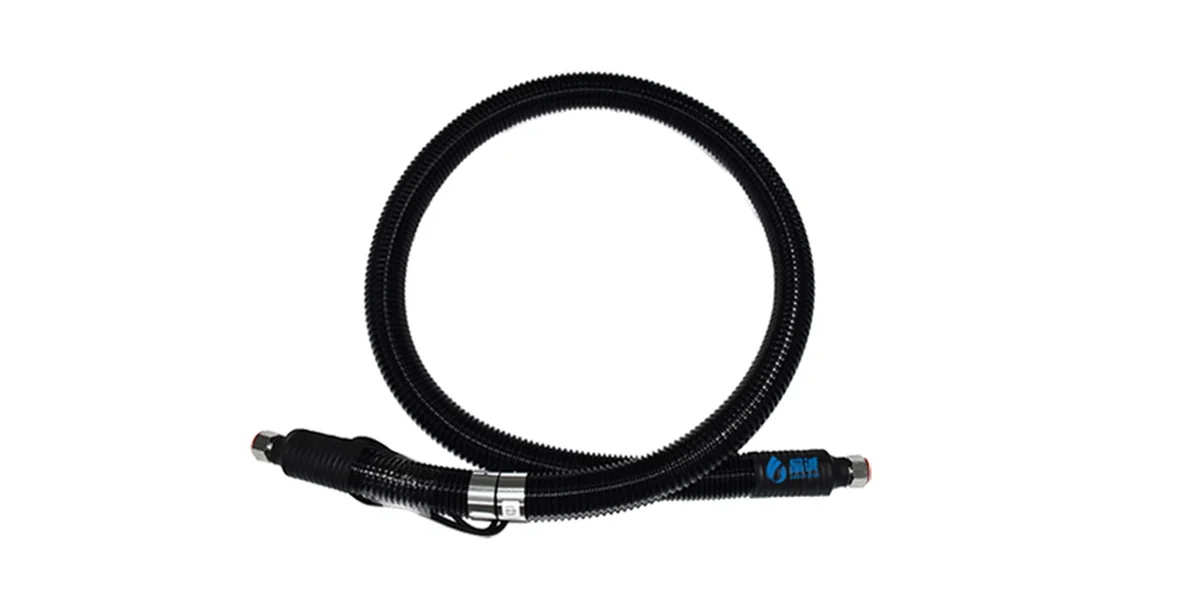
JCH is the electrically heated hose our catalog lists for automotive production lines: a heated, insulated hose that carries sealant from a glue or sealant pump to the dispensing point without letting the material cool on the way. The catalog states the application as imported and domestic glue and sealant pumps. Maximum heat resistance is up to 200 °C (392 °F), and higher temperatures are custom on request. The catalog prints five bore sizes for this product, 3/8" to 1".
- Max heat resistance200 °C / 392 °F, higher on request
- Pressure classhigh pressure
- Inner tubeorder-form code, 3/8"–1" bore
- Supply110 / 220 / 380 Vac, 12 Vdc
- SensorJ, K, Ni120, PT100, PT1000
Overview
The complaint I get most often on a dispensing line is not a burst hose or a dead heater. It is a bead that changes width along the same robot path: the first part is fine, then the last 300 mm before the gun runs thin, or a sealant that was flowing at the start of the shift starts dragging in the afternoon. On a line that is being set up or re-commissioned, the same symptom shows up as a pressure reading on the pump that creeps up while the flow at the nozzle falls.
Most of that is heat, not the pump. A sealant has a viscosity curve, and the last stretch of hose between the temperature controller's sensor and the nozzle is the stretch that cools fastest, because it is the part that hangs in the cell, moves with the robot, and is closest to the part being glued. If the heating layer puts in more heat per metre at the fitting than in the middle of the run, the sensor reads the average and the nozzle gets the cold end. That is why this build uses a heating layer of uniformly braided heating elements — the aim is a small temperature difference along the inner wall rather than a hot spot somewhere in the middle. The insulation is chosen from high-insulation-efficiency materials with surface temperature in mind, so a hose lying across a cell or next to a control cabinet does not shed heat it needs at the nozzle.
The second thing to look at is pressure. These are glue-pump hoses, not low-pressure adhesive lines. A pump that dead-heads against a closed nozzle valve will pulse the hose many times a shift, and a hose that was routed too tight at the gun will eventually show it at the crimp — typically a weep or a damp patch under the fitting, not a clean burst. Send the pressure the pump actually reaches, including any pulse, and the tightest bend on the route, so the assembly can be sized on the quotation drawing. Do not twist the hose laterally during or after installation either.
What the build gives you is heat plus a high-pressure class in one assembly, sized for automotive dispensing cell work. What it does not give you is a universal answer: the bore, the pressure, the tube and the fittings all have to be chosen for your pump and your robot. In recent years Jingcheng has supplied a number of domestic and overseas glue-pump manufacturers, and that work is why the fittings and the electrical lead exit are specified per machine rather than picked off a shelf.
Specifications
| Item | Range / options |
|---|---|
| Product type | Electrically heated, insulated hose for automotive production-line sealant dispensing, for imported and domestic glue and sealant pumps |
| Inner tube | Chosen on the order form by model-code letter (B, TB, T or X); bores 3/8"–1" |
| Heating layer | Heating elements uniformly braided around the hose to minimise temperature differences along the inner wall |
| Max heat resistance | Up to 200 °C / 392 °F; higher temperatures custom on request |
| Pressure class | High pressure; the rating for your bore is confirmed on the quotation drawing |
| Order-form pressure steps | 4, 10, 20, 35 MPa, or other |
| Rated power | 110, 150, 170, 200 W/m, or other |
| Supply voltage | 380 Vac, 220 Vac, 110 Vac, 12 Vdc, or other; operating range 12–380 Vac |
| Temperature sensor | Type J or type K thermocouple, Ni120, PT100, PT1000, or special |
| Hose length | 3, 4.5, 5, 6, 10 m, or other; length to order |
| End fittings | US, British or metric threads, other; each end specified separately, to order |
| Min bend radius | Specified with the assembly on the quotation drawing |
| Ambient conditions | −40 to +55 °C (−40 to 131 °F), relative humidity ≤ 85 %, 86–106 kPa |
| Controller | PID with SSR or thyristor output; optional waterproof enclosure, volt/ammeter; multi-channel control boxes |
All values as printed in the Jingcheng 2025 electrically heated hose catalog.
Full catalog: Heated hose catalog (PDF, 4.9 MB)
Materials and construction
- Inner tube: specified on the order form by model-code letter – B stainless corrugated tube, TB PTFE hose with stainless braid, T PTFE hose, X special material. Which one suits a sealant dispensing line depends on the material the pump handles, the pressure and how the hose is cleaned; tell us those and we will propose the tube.
- Heating layer: heating elements braided uniformly around the hose, to minimise differences in temperature distribution along the inner wall.
- Insulation: high-insulation-efficiency material, selected with surface temperature in mind.
- Outer surface: the hose in the photo has a black ribbed outer cover. The catalog page does not name the cover material, so it is specified on the drawing for your line rather than guessed from a picture.
- Sensor: a temperature sensor in the assembly, matched to your controller. Type J or K, Ni120, PT100 or PT1000, agreed on the drawing.
- End fittings: a metal fitting at each end – on the photo hose, a silver and black fitting at one end and a silver collar near the lead exit at the other. Thread standard and size are specified per end. The electrical lead exits near one end, as the photo shows.
Temperature and pressure notes
200 °C (392 °F) is the maximum heat resistance printed for this product; the catalog marks higher temperatures as custom, on request. The catalog places this hose in the low-temperature, high-pressure group of the heated range. That is a grouping of the range, not a 100 °C ceiling — the figure for this hose is 200 °C, and the useful number for your line is the setpoint the sealant needs at the nozzle, which is normally well below it.
This hose sits in the high-pressure group of the heated range. Working and burst pressure for the bore you need, and the minimum bend radius of the finished assembly, are confirmed on the quotation drawing. The catalog order form lists pressure steps of 4, 10, 20 and 35 MPa, or other. Send the pressure the pump actually reaches at the nozzle, including any dead-head or pulse, and the tightest bend on the route.
Keep the ambient inside −40 to +55 °C (−40 to 131 °F) at 85 % relative humidity or less and 86–106 kPa, and keep the surroundings free of gases that corrode metal or damage insulation, of conductive media and of severe mould; anything outside that is a custom build. Only trained personnel should operate the hose, and modification not agreed with us voids the warranty. Do not twist the hose laterally during or after installation.
Applications
The catalog application is automotive production-line dispensing on imported and domestic glue and sealant pumps. In practice that is:
- Robot and fixed-cell sealant dispensing where the bead must stay at a constant section from part to part
- Lines where the sealant or adhesive thickens as it cools between the pump and the nozzle
- Glue-pump outlets where the hose has to hold a high working pressure, not just stay warm
- Cells that need a sensor and a controller integrated with the line's own cabinet
It is not the right hose for a metering line where a single heating zone is asked to hold an exact nozzle temperature without a sensor at the gun, or for a low-pressure adhesive line where the route is tight and the pressure is modest — a low-pressure heated build will route better and cost less. If the line runs at low pressure and high temperature, look at the hot-melt family instead.
Options and related builds
How to order
A JCH part number carries the main choices, so the fastest way to order is to quote one. The catalog example is JCH-200-16-B-3X220-P2-8:
- 200 – working temperature in °C. 200 means 200 °C.
- 16 – inner tube bore in mm. 16 means Φ16 mm.
- Inner tube letter – B is a stainless corrugated tube, TB is PTFE hose with stainless braid, T is a PTFE hose, X is a special material.
- Supply – 220 means 220 V, 3X220 means three-phase four-wire 220 V.
- Sensor code – P2 is PT100 two-wire, P3 is PT100 three-wire, K is type K, J is type J, W is no sensor, T is a special sensor.
- Pressure – working pressure in MPa. 8 means 8 MPa.
If you do not have a part number, send these instead:
- Bore and length, the number of pieces, and the distance from the pump to the nozzle.
- The sealant or adhesive, its nozzle temperature, and the pump pressure and flow you run.
- The setpoint you want and the highest ambient the run passes through in the cell.
- Supply voltage and the controller or cabinet the hose plugs into.
- Sensor type and wiring, if the cabinet dictates it, plus the pin table if one exists.
- End fittings at each end: thread standard, size, angle, with a photo or part number if you have one.
- The route – how the hose is supported at the robot and at the gun, and the tightest bend on it.
If a drawing exists, send it. We propose the specification against it, you confirm it with the quotation, and production follows the confirmed specification.
Frequently asked questions
What is an automotive sealant dispensing heated hose?
An electrically heated, insulated hose for production-line sealant dispensing on glue and sealant pumps. It combines a heated inner hose, a braided heating layer, insulation, an outer cover, a metal fitting at each end and an electrical lead, built to a high-pressure class.
What temperature does it run at?
Maximum heat resistance is up to 200 °C (392 °F), with higher temperatures custom on request. The catalog groups this product in the low-temperature, high-pressure family, but the 200 °C figure is the limit for the hose. Order the setpoint the sealant needs at the nozzle, not the maximum of the hose.
How much pressure can it take?
The hose is built to a high-pressure class. Working and burst pressure for the bore you need are confirmed on the quotation drawing. Send the pressure the pump actually reaches at the nozzle, including any dead-head or pulse, when you enquire. The order form lists 4, 10, 20 and 35 MPa, or other.
Which bores are available?
Five are printed for this product: 3/8", 1/2", 5/8", 3/4" and 1". The order form also lists Φ8, Φ12, Φ16, Φ19 and Φ25 mm with an "other" option for the JCH range.
How is the heating layer built?
The catalog specifies a heating layer of uniformly braided heating elements, to minimise differences in temperature distribution along the inner wall. The insulation is a high-insulation-efficiency material chosen with surface temperature in mind.
Can it be supplied with my pump fittings and controller?
Yes. Both ends are specified separately on the order – US, British or metric threads, or another type – and made to order. The sensor is matched to your controller: type J or K, Ni120, PT100 or PT1000, with PID control and SSR or thyristor output on our controllers.
Send your dispensing-line details
Sealant, nozzle temperature, bore, length, pump pressure, supply voltage and fittings is all we need to come back with a specification and a price.
Request a quoteSoren Miles, Marketing Manager | JC
Mobile: +86 13087118553 / +1 (757) 733-8947
WhatsApp: +86 185 6950 4906
Email: soren.miles@shenzhenjingcheng.com
Company (Canada): JINCHEN ELECTRIC TRACING CO., LTD.
Company (Hong Kong, China): HK JINGCHENG HIGH TECH CO., Ltd
Company (China): SHENZHEN JINGCHENG HIGH TECH CO., Ltd / Jingcheng Fluoroplastic (Guangdong) Co., Ltd.
Website: https://www.jingchenghose.com | https://www.electricallyheatedhose.com
Factory address: No. 7 Qiguan East Road, Torch Development Zone, Zhongshan City (Jingcheng Industrial Park)
Source: Jingcheng 2025 electrically heated hose catalog, p.9 automotive production-line hose and p.4 order form and model code, and our published business policies. Notes on viscosity, cooling at the nozzle and crimp fatigue are general engineering practice.