
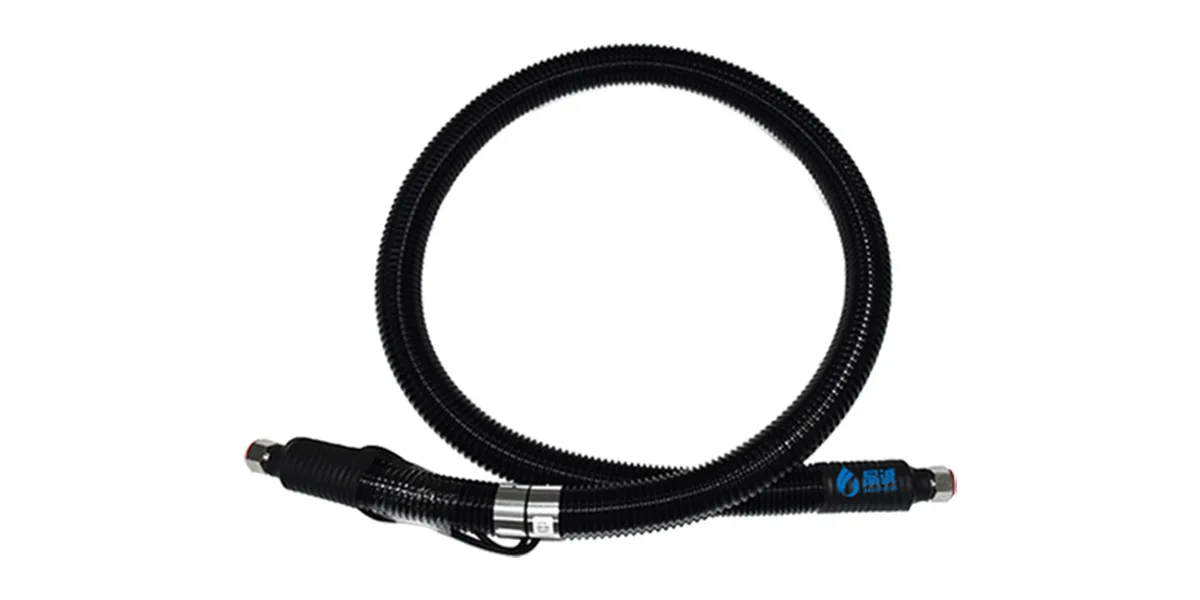
JCH is the special-industry connection hose from our electrically heated range: a Japanese Daikin PTFE inner tube with 304 stainless pressure wire, a braided heating layer and an insulated outer cover, built for domestic and imported special equipment. Standard heat resistance is up to 230 °C (446 °F), the pressure class goes up to 40 MPa or higher on a custom build, and every unit is made to the drawing for the machine it connects to.
- Max temperature230 °C / 446 °F standard
- Pressure classup to 40 MPa, custom
- Inner tubePTFE, Φ8–Φ25 mm
- Supply110 / 220 / 380 Vac, 12 Vdc
- SensorJ, K, Ni120, PT100, PT1000
Overview
The failure I see most on special-equipment heated lines is not a burst hose. It is a hose that holds temperature on the bench and then runs cold over the last half metre before the fitting, or a hose that starts weeping at the crimp after a few weeks because someone twisted it to make the bend. Both come back to the same two things: how evenly the heat is spread, and how the assembly is treated on site.
This build attacks the first one with the heating layer. The elements are braided uniformly around the inner tube rather than wound as a single helix, so the heat input per metre is even along the length and the temperature difference along the inner wall stays small. The insulation is chosen for high thermal efficiency with the surface temperature in mind, which matters when the hose runs through a cabinet or next to a control panel.
The second one is a mechanical rule, not a product feature: the minimum bend radius for the finished assembly is 0.2 m, a 0.4 m bend diameter. If the routing will not give you that, the hose will be bent tighter than it was built for, and the risk is damage, a short in the heating layer, leakage or fire. Do not twist the hose laterally during or after installation either. Plan the route before the order, not after.
Inside, it is a PTFE tube with 304 stainless pressure wire over it. That combination is why the series is rated for both heat and pressure rather than one or the other: PTFE gives the chemical and temperature resistance, the stainless wire takes the pressure load. It is the right hose when the equipment is a special machine with a hard connection, a fixed route and a specification that has to be met. If the line only needs to stay warm at low pressure and the fittings are standard, a hot-melt or gas-sampling hose is cheaper and easier to route.
Specifications
| Item | Range / options |
|---|---|
| Product type | Electrically heated, insulated connection hose for domestic and imported special equipment |
| Inner tube | Japanese Daikin PTFE tube, Φ8, Φ12, Φ16, Φ19, Φ25 mm (other on request) |
| Pressure reinforcement | 304 stainless steel pressure wire |
| Max working temperature | Up to 230 °C / 446 °F standard; higher on request |
| Pressure class | Up to 40 MPa or higher (custom); per-size table below |
| Order-form pressure steps | 4, 10, 20, 35 MPa, or other |
| Rated power | 110, 150, 170, 200 W/m, or other |
| Supply voltage | 380 Vac, 220 Vac, 110 Vac, 12 Vdc, or other; operating range 12–380 Vac |
| Temperature sensor | Type J or type K thermocouple, Ni120, PT100, PT1000, or special |
| Hose length | 3, 4.5, 5, 6, 10 m, or other; length to drawing |
| End fittings | US, British or metric threads, other; each end specified separately, to drawing |
| Min bend radius | 0.2 m for the assembly (0.4 m bend diameter) |
| Ambient conditions | −40 to +55 °C (−40 to 131 °F), relative humidity ≤ 85 %, 86–106 kPa |
| Controller | PID with SSR or thyristor output; optional waterproof enclosure, volt/ammeter; multi-channel control boxes |
| Quality assurance | Three levels: testing agency (routine), self-inspection, supplier |
Pressure up to 40 MPa or higher (custom). Inner tube material: Japanese Daikin PTFE (Teflon) throughout; 304 stainless steel pressure wire. Quality is assured at three levels: testing agency (routine), self-inspection and supplier, so every line is checked for temperature and pressure resistance.
Size and pressure table
| ID inch | OD mm (±0.2) | Working bar | Working psi | Burst bar | Burst psi | Min bend radius mm |
|---|---|---|---|---|---|---|
| 5/16" | 13.3 | 113 | 1631 | 450 | 6525 | 15 |
| 3/8" | 15.5 | 110 | 1595 | 440 | 6380 | 20 |
| 1/2" | 19 | 88 | 1269 | 350 | 5075 | 25 |
| 5/8" | 22.7 | 70 | 1015 | 280 | 4060 | 30 |
| 3/4" | 27 | 65 | 943 | 260 | 3770 | 60 |
| 1" | 34 | 57.5 | 834 | 230 | 3335 | 85 |
| 1-1/4" | 43 | 52.5 | 761 | 210 | 3045 | 155 |
| 1-1/2" | 49.5 | 50 | 725 | 200 | 2900 | 200 |
All values as printed in the Jingcheng 2025 electrically heated hose catalog. Higher temperatures available on request.
Materials and construction
- Inner tube: PTFE tube. Chemical resistance, a non-stick bore and the temperature capability all come from this layer.
- Pressure wire: 304 stainless steel wire over the inner tube. This is what carries the pressure, which is why the series can be built to a 40 MPa class.
- Heating layer: heating elements braided uniformly around the hose to keep the temperature difference along the inner wall small.
- Sensor: a temperature sensor sits in the assembly, matched to the controller you are using. Type, wiring and position are agreed on the drawing.
- Insulation and cover: high-insulation-efficiency material, selected with surface temperature in mind, under a corrugated outer cover as in the photo.
- End fittings: metal fittings at both ends, specification per end from the order form. A moulded end sleeve carries the lead exit and protects the heating-layer connection.
Temperature and pressure notes
230 °C (446 °F) is the standard heat resistance of the series. Higher temperatures are available on request, and the order form also lists 100, 120 and 200 °C as alternative setpoints, so tell us the setpoint you actually run at rather than the maximum the hose can survive. A hose built and controlled to run at 180 °C generally lasts longer and loses less heat than one cycling around its limit.
On pressure, the headline is 40 MPa or higher on a custom build. That is a class, not a per-size number: the allowable pressure at your bore and temperature is worked out for the assembly and printed on the quotation drawing. Do not take the headline number and design a line to it without that drawing. Pressure capacity also falls as temperature rises, which is normal for a polymer-lined assembly, and the medium matters: a gas or a low-viscosity solvent is less forgiving than a filled adhesive.
Two practical limits are easy to forget. The assembly is rated for −40 to +55 °C (−40 to 131 °F) ambient, so a cold loading dock in winter or a hot enclosure in summer both count. And the environment should be free of gases that corrode metal or damage insulation, conductive media and severe mould; anything outside that is a custom build.
Applications
The catalog application for this series is domestic and imported special equipment, and that is the honest scope. In practice it covers:
- Special machines where a heated connection has to meet a fixed pressure and temperature specification
- Lines where the medium must not cool or thicken between the supply and the point of use
- Applications needing a sensor and a controller integrated with the machine
- Heated connections on imported special equipment as well as domestic machines
It is not a general-purpose line. If the machine moves, or the hose is handled every shift, or the pressure is low and the route is tight, a lighter heated hose from the low-pressure range will serve better.
Options and related builds
How to order
A JCH part number carries the main choices, so the fastest way to order is to quote one. The catalog example is JCH-200-16-B-3X220-P2-8-N:
- 200 – working temperature in °C. 200 means 200 °C.
- 16 – inner tube bore in mm. 16 means Φ16 mm.
- Inner tube letter – B is a stainless corrugated tube, TB is PTFE hose with stainless braid, T is a PTFE hose, X is a special material. This series uses the PTFE options.
- Supply – 220 means 220 V, 3X220 means three-phase four-wire 220 V.
- Sensor code – P2 is PT100 two-wire, P3 is PT100 three-wire, K is type K, J is type J, W is no sensor, T is a special sensor.
- Pressure – working pressure in MPa. 8 means 8 MPa.
If you do not have a part number, send these instead:
- Bore and length, with the number of pieces.
- Medium, working temperature and peak temperature.
- Working pressure and the highest transient you expect.
- Supply voltage and the controller or machine the hose plugs into.
- Sensor type and wiring, if the machine dictates it.
- End fittings at each end: thread standard, size, angle, with a photo or part number if you have one.
- Rated power per metre if your controller sets it, and the ambient conditions on site.
If a drawing exists, send it. We propose the specification against it, you confirm it with the quotation, and production follows the confirmed specification.
Frequently asked questions
What is a special-industry heated hose?
A heated, insulated hose built for special equipment rather than for standard machines. The construction here is a PTFE inner tube with 304 stainless pressure wire, a braided heating layer, insulation, an outer cover and end fittings made to the machine's connection. It is specified against the equipment drawing, not chosen from a shelf.
What temperature can it run at?
Up to 230 °C (446 °F) as standard, with higher temperatures available on request. The catalog order form also lists lower setpoints such as 100, 120 and 200 °C, so the useful answer is the setpoint your process needs. Give us that number and the hose and controller are built around it.
What does "up to 40 MPa" mean for my size?
The series can be built for up to 40 MPa or higher on custom order. For standard sizes the catalog table gives the working pressure per bore: 113 bar at 5/16", 88 bar at 1/2", 57.5 bar at 1" and 50 bar at 1-1/2", with burst pressure four times working.
Can I use my existing controller?
Yes, if we know its sensor input and output type before we build. The catalog lists type J and type K thermocouples, Ni120, PT100 and PT1000 sensors, and controllers with PID and SSR or thyristor output. Send the controller model or a photo of its label and the wiring is matched to it.
How tight can the bend be?
The minimum bend radius for the assembly is 0.2 m, so a bend diameter of 0.4 m. Bending tighter than that can damage the hose, short the heating layer, cause leakage or start a fire. Plan the route on site before you order, and support the hose so the weight of the run does not pull it into a tighter arc.
How is a JCH hose delivered and tested?
Each assembly is built to the confirmed drawing, then inspected and packed. Assurance runs at three levels: the testing agency for routine checks, our own self-inspection, and the supplier. The test and inspection scope for your order is agreed in the quotation rather than assumed.
Send your special-industry hose details
Machine, bore, length, medium, temperature, pressure, supply voltage and fittings is all we need to come back with a specification and a price.
Request a quoteSoren Miles, Marketing Manager | JC
Mobile: +86 13087118553 / +1 (757) 733-8947
WhatsApp: +86 185 6950 4906
Email: soren.miles@shenzhenjingcheng.com
Company (Canada): JINCHEN ELECTRIC TRACING CO., LTD.
Company (Hong Kong, China): HK JINGCHENG HIGH TECH CO., Ltd
Company (China): SHENZHEN JINGCHENG HIGH TECH CO., Ltd / Jingcheng Fluoroplastic (Guangdong) Co., Ltd.
Website: https://www.jingchenghose.com | https://www.electricallyheatedhose.com
Factory address: No. 7 Qiguan East Road, Torch Development Zone, Zhongshan City (Jingcheng Industrial Park)
Source: Jingcheng 2025 electrically heated hose catalog, p.4 order form and model code, p.6 special-industry connection hose, and our published business policies.