
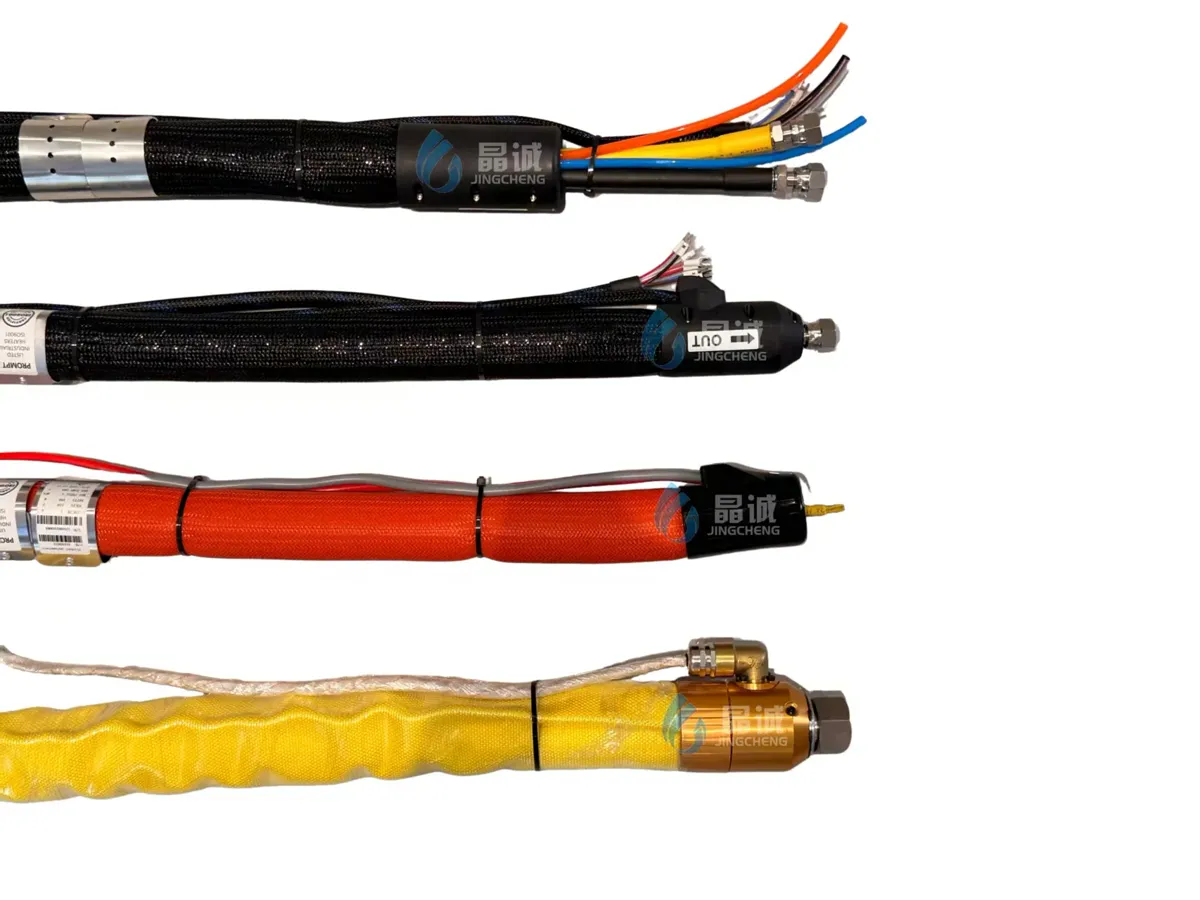
A heated sample line is an insulated, electrically heat-traced hose that carries flue gas or process gas from a sampling probe to an analyzer without letting the sample cool to its dew point. Jingcheng builds heated sample lines with the gas-sampling hose in the 2025 heated hose catalog, rated to 230 °C (446 °F).
What a heated sample line does
A heated sample line is the part of a gas analysis system that moves the sample from where it is taken to where it is measured. Its job is thermal: keep every metre of the path warm enough that the sample stays above its dew point, and keep the path chemically inert so the reading that arrives at the analyzer is the reading that left the probe.
Jingcheng's 2025 electrically heated hose catalog lists the gas-sampling hose as a high-temperature, low-pressure product for flue-gas pretreatment, online monitoring, infrared and ultraviolet sampling analyzers, and laboratory test equipment. The catalog gives its maximum heat resistance as 230 °C (446 °F) and adds that higher temperatures are built on request. Two properties are named for this hose in particular: it resists bending and kinking, and its insulation stays stable in service.
Those two properties are why a sample line is its own product rather than a length of heated hose with different fittings. The line is often routed through a cramped analyzer shelter, around ductwork and over a cable tray, and is expected to hold its setpoint for years with little attention. Its bore is small: the smallest inner diameter on the Jingcheng order form is Φ8 mm, and a kink that would be an inconvenience on a 25 mm hose stops the sample flow altogether.
Where a heated sample line is used
Jingcheng's catalog groups the gas-sampling hose under four applications. Each puts a different demand on the same product.
- Flue-gas pretreatment. The sample leaves a stack hot, wet and often dusty. The line holds it above the water dew point and, where acid gases are present, above the acid dew point, so filters and chillers receive gas rather than liquid.
- Online monitoring and CEMS-type systems. A continuous system reads the same stream for months, so a cold spot along the line becomes a permanent bias in the reading rather than a one-off error.
- Infrared and ultraviolet sampling analyzers. These measure absorption across an optical path, so a change in sample composition from condensation or wall adsorption shows up directly as measurement error.
- Laboratory test equipment. Bench rigs and pilot plants use the same construction at smaller scale, where a flexible line routes more easily than rigid heat-traced tubing.
Jingcheng's catalog introduction also lists portable flue-gas sampling among the industries it serves, which is the same duty in a form that is carried rather than fixed.
How a Jingcheng heated sample line is built
Jingcheng's catalog describes every product in the heated hose range as an inner tube, a heating layer and an insulation layer assembled into one finished hose, then fitted. It describes the heating layer as uniformly braided heating elements, wound so that temperature differences along the inner wall are kept to a minimum, and the insulation as a high-insulation-efficiency material chosen with the surface temperature of the finished hose in mind.
On a sample line the inner tube is the part that touches the gas, so it is the part worth choosing deliberately. In Jingcheng's model code it is a field of its own, with four values.
Inner tube: B, TB, T or X
| Code | Inner tube | What it means for a sample line |
|---|---|---|
| B | Stainless-steel corrugated tube | A metal flow path that tolerates hot, wet, particle-bearing flue gas. The corrugations take a tight bend, and they also give the bore a rippled surface, which is worth weighing where the sample is sticky or the line is purged between readings. |
| TB | PTFE hose with stainless-steel braid | An inert bore with a braid over it. The braid carries pressure and protects the tube from outside, which suits a line pulled through ducts or cable trays. |
| T | PTFE hose | An inert bore on its own, for samples that would react with a metal wall or be adsorbed on it. The usual choice where the analyzer measures a low concentration. |
| X | Special material | An inner tube in another material when none of the three above suits the sample. |
Where the inner tube is PTFE, the material's limits are documented separately from the finished hose. Jingcheng's PTFE hose brochure rates the smooth-bore PTFE tube, JCC-00000, from −70 °C to +260 °C (−94 °F to +500 °F) and lists strong acids and alkalis, oxidizers, reducing agents and organic solvents for it. That is the material rating; the maximum working temperature of a finished heated sample line is a different figure, set by its heater, insulation and fittings. The PTFE constructions are compared in the PTFE hose construction guide.
Heating layer and insulation
A heated sample line carries its heater inside the hose, wound along the full length. Jingcheng's catalog describes the heating layer as a uniformly braided element and gives the reason: even coverage keeps the temperature difference between one point on the inner wall and another to a minimum. On a sample line that is not a refinement. A cold spot is where condensation begins, and liquid in the line can carry into the analyzer, block a filter, or dissolve part of the sample and change the reading.
The insulation is specified with the surface temperature of the hose in mind, not the sample temperature alone, so the outside stays cool enough to handle and to route alongside other services. Heater output is rated per metre, and the order form lists 110, 150, 170 and 200 W/m as standard, with other ratings made to order. Total power is that figure multiplied by the length, so a 10 m line at 200 W/m draws 2,000 W and loads the supply circuit accordingly. Heat loss rises with length, with colder surroundings and with air moving over the hose, which is why the installation surroundings belong in the specification rather than in a footnote.
Temperature sensor and controller
A heated sample line reports its temperature through a sensor built into the assembly, and the reading is only useful if the controller can interpret it. Jingcheng's catalog lists type J and type K thermocouples, Ni120, PT100 in 2-wire and 3-wire form, and PT1000; the sensor is another model-code field. A controller set up for a PT100 input will not read a type K thermocouple correctly, so the sensor type has to come from the equipment that will read it. Where a line replaces an existing one, the simplest source of truth is the old hose and its label.
If the controller is supplied with the hose, the catalog lists PID controllers with SSR output or thyristor output, with options for a waterproof enclosure and a voltmeter or ammeter, plus separate heating control boxes with two, three or more channels. Jingcheng asks customers to specify their own control method, which leaves room for a sample line that has to sit inside an existing analyzer cabinet.
Configuration options for a heated sample line
Jingcheng's 2025 catalog uses one order form for the whole heated hose range, and the gas-sampling hose is specified from it. The values below are the catalog's own list; the right-hand column explains what each one changes on a sample line.
| Option | Values listed in the catalog | What it changes on a sample line |
|---|---|---|
| Rated voltage | 380 Vac, 220 Vac, 110 Vac, 12 Vdc, other | The heater is built for one supply. The choice depends on what the analyzer shelter can provide and on the total load. |
| Temperature sensor | Type J, type K, Ni120, PT100, PT1000, other | Must match the input of the controller or analyzer that reads it. |
| Hose length | 3 m, 4.5 m, 5 m, 6 m, 10 m (about 9.8–32.8 ft), other | Sets total heater load and the heat loss the line must make up. Include slack for routing. |
| Inner diameter | Φ8, Φ12, Φ16, Φ19, Φ25 mm (about 5/16–1 inch), other | Sets flow for the sample pump and the lag between probe and reading. Narrow bores respond faster but kink more easily. |
| Maximum working temperature | 400 °C, 200 °C, 120 °C, 100 °C (752, 392, 248, 212 °F), other | Drives heater and insulation selection. The gas-sampling hose is rated to 230 °C (446 °F) as standard; higher is quoted on request. |
| Working pressure | 4, 10, 20, 35 MPa (40, 100, 200, 350 bar; about 580–5,076 psi), other | Sets reinforcement and fittings. The form spans the whole heated hose range, so state the actual sample pressure and let engineering confirm the class. |
| Rated power | 110, 150, 170, 200 W/m, other | Sets how quickly the line reaches setpoint and recovers after a cold start or a purge. |
| End fittings | US, British or metric threads, other | Each end is specified separately. A photo or drawing of the mating port at the probe and analyzer removes most of the doubt. |
| Wiring | Pin table recorded for each end | Pin number, wire colour and function are recorded for both ends, so the line plugs into the existing cabinet. |
Operating environment and installation limits
Jingcheng's catalog gives a standard operating environment for the heated hose range: ambient −40 °C to +55 °C (−40 °F to 131 °F), relative humidity 85 % or less, atmospheric pressure 86–106 kPa, and a supply voltage anywhere from 12 V to 380 V AC. The surroundings must be free of gases that corrode metal or damage insulation, free of conductive media, and free of severe mould. Anything outside that envelope is a custom build.
Two installation rules come with the same page. A heated hose must not be twisted about its own axis during or after installation. And it is to be installed and operated by authorized, trained personnel; unauthorized modification voids the warranty. Bend-and-kink resistance is a listed feature of the gas-sampling hose, but the tightest bend in a real installation should still be stated so the routing can be reviewed against the construction.
How a heated sample line is made and checked
Jingcheng builds to a confirmed specification rather than to a catalog part number. The process in the catalog runs in six steps: inquiry by phone, fax or web form; specification confirmation, in which Jingcheng proposes the specification it considers best as the basis for a quotation; quotation issued and confirmed by the customer with a purchase order; production to the confirmed specification; inspection and packing; and shipment to the customer's address.
Quality assurance is described as three levels: testing by an outside agency as routine practice, self-inspection, and supplier inspection. Inspection and test requirements for a given order are agreed during the engineering review and recorded. Selected heated hose samples have third-party test documentation, and the reports shown on the About page identify their issuing laboratory, report number and evaluated sample; each report applies only to the sample and scope named in it. The business policies set out how ratings, drawings and order approval are handled.
Common mistakes
- Using the analyzer's temperature as the line rating. An analyzer rated to 200 °C does not mean the sample line stops there. The line must hold the sample above its dew point all the way to the inlet, and its own rating is a separate figure.
- Choosing the sensor by what is on the shelf. A sensor that does not match the controller input gives a wrong reading or none at all. Copy the type from the existing hose or the controller's specification.
- Ordering the length between the two ports only. Heater load is rated per metre and routing needs slack; a line too short to route properly is not usable at any price.
- Leaving out the surroundings. Wind, a cold shelter, a nearby hot duct and an outdoor run all change heat loss, and heat loss decides whether the specified power per metre is enough.
- Picking the bore for the fitting rather than for the analyzer. The bore sets sample lag time. A very narrow bore reduces lag but makes the line easier to kink and harder to purge.
What to send for a heated sample line quotation
A heated sample line is quoted from the sample-specific details below. Sending the full list in one pass saves a round of questions:
- The gas or gas mixture, and anything corrosive or condensable in it.
- The expected moisture level, or the dew point the line must stay above.
- The temperature to be held, and the hottest the line will see.
- The actual sample pressure, and whether the line runs under vacuum.
- The analyzer or CEMS model, its sample flow requirement, and the sensor input its controller reads.
- The route: total length, tightest bend, indoor or outdoor, and what supports the line.
- The connection at each end, with a photo or drawing of the mating ports.
- Quantity, any test documents required, and your target date.
The heated hose specification checklist covers the same inputs in the order our engineers review them, with the option ranges and the model code field by field. Heated hose families and their maximum temperatures are listed on the products page, and the series the gas-sampling hose belongs to is under heated low-pressure hose.
Frequently asked questions
What temperature does a Jingcheng heated sample line run at?
The gas-sampling hose is rated to a maximum working temperature of 230 °C (446 °F). Higher temperatures are built on request, and the setpoint you run at is chosen to stay above the sample's dew point with margin.
Which inner tube should I choose for flue gas?
It depends on the sample and the measurement. Stainless-steel corrugated tube (code B) suits hot, wet, particle-bearing flue gas. PTFE (code T) suits a sample that would react with a metal wall or be adsorbed on it, which matters where the analyzer reads low concentrations. Code TB adds a stainless-steel braid over the PTFE tube, and code X covers a special material.
Can the temperature controller be supplied with the sample line?
Yes. Jingcheng's catalog lists PID controllers with SSR or thyristor output, optional waterproof enclosures and volt or ammeter displays, and separate control boxes with two, three or more channels. Many sample lines are instead wired into the analyzer cabinet's existing controller, which is why the sensor type has to match its input.
Are other lengths, bores or voltages available?
The catalog lists 3, 4.5, 5, 6 and 10 m lengths, Φ8 to Φ25 mm bores, and 380, 220 and 110 Vac or 12 Vdc supplies, and adds "other" to each. Custom values are quoted after the specification is confirmed.
Send your sample line details
Tell us the gas, the dew point you have to stay above, the analyzer and its sensor input, and how the line is routed. Our engineers will review the construction and come back with a specification and quotation.
Request a sample line quotationSoren Miles, Marketing Manager | JC
Mobile: +86 13087118553 / +1 (757) 733-8947
WhatsApp: +86 185 6950 4906
Email: soren.miles@shenzhenjingcheng.com
Company (Canada): JINCHEN ELECTRIC TRACING CO., LTD.
Company (Hong Kong, China): HK JINGCHENG HIGH TECH CO., Ltd
Company (China): SHENZHEN JINGCHENG HIGH TECH CO., Ltd / Jingcheng Fluoroplastic (Guangdong) Co., Ltd.
Website: https://www.jingchenghose.com | https://www.electricallyheatedhose.com
Factory address: No. 7 Qiguan East Road, Torch Development Zone, Zhongshan City (Jingcheng Industrial Park)
Sources: Jingcheng 2025 electrically heated hose catalog (gas-sampling hose, heated hose order form, model code, controller and installation pages), the Jingcheng PTFE hose brochure for the PTFE material rating, and our published business policies. General engineering notes on condensation, flow and controller input matching are not product ratings. Final ratings for each project are confirmed in the quotation and drawing.