
A hot melt hose, also called a hot melt glue hose, is an electrically heated hose that carries molten adhesive from a melter to a dispensing gun without letting the adhesive cool and thicken. Jingcheng builds hot melt hoses for hot melt and PUR adhesive machines, with a standard maximum working temperature of 230 °C (446 °F).
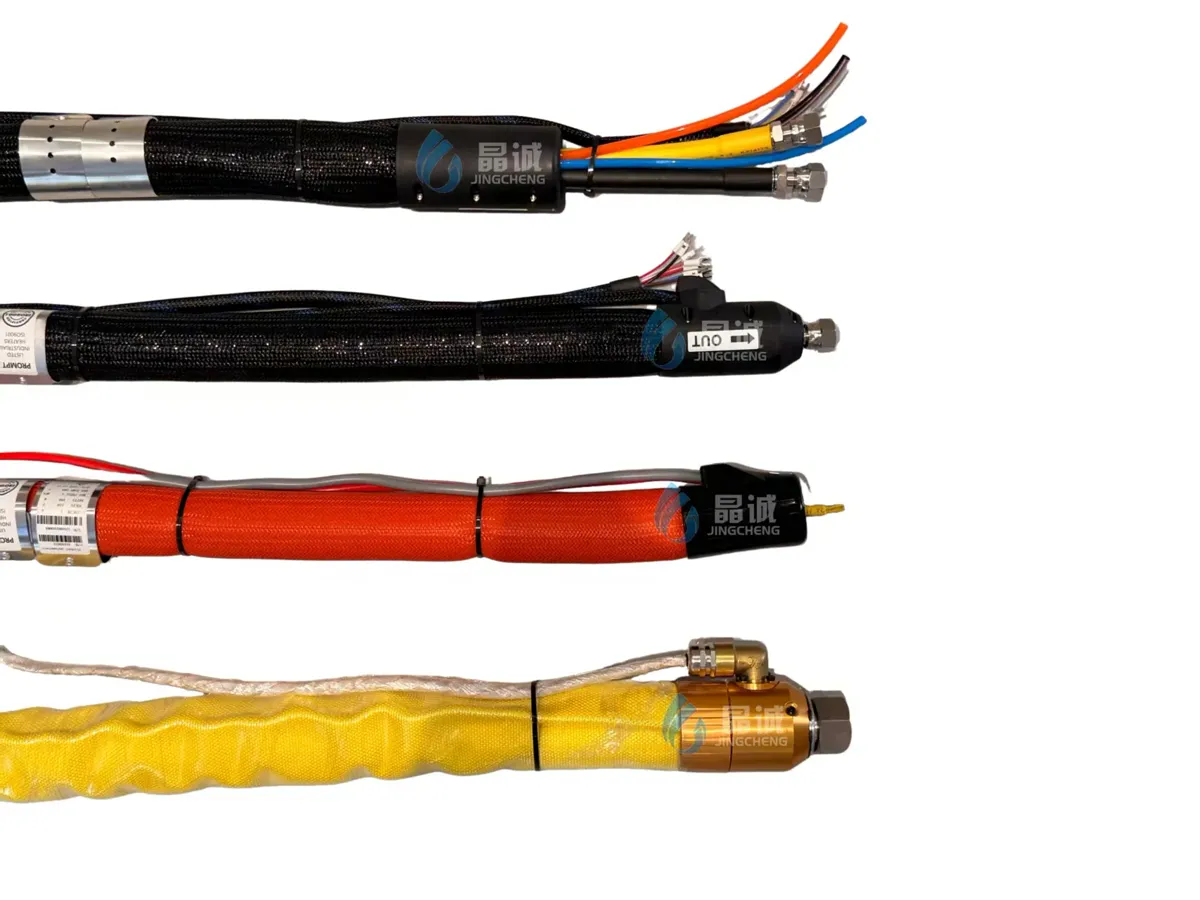
What a hot melt hose does on the machine
Jingcheng's 2025 electrically heated hose catalog lists the heated hose for hot melt adhesive as a high-temperature, low-pressure product for hot melt and PUR adhesive machines, with a maximum heat resistance of 230 °C (446 °F) and higher temperatures on request.
The task of the hose is thermal. Adhesive leaves the melter at its setpoint and loses heat through the hose wall for the whole length of the run. Insulation slows that loss but cannot stop it, and a long run on a cold shop floor loses more than a short one. The hose therefore carries its own heater along the length, and the controller uses the hose sensor to hold the adhesive at the gun close to the tank temperature.
The adhesive also has to reach the gun at a usable viscosity. Hot melt adhesives thicken as they cool, so a hose that runs a few degrees low still pumps, but the bead at the nozzle changes, open time shortens and the bond suffers. Stability along the hose matters as much as the setpoint.
How a Jingcheng hot melt hose is built
Jingcheng's catalog describes each heated hose as an inner tube, a heating layer and an insulation layer assembled into one hose and fitted at both ends. It also states how the hot melt hose is made: on fully automated equipment instead of by hand, replacing the manual winding the catalog describes as previous practice. Even winding keeps the pitch and tension of the heating layer consistent from hose to hose, which is what lets the temperature behaviour repeat from one order to the next.
Inner tube: B, TB, T or X
The inner tube is the only part of the assembly that touches the adhesive, and in the Jingcheng model code it is a field of its own.
| Code | Inner tube | On a hot melt line |
|---|---|---|
| B | Stainless-steel corrugated tube | A metal flow path that takes heat well and tolerates a tight routing bend. The corrugations leave a rippled bore, which is worth weighing where the adhesive is purged between colours or grades. |
| TB | PTFE hose with stainless-steel braid | An inert bore with a braid over it. The braid carries pressure and shields the tube where the hose is clipped to a machine frame or pulled through a guard. |
| T | PTFE hose | An inert bore for adhesives that would cling to or react with a metal wall, and where a smooth, cleanable flow path matters. |
| X | Special material | An inner tube in another material when the adhesive or the cleaning routine rules out the three above. |
Where the inner tube is PTFE, its material limits are documented apart from the finished hose. Jingcheng's PTFE hose brochure rates the smooth-bore tube, JCC-00000, from −70 °C to +260 °C (−94 °F to +500 °F); the constructions are compared in the PTFE hose construction guide.
Heating layer and insulation
Jingcheng's catalog describes the heating layer as uniformly braided heating elements, wound so that temperature differences along the inner wall stay small, and the insulation as a high-insulation-efficiency material selected with the surface temperature of the finished hose in mind. An even heating layer keeps the adhesive at one viscosity from melter to gun; insulation sized around the outside surface temperature keeps the outer cover cooler to the touch and limits heat lost to the room.
Temperature: what 230 °C covers
Most products in Jingcheng's heated hose range, including the hot melt hose, are rated to a maximum working temperature of 230 °C (446 °F) as standard, and the catalog states that higher temperatures are built on request. Common hot melt adhesives run well below that ceiling, which leaves headroom for a high-temperature grade or a hotter melt.
The rating belongs to the finished assembly, not the inner tube alone. A PTFE inner tube is rated to +260 °C (+500 °F) as a material, while the hose carrying it has its own maximum, set by the heater, the insulation and the end connections. Close to the ceiling, setpoint, ambient conditions and length are reviewed together, and the figure that applies is the one on the drawing.
Jingcheng's catalog gives a standard operating environment for the heated hose range: ambient −40 °C to +55 °C (−40 °F to +131 °F), relative humidity of 85 % or less, atmospheric pressure 86–106 kPa, and a supply from 12 V to 380 V AC. The surroundings must be free of gases that corrode metal or damage insulation, free of conductive media and free of severe mould; anything outside that envelope is a custom build.
Hot melt and PUR: what changes
Jingcheng's catalog lists one hot melt adhesive hose for both hot melt and PUR adhesive machines. The difference sits in the process, not the catalog row; the notes below are general engineering practice, not Jingcheng specifications.
A standard hot melt adhesive, typically an EVA or polyolefin grade, softens and sets reversibly. Its main enemy in a hose is time at temperature: adhesive held hot for hours or days can oxidise or form a skin against the wall. The usual discipline is to run the lowest setpoint that gives a usable viscosity and to bring the line down when it is idle for long periods. A hose longer or hotter than the job needs adds to that exposure without adding anything to the bond.
A PUR hot melt is moisture-curing. The adhesive reacts with water in the air, and once cured it cannot be melted again, so a PUR line is managed around exposure rather than heat alone. The system is kept closed, dwell time at temperature is kept short, the hose is purged before a shutdown, and the setpoint is held steady, because a cold section slows the flow and lengthens the residence time of everything behind it. Temperature uniformity along the hose also counts for more than it does with a standard hot melt, since a cooler wall section is where adhesive starts to build up.
Both adhesives lead to the same conclusion for the hose: length, bore and power per metre are chosen so the adhesive reaches the gun at the right viscosity, not so the hose reaches a number on a dial.
Bore, length and power per metre
Jingcheng's order form lists inner diameters of Φ8, Φ12, Φ16, Φ19 and Φ25 mm, or other on request. The bore sets how much adhesive sits in the hose, how much pressure the pump needs and how quickly a grade change clears. A narrow bore holds less adhesive and responds faster; a wider bore needs less pressure for a given flow and tolerates a thicker adhesive.
Hose lengths on the same form are 3 m, 4.5 m, 5 m, 6 m and 10 m (about 9.8 to 32.8 ft), or other. Heater output is rated per metre, with 110, 150, 170 and 200 W/m standard and other ratings made to order. Total heater load is the power per metre times the length: a 10 m hose at 200 W/m draws 2,000 W, which the supply circuit and controller have to carry.
Configuration options for a hot melt hose
Jingcheng's 2025 catalog uses one order form for the whole heated hose range, and the hot melt hose is specified from it. The values are the catalog's own; the right-hand column gives what each one changes on an adhesive line.
| Option | Values listed in the catalog | What it changes on a hot melt line |
|---|---|---|
| Rated voltage | 380 Vac, 220 Vac, 110 Vac, 12 Vdc, other | The heater is built for one supply. The choice follows the machine's cabinet and the total heater load. |
| Temperature sensor | Type J, type K, Ni120, PT100, PT1000, other | Has to match the input of the controller or melter that reads it. The type is recorded in the wiring table. |
| Hose length | 3 m, 4.5 m, 5 m, 6 m, 10 m (about 9.8–32.8 ft), other | Sets the total heater load and the heat loss the hose must make up. Route length and slack both count. |
| Inner diameter | Φ8, Φ12, Φ16, Φ19, Φ25 mm (about 5/16–1 inch), other | Sets how much adhesive is held in the line, the pump pressure needed and how fast a grade change clears. |
| Maximum working temperature | Other, as specified; the hot melt hose is rated 230 °C (446 °F) as standard, higher on request | Drives the heater, insulation and sensor selection. State the hottest the process will run, not the normal setpoint alone. |
| Working pressure | 4, 10, 20, 35 MPa (40, 100, 200, 350 bar; about 580–5,076 psi), other | Sets reinforcement and fittings. The form spans the whole heated hose range, so state the actual pump pressure and let engineering confirm the class. |
| Rated power | 110, 150, 170, 200 W/m, other | Sets how fast the hose heats from cold and how well it holds setpoint on a long run. |
| End fittings | US, British or metric threads, other | Each end is specified separately, and the machine connection at the melter and at the gun is often different. |
| Wiring | Pin table recorded for the melter end and the gun end | Pin number, wire colour and function are written down for both ends, so a replacement connects the same way as the original. |
How a Jingcheng hot melt hose is made and checked
Jingcheng builds to a confirmed specification. The catalog sets out six steps: inquiry by phone, fax or web form; specification confirmation, in which Jingcheng proposes the specification it considers best as the basis for a quotation; a quotation confirmed by the customer with a purchase order; production to that specification; inspection and packing; and shipment to the customer's address.
The catalog describes quality assurance on three levels: testing by an outside agency as routine practice, self-inspection, and supplier inspection. Inspection and test requirements for an order are agreed during the engineering review and recorded there. The business policies set out how ratings, drawings and order approval are handled.
Common mistakes when ordering a hot melt hose
- Ordering from the machine name instead of the connection drawing. A hot melt hose is made to the port at the melter and the port at the gun. A drawing or clear photo of both ends, with the electrical connector, settles more than any description.
- Using the normal setpoint as the temperature rating. Start-up, a hot grade or a purge cycle can run hotter, so the maximum on the order should cover the hottest case.
- Measuring the length along the floor. The route bends around frames and needs slack at the gun. Add the real routing length, and remember that heater load grows with every metre.
- Choosing the sensor by what is available. A sensor that does not match the controller input gives a wrong reading or none. Copy the type from the existing hose label or the melter's specification.
- Keeping one power rating for every length. The same watts per metre on a 3 m and a 10 m hose do not give the same heat-up time or the same margin against loss.
- Leaving the PUR routine out of the specification. Purge practice, dwell time and shutdown routine decide whether the hose and the adhesive survive, so say that the line runs PUR before the hose is configured.
What to send for a hot melt hose quotation
These details are enough for an engineering review to begin:
- The adhesive type and grade, and whether it is a standard hot melt or a PUR.
- The setpoint, the hottest the hose will see, and the ambient temperature around the route.
- The pump pressure and anything that raises it, such as a valve closing at the gun.
- The bore the process needs, and the routing length with the tightest bend.
- The supply available at the machine, the sensor type its controller reads, and the connector at each end.
- A drawing or photo of the melter port, the gun port and the electrical connector.
- Quantity, any documents required, and the date the hose is needed.
The heated hose specification checklist sets out the full set of inputs in the order our engineers review them, including the model code field by field. The hot melt hose sits in the heated low-pressure hose family on the products page, alongside the other applications built on the same order form, including the heated sample line.
Frequently asked questions
What temperature is a hot melt hose rated to?
Jingcheng's hot melt hose is rated to a maximum working temperature of 230 °C (446 °F) as standard. Higher temperatures are built on request; the rating that applies is confirmed in the quotation and drawing.
Is a PUR hot melt hose different from a standard hot melt hose?
Jingcheng's catalog lists the same hot melt adhesive hose for hot melt and PUR adhesive machines, built from the same options. The practical difference is in how the line is run: PUR is moisture-curing, so dwell time, purging and shutdown routine are managed more tightly, and steady temperature along the hose matters more.
Which inner tube should I choose?
Code B is a stainless-steel corrugated tube, code TB is a PTFE hose with stainless-steel braid, code T is a PTFE hose, and code X is a special material. The choice follows the adhesive, the cleaning routine and the pressure; send the adhesive details and our engineers will confirm the tube in the drawing.
Can Jingcheng supply the temperature controller with the hose?
Yes. The catalog lists PID controllers with SSR or thyristor output, optional waterproof enclosures and volt or ammeter displays, and separate control boxes with two, three or more channels. Many hot melt machines instead use the melter's own controller, so the hose sensor has to match its input.
Can a Jingcheng hose replace the hose on an existing machine?
Jingcheng builds each hose to the connection and electrical interface confirmed in the drawing. Send the old hose's label, the pin table from both ends and photos of the fittings, and the replacement is specified from those, not from a machine name.
Send your hot melt hose details
Tell us the adhesive, the setpoint, the pump pressure and the connection at each end, and our engineers will review the configuration and come back with a specification and quotation.
Request a hot melt hose quotationSoren Miles, Marketing Manager | JC
Mobile: +86 13087118553 / +1 (757) 733-8947
WhatsApp: +86 185 6950 4906
Email: soren.miles@shenzhenjingcheng.com
Company (Canada): JINCHEN ELECTRIC TRACING CO., LTD.
Company (Hong Kong, China): HK JINGCHENG HIGH TECH CO., Ltd
Company (China): SHENZHEN JINGCHENG HIGH TECH CO., Ltd / Jingcheng Fluoroplastic (Guangdong) Co., Ltd.
Website: https://www.jingchenghose.com | https://www.electricallyheatedhose.com
Factory address: No. 7 Qiguan East Road, Torch Development Zone, Zhongshan City (Jingcheng Industrial Park)
Sources: Jingcheng 2025 electrically heated hose catalog (hot melt adhesive hose page, heated hose order form, model code, operating environment, controller and quotation pages), the Jingcheng PTFE hose brochure for the PTFE material rating, and our published business policies. Notes on adhesive behaviour, dwell time and purging are general engineering practice, not product ratings. Final ratings for each project are confirmed in the quotation and drawing.