
PTFE tubing leaking at the fitting is almost never a faulty tube. A bare PTFE tube that passed a leak test can be weeping at the ferrule a week later, because the polymer creeps out from under the clamp until the joint loses its preload. Here is how I diagnose it.
The symptom: tight on install, wet a week later
A typical version of the call: a bare PTFE tube on a dosing pump outlet held its test pressure on the bench. Ten days later there is a wet ring under the nut and a crust of dried product around the ferrule. The tube has not split, nothing was touched, and the operator assumes it is porous.
It is not porous. PTFE is one of the least permeable plastics you can put in a line. What failed is the joint, and it was already failing on day one.
There is a second version with a temperature in it: dry at room temperature, weeping at 70 or 80 °C, sealing again when the line cools. That is a diagnostic gift, and it points at a different mechanism from a cold leak that never stops.
If you want the numbers for the tube itself, the smooth bore PTFE hose page has the full per-size table. This article is about the joint at the end of it.
Why PTFE joints let go
What follows is general engineering knowledge about PTFE and compression fittings, not test data from our line. Fitting makers' procedures win over anything here.
Cold flow under the ferrule
PTFE flows plastically under sustained load. A ferrule biting into the wall puts a high local stress on the polymer. Over hours and days the material under the bite migrates away from that point, the wall thins, the ring sinks deeper, and the clamp load holding the seal relaxes with it.
That is why a joint can pass a pressure test and fail a week later untouched: it was not over-pressurised, it lost preload.
Heat cycles that ratchet the joint loose
PTFE expands several times more than brass or stainless steel over the same rise. Take the assembly from 20 to 80 °C and the tube grows more than the fitting body. At a clamped joint that difference goes into the seal: the tube pushes on the ferrule, the ring takes a new position, and on cool-down the tube shrinks back further than the metal.
Repeat that a few times a week and the joint walks loose. A joint that only leaks warm is telling you the clamp load is nearly gone, not that temperature is the problem.
The cut end
A compression joint seals on the outside diameter, and in some designs on a square-cut end face. A ragged or angled cut, or a burr on the OD, gives the ferrule a poor surface to bite and a path for the medium to creep along. A tube not fully home leaves too little length inside the fitting for the ring to seat. A hacksaw cut with a burr left on can hold for a shift and then weep; the fix is ten seconds with a proper cutter.
Nominal size is not the tube OD
This one catches experienced people. Compression fittings are sized to the tube's outside diameter, but a PTFE tube's nominal size is a bore designation. On JCC-00000 the 1/4" size is 6.8 mm ID and 8.8 mm OD (±0.2 mm), so a fitting picked off the shelf as "1/4 inch" (made for a 6.35 mm OD tube) or as "8 mm" or "10 mm" metric is the wrong part. A small mismatch is the dangerous one: the ring deforms enough to pass a quick test, then under-clamps in service. I caliper the OD and compare it with the OD in the JCC-00000 size table and the fitting maker's tube size before I blame the tube.
Over-tightening
When a PTFE joint weeps, the instinct is another quarter turn, and that often makes it worse. Over-tightening necks or cuts the wall under the ferrule, removing the thickness carrying the seal and sometimes starting a split later. It also speeds up cold flow.
Fitting makers publish a tightening procedure for a reason. Follow theirs, including any hand-tight-then-torque instruction, and I would not add "just a bit more" for luck.
Side load and a kink at the exit
A tube that leaves the fitting under tension, or bends sharply near the nut, puts a constant bending moment on the joint. PTFE creeps faster under steady load than intermittent, so a poorly supported run loses preload quicker. A kink at the exit points at routing, not the fitting.
Running above the size rating, or under vacuum
JCC-00000 is a bare tube, and nothing but the wall holds the pressure. The rating falls steeply with bore: 1.73 MPa (251 psi) at the 1/4" size, 0.40 MPa (58 psi) at 2". A 2" line at 5 bar is over its limit, and the joint usually fails first.
Vacuum is the other trap. The series has no published vacuum rating, so if the line is ever pulled down the tube can collapse or the joint can draw air, and no amount of re-tightening fixes a construction that was never designed for it.
What I check first, in order
This is the order I work through on site, before changing any parts.
- Where exactly is it wet? Under the nut, at the tube exit, or along the body. At the exit points at the ferrule and the cut; along the body means a wall fault, which is rare and usually shows as a split or a bulge.
- Measure the tube OD. Caliper, not the label, against the tube size the fitting is made for. A fitting chosen by nominal size rather than real OD is the classic silent failure.
- Paint-mark the nut and the tube, then run one heat cycle. If the marks move relative to each other, the joint is creeping and you have your mechanism.
- Cut 50 mm off and look at the wall. A necked wall under the old ferrule position confirms over-tightening; a ragged or angled end face confirms the cut.
- Check the routing. Is the tube pulling sideways at the nut, or kinked within 100 mm? Add a clamp and re-test before changing anything else.
- Put a gauge at the joint, not the pump. A gauge on the discharge misses the pressure drop and pulsation the joint sees.
- Take the temperature at the fitting. A hot-only leak is the thermal cycling signature, and it changes the fix to a re-make with a support insert and a re-check after the first cycle.
| Symptom | Likely cause | First check |
|---|---|---|
| Dry at ambient, weeps when hot, seals when cold | Clamp load nearly gone; differential expansion over heat cycles | Paint-mark the nut and tube, run one cycle, look for movement |
| Held on install, wet after days with nothing touched | Cold flow under the ferrule | Cut 50 mm back and inspect the wall under the old ring position |
| Tube pulls out of the fitting | Wall necked or cut by over-tightening; tube not fully seated | Measure remaining wall thickness; check insertion depth against the fitting |
| Leak at the tube exit only, no leak at the thread | Ragged or angled cut, or a burr on the OD | Re-cut square with a tube cutter and deburr |
| New joint leaks immediately | Fitting sized to the nominal size or the wrong unit system, not the real tube OD | Caliper the OD against the tube size the fitting is made for |
The fix, in the order that works
Most are cheap, and none need a new tube unless the wall is damaged. I would do them in this order.
1. Cut square and deburr
Use a tube cutter made for plastic, not a knife or hacksaw. The end must be square to the axis, with no burr on the OD and no swarf in the bore.
2. Add a support insert
An internal stiffener inside the tube end gives the ferrule something to compress against instead of an unsupported wall. On thin-wall or large-bore tube this is the biggest single improvement. Ask your fitting supplier for the insert matched to the series; its length and wall suit the fitting, not just the tube.
3. Use the right ferrule for PTFE
Fittings designed for nylon or rigid plastic are not automatically right for PTFE. The material is softer and creeps more, and makers who support PTFE publish their own ring and procedure. Where several ferrule designs exist, the data sheet decides, not a rule of thumb.
4. Tighten to the maker's procedure, then re-check once
Follow the published method exactly, then, as general practice, re-check the joint after the first full heat cycle and after the first week, at whatever temperature and interval the maker specifies. I would not borrow a torque figure from another fitting family; it is worse than no number.
5. Support the tube close to the fitting
Clamp the tube close to the nut so the joint does not carry the bending load of the run. On a moving machine, leave a service loop rather than pulling the tube straight. That is often the difference between a year and a month.
6. Step up when the duty demands it
If the line runs above the bare tube's working pressure for its size, sees water hammer or pump pulsation, or is ever pulled under vacuum, no joint procedure will save it. A single-braid build such as JCC-01100 puts a 304 stainless braid over the same PTFE bore and takes the pressure load off the wall. That is a product decision, not a fitting fix.
What JCC-00000 actually is
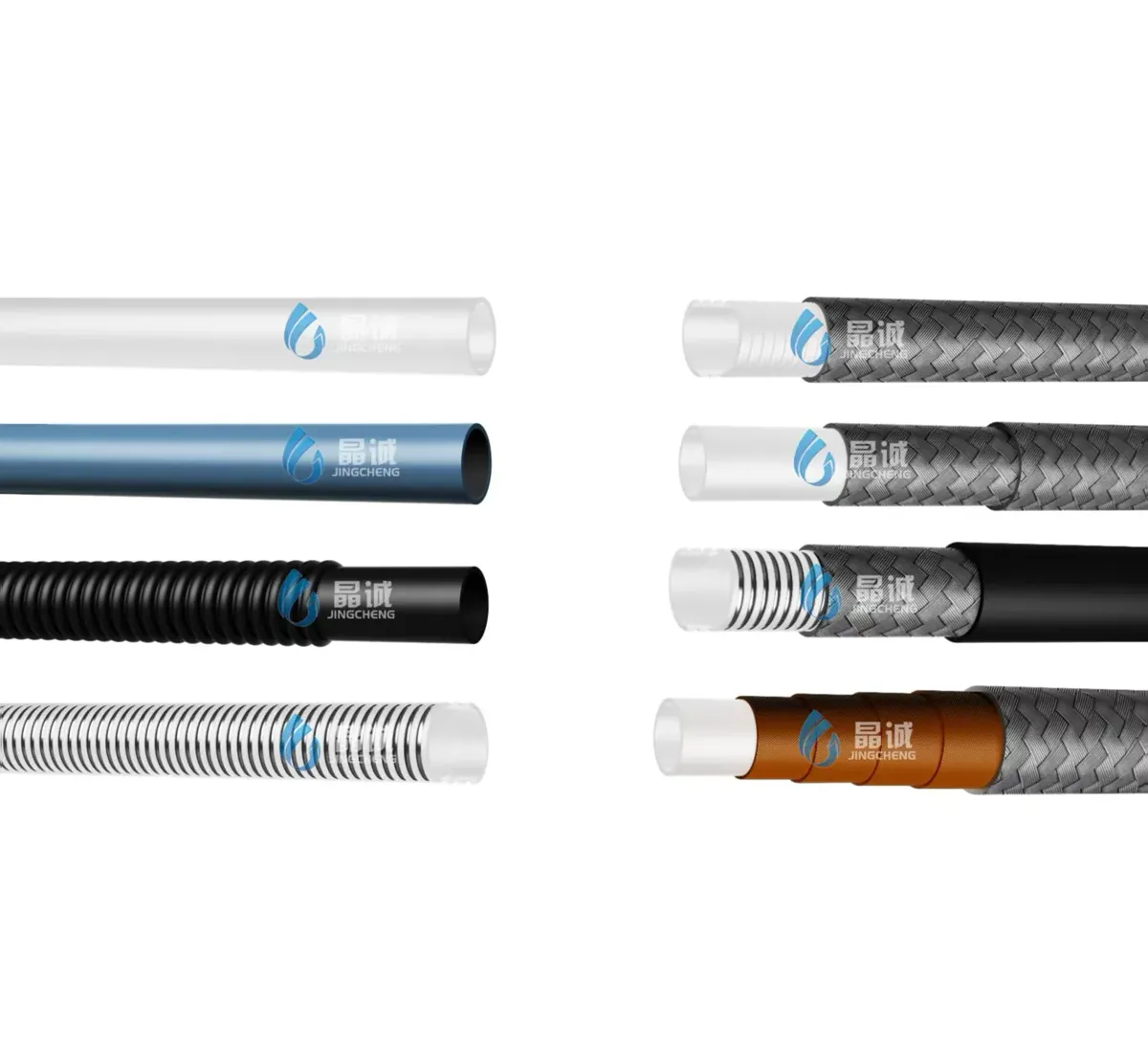
JCC-00000 is the bare tube in our PTFE range. PTFE resin is extruded into a tube, dried, sintered at high temperature and shaped to final dimensions. The wall is solid PTFE, 1.0 to 2.0 mm depending on size, with no braid, no liner and no corrugation, so the bore has no corrugations to hold liquid.
The catalog range is 5/32" to 2", with IDs from 4.5 to 51 mm, rated −70 to +260 °C (−94 to +500 °F). It carries strong acids and alkalis, oxidizers, reducing agents, organic solvents and high-purity chemicals, where PTFE's chemical resistance is the point.
What it is not: a pressure hose. With no reinforcement, no vacuum rating is published and there is no braid to lean on. If your line needs either, say so at the enquiry stage. The per-size specification table on the product page lists every model with its ID, OD, wall, working and burst pressure and bend radius, so you can check your size before ordering.
Common mistakes
- Adding another quarter turn. It necks the wall and speeds up cold flow. Re-make the joint.
- Blaming the tube for a fitting problem. PTFE is not porous; a wet ring at the nut is a joint issue until proven otherwise.
- Buying the fitting by nominal size. The 1/4" JCC-00000 tube is 8.8 mm OD, not 6.35 mm. Match the fitting to the real OD.
- Skipping the re-check after the first heat cycle. The first cycle is where the joint usually moves most.
- Running a big bore at small-bore pressure. 2" tube is rated 0.40 MPa (58 psi). A 5 bar line is over its limit before the joint is even tightened.
- Using it under vacuum. No published rating on this series; ask for a different construction.
What to send for a quotation
For a tube-only order the list is short, and getting it right first time saves a week of emails:
- Bore and unit system. Nominal size, and whether it is inch or metric. If you know the OD and wall, send those too.
- Fitting type and part number. The maker's series or part number, or a photo of the connector. With the part number we do not have to guess the thread standard.
- Medium and concentration. This decides whether bare PTFE is enough.
- Temperature, including cleaning peaks. Steam-in-place or a hot flush can sit well above the running temperature and matters more than the setpoint.
- Pressure or vacuum. Working pressure, and whether the line is ever pulled under vacuum.
- Length and quantity for the first order, plus expected annual use.
- Routing notes. Tight bends, movement, or a run needing support.
Still deciding which construction suits the line? The PTFE hose selection guide works through smooth bore, convoluted and braided builds by bore profile and pressure.
Frequently asked questions
Can I stop a PTFE joint leaking by tightening it more?
Usually not, and often it makes things worse. Extra torque necks the wall under the ferrule and speeds up cold flow. Cut the end back and re-make it with a support insert where the fitting allows one.
Why does my PTFE joint only leak when the line is hot?
Because PTFE expands more than the metal fitting over the same rise. Each heat-up lets the tube move against the ferrule and each cool-down leaves the joint looser. A hot-only leak means the clamp load is nearly gone, so re-make the joint and re-check after the first cycle.
Will a 1/4 inch tube fitting fit 1/4" PTFE tube?
Not necessarily. Tube fittings are sized to outside diameter, while the PTFE tube size is a bore designation: the 1/4" JCC-00000 size is 6.8 mm ID and 8.8 mm OD. Caliper the tube OD and choose the fitting for that diameter, or send us the fitting part number and we match the tube to it.
How often should I re-check a PTFE compression joint?
As general practice, once after the first full heat cycle and once after the first week. After that, follow the maker's maintenance interval and re-check whenever the line is disturbed.
Does JCC-00000 work under vacuum?
There is no published vacuum rating for this series, so I would not use it in vacuum service. A convoluted or braided build with a spring or braid is the right answer there.
Send your tube and fitting details
Tell us the bore and unit system, the fitting part number, the medium, the temperature including cleaning peaks, and the pressure or vacuum. We will confirm the size and the joint details on a drawing before production.
Request a PTFE tube quotationSoren Miles, Marketing Manager | JC
Mobile: +86 13087118553 / +1 (757) 733-8947
WhatsApp: +86 185 6950 4906
Email: soren.miles@shenzhenjingcheng.com
Company (Canada): JINCHEN ELECTRIC TRACING CO., LTD.
Company (Hong Kong, China): HK JINGCHENG HIGH TECH CO., Ltd
Company (China): SHENZHEN JINGCHENG HIGH TECH CO., Ltd / Jingcheng Fluoroplastic (Guangdong) Co., Ltd.
Website: https://www.jingchenghose.com | https://www.electricallyheatedhose.com
Factory address: No. 7 Qiguan East Road, Torch Development Zone, Zhongshan City (Jingcheng Industrial Park)
Sources: Jingcheng PTFE hose brochure (p04, JCC-00000 smooth bore PTFE tube) and our published business policies. Notes on cold flow, thermal expansion, cutting and tightening are general engineering practice, not Jingcheng test data; follow the fitting manufacturer's published procedure. Final ratings for each project are confirmed in the quotation and drawing.