
A heated hose for polyurethane is half of your metering loop. When a 2K machine doses a ratio that drifts between the morning shift and the afternoon, or a laminator coat weight creeps up, the hose temperature is the first thing I check. Here is the order I work in.
The symptom: the ratio moves during the shift
The call usually comes in two forms. The first is from a laminating line: the film is tacky or slightly under-cured for the first hour, then runs fine until lunch, then the operator has to trim the coat weight back again in the afternoon. Nobody has touched the pump. The second is from a 2K polyurethane dispenser: the meter says 1:1 and the operator believes it, but the parts come out soft, or hard and brittle, and the reject rate is worse on Monday morning than on Thursday.
By the time I am called, both crews have already changed the pump seals, cleaned the mixer and checked the meter calibration. Right instinct, wrong place: the thing that changed is not in the pump. It is in the hose.
Why hose temperature changes the ratio
General fluid behaviour, not a Jingcheng figure: viscosity falls as temperature rises. A polyol and an isocyanate do not follow the same curve, so a 10 °C difference between the two feed lines does not shift both components equally. Volumetric pumps push a fixed swept volume per stroke, but what arrives at the mixer also depends on how hard it is to push through the hose, the fittings and the check valves. Warm the A line and it flows a little more freely; leave the B line cold and the ratio leans towards A.
Five causes we keep finding, in rough order of frequency:
- The hose was never warmed up. The machine runs at 07:00, the controller is on, and the hose is still sitting in a cold plant. A thermostat reading at the sensor does not mean the material 6 m away is at temperature, so the first 20 minutes of production are a different process.
- One component hose is set differently from the other. Someone raised the B setpoint to stop a cold plug months ago and nobody wrote it down, so the machine has been dosing a shifted ratio ever since.
- The sensor is not where the problem is. If the thermocouple sits under the insulation near the connector while the rest of the hose is in a cold draught, the controller holds a number that has little to do with the material in the bore.
- The setpoint is too high. This is the mistake that looks like the fix. Chasing a cold line by winding the controller up shortens pot life, and on a two-component system it can start the reaction inside the hose or the static mixer. A gelled dead leg after the mixer is a classic result.
- Dead legs after the mixer. The short run between the mixer and the die or the gun stays hot with mixed material sitting in it. On a stop, that slug cures. Restart pushes it through and you get a streak, a plug or a pressure spike that the operator reads as a ratio fault.
Solvent-free laminating lines get a slower version of the same thing. The adhesive runs at the temperature its maker sets in the data sheet, and coat weight follows viscosity at the nip. If the hose runs cool, the operator raises the coat weight to make the film look right, and the line uses more adhesive all shift.
What I would check first, in this order
- Feel both hoses. Hand on the outside cover at the same distance from each pump, on both lines, before anything is switched on. Warm is not the same as warm enough, but a clearly cooler hose is the answer half the time, and it takes ten seconds.
- Read both controllers, then prove them. Note the setpoint and the actual reading on the A and B channels. Then put a surface probe or a contact thermometer on the hose cover at three points: near the pump, mid-length, near the mixer. A drop of more than a few degrees along the length means the sensor is not seeing the hose, or the hose is under-insulated for the room.
- Look at when it drifts. If the fault tracks the ambient temperature, the shift start or the plant heating coming on, you are looking at heat loss, not metering. If it tracks production stops, look at the dead leg and the mixer.
- Confirm both hoses are the same build. Different length, different power per metre, or a replacement hose ordered to a different specification will heat differently even at the same setpoint. Check the model code on both.
- Check the sensor type against the controller input. A type J thermocouple on an input configured for type K reads wrong, and it reads wrong in a way that looks like a stable but offset temperature. This is the one that wastes a full day, because everything looks plausible on the display.
- Only then touch the pump. If both hoses match, both are at temperature along their full length, and the ratio still moves, the hose is not your problem.
| What you see | Likely cause | First check |
|---|---|---|
| Soft or tacky result for the first hour of the shift, fine by mid-morning | One component hose cold after a cold night, or both hoses under-heated at start-up | Feel both hoses at the same distance from the pump before production starts |
| Meter reads correct but coat weight or part weight creeps up during the day | A and B hoses running at different temperatures, so viscosity and flow no longer match | Compare both setpoints and both actual readings, then check both hoses with a surface probe |
| Plug or streak a few centimetres after the mixer, usually after a stop | Mixed material sitting in a hot dead leg, or setpoint high enough to start the reaction in the line | Inspect the static mixer and the short hose between mixer and die, and review the setpoint |
| A replacement hose doses differently from the one it replaced | Different length, different power per metre, or a sensor in a different position | Compare the model code and length on both hoses, not just the inner diameter |
The fix, in the order that costs least
I start with warm-up time. Give the hoses long enough to reach temperature along their full length, not just at the sensor; bringing 6 m of hose up takes far longer than bringing a thermocouple up. Many lines solve the morning problem with a timer on the hose heat, switched on an hour before the first batch.
Second, I match the two lines. Put A and B on the same controller or the same multi-channel box, so one setpoint drives both: same length, same power per metre, sensors in the same position on each hose. That is why we build multi-channel boxes with two or three separate PID loops in one enclosure.
Third, if the hose is under-insulated for the room, change the hose rather than the setpoint. A hose running hot to compensate for heat loss works hard all shift, and the material at the wall is hotter than the material in the middle of the bore, which is worse than a cold hose because you cannot see it in the reading.
Last, I deal with the dead leg: shorten the run between mixer and die, purge on stop, or both. No hose temperature saves a slug of mixed material that has been sitting in a hot fitting for twenty minutes.
What the Jingcheng polyurethane and laminator hoses are
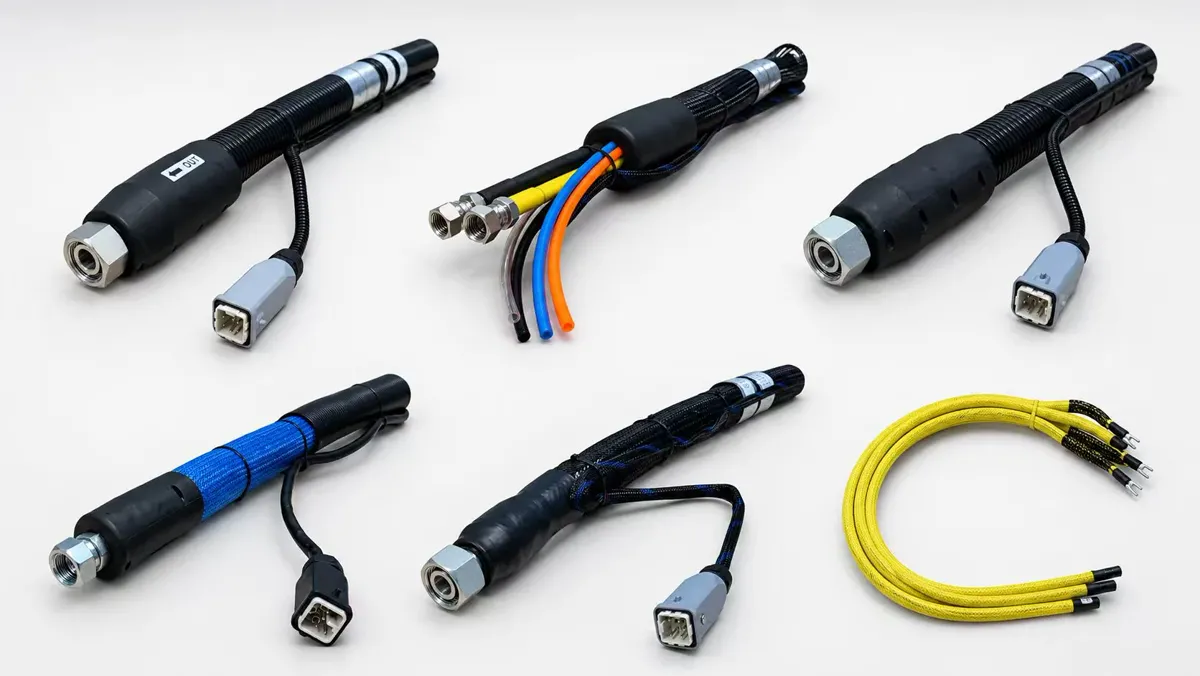
The polyurethane hose is built on our T-STD construction, rated to 180 °C, and is used on laminators and on one- and two-component polyurethane equipment. The solvent-free laminator hose is the same T-STD build taken to 230 °C (446 °F), in 1/4" to 1/2" bore, for imported and domestic solvent-free laminating machines. Both sit in the low-temperature low-pressure heated hose family, which is an application grouping in our catalog rather than a temperature limit.
The build, in plain terms: an inner tube that carries the component, a heating layer of uniformly braided heating elements, insulation, and an outer cover. We braid the heating layer evenly to keep the temperature difference along the inner wall small, which matters more on a PU line than on a water line, because it is the wall temperature that sets the viscosity of the material touching it. The outer cover is chosen for the surface temperature you can live with in the plant.
Options on our order form: supply at 380, 220 or 110 V AC, or 12 V DC; type J or K thermocouple, Ni120, PT100 or PT1000 sensor; inner diameter from 8 to 25 mm; rated power from 110 to 200 W per metre; lengths of 3, 4.5, 5, 6 or 10 m, or to your drawing. End fittings are made to US, imperial or metric threads as specified. Ambient range is -40 °C to +55 °C (-40 °F to 131 °F) at up to 85 % relative humidity, with no conductive dust or corrosive gas around the hose; anything outside that we would rather discuss at quotation than after installation.
Control is a PID controller with SSR output, or PID with thyristor output where the load calls for it. Separate control boxes are available with two, three or more channels, which is the usual way to run an A line and a B line from one enclosure, plus a third channel for a gun or a short heated run. Options include a stainless outer layer, a drip-proof silicone coating rated to 200 °C and not waterproof, and a built-in thermocouple or thermostat.
Operating notes for PU and laminating lines
Warm up before you run. Hose heat on before material, material circulating before production. The warm-up is not complete when the display reaches setpoint; it is complete when the far end of the hose is at temperature too.
Match both component hoses. Same length, same power, same setpoint, sensors in the same place. If one hose has to be replaced, replace it to the same specification, not to whatever is on the shelf.
Purge before a stop you can predict. If the line is going down for a break, purge the mixed material out of the mixer and the short run after it. Cured material in a hot fitting is the most common cause of a Monday morning plug.
Never heat mixed material in the hose. A heated hose holds temperature; it does not extend pot life. Once the two components are together, heat only shortens the time you have.
Do not chase a cold spot with the setpoint. Find out why the hose is cold: sensor position, insulation, ambient, a damaged heating layer, a connector that has been pulled. Raising the number on the controller hides the cause and creates a new one.
Handle the hose like a hose. Do not twist it laterally when you install it, and do not bend it tighter than the assembly allows. A heating layer that has been strained shows up later as a cold section, which brings you back to the ratio drift you started with.
Common mistakes
- Setting A and B to different temperatures. It is almost always done to solve a local problem, and it almost always shifts the ratio.
- Reading the controller instead of the hose. The display tells you what the sensor sees. A probe on the cover tells you what the hose is doing.
- Fitting a type J sensor to a type K input. Stable, plausible, and wrong by a margin big enough to matter.
- Replacing one hose of a pair with a different build. Same bore, different power per metre, different behaviour.
- Raising the setpoint to fix a cold line. Shortens pot life, can start the reaction in the line, and hides the real fault.
- Forgetting the dead leg. The mixer and the short run after it are part of the heated system whether or not they are heated.
What to send for a quotation
For a PU or laminator hose we need the component or adhesive you are running, the temperature your supplier's data sheet calls for, the bore you need, the length and routing, the supply voltage available at the machine, the sensor type your controller expects, and the end fittings at each end. If you are replacing a hose, the model code off the old one saves a round of questions. The full list is in our heated hose specification checklist. If you are running PUR hot melt rather than liquid PU, the hot melt hose page covers that material instead.
Frequently asked questions
What temperature should a polyurethane hose run at?
Set it from the material supplier's data sheet, not from the machine. The hose's job is to hold the component at the temperature the process needs. Our PU hose is rated to 180 °C, and the solvent-free laminator hose to 230 °C, but the working setpoint is normally well below the rating and is decided by the adhesive or resin you are running.
Can I run one component hose hotter to compensate for a cold line?
No, and this is the mistake that causes the most damage. Heating one side changes that side's viscosity and therefore the ratio. If the line is cold, fix the heat loss or the sensor position, and keep both component hoses matched.
Why does the ratio drift in the morning and settle later?
Because the plant is colder at 07:00 than at 11:00, and the hose takes time to bring its full length up to temperature. If the fault follows the ambient or the start of the shift, treat it as a warm-up and heat-loss problem before you touch the meter.
Do I need a separate controller for each component?
Not necessarily. A multi-channel control box with two or three PID channels runs the A line, the B line and a gun or short heated run from one enclosure, with an independent loop on each. What matters is that each channel has its own sensor on its own hose.
Send your PU or laminator hose details
Tell us the component, the temperature from the data sheet, the bore, the length and the sensor your controller expects, and we will come back with a specification and a quotation.
Request a polyurethane hose quotationSoren Miles, Marketing Manager | JC
Mobile: +86 13087118553 / +1 (757) 733-8947
WhatsApp: +86 185 6950 4906
Email: soren.miles@shenzhenjingcheng.com
Company (Canada): JINCHEN ELECTRIC TRACING CO., LTD.
Company (Hong Kong, China): HK JINGCHENG HIGH TECH CO., Ltd
Company (China): SHENZHEN JINGCHENG HIGH TECH CO., Ltd / Jingcheng Fluoroplastic (Guangdong) Co., Ltd.
Website: https://www.jingchenghose.com | https://www.electricallyheatedhose.com
Factory address: No. 7 Qiguan East Road, Torch Development Zone, Zhongshan City (Jingcheng Industrial Park)
Sources: Jingcheng 2025 electrically heated hose catalog (order form p4, low-temperature low-pressure product pages p10 and p11, controllers p15), and our published business policies. Notes on viscosity, pot life, moisture sensitivity and metering are general engineering practice, not Jingcheng test data. Final ratings for each project are confirmed in the quotation and drawing.