
A crack sealing hose carries hot, sticky rubberized sealant along a long boom and has to deliver it at the wand hot enough to flow. When the gun end runs cold, the hose is usually the messenger, not the culprit. Here is how we find the cold spot.
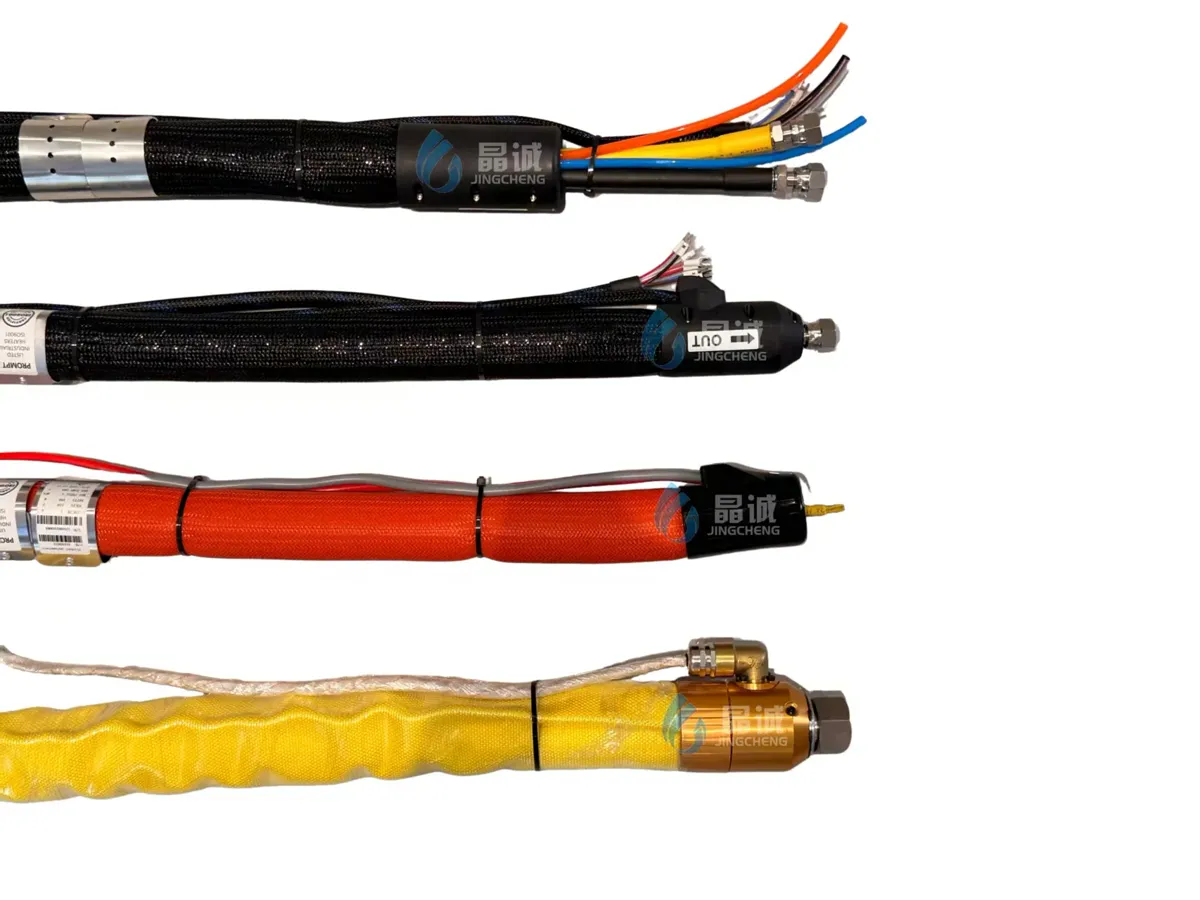
The symptom: a stiff plug at the wand, twenty minutes into the shift
A foreman calls it a plugged hose. What he describes is usually this: the melter is at temperature, the pump builds pressure, the trigger is pulled, and the first metre of bead comes out thin, lumpy, or not at all. Give it a minute and the flow comes back. Do it again after a ten-minute stop and the same thing happens. By the end of the week the hose has a soft spot near the gun.
That pattern narrows it fast. A hose that is cold all over gives a bad bead from the first metre; a worn pump lets the gauge sag. What this operator has is a local cold section between the melter outlet and the wand tip.
Rubberized crack sealant is unforgiving here. It is stiff at ambient temperature and flows only in a narrow band the sealant maker publishes on the data sheet, commonly around 170 °C to 200 °C for hot-pour road sealants. Push it through a section that has dropped thirty or forty degrees and it drags on the wall, pump pressure climbs, and the material there sets up. The next slug pushes part of it out and leaves the rest as a ring on the inner wall. That ring is where the hose eventually fails.
Three cold ends, three different causes
Every cold-gun complaint we get is one of three things. They feel the same from the seat and have different fixes, which is why we tell people not to swap the hose first.
1. The gun and the last half metre of hose
The wand end loses heat faster than any other part of the system. It is out in the air, it is handled, it rests on the road between passes, and on a long gun it is a metre of metal conducting heat away from the sealant. If the heating layer stops short of the fitting, that end drops first. On a short hand-held gun it is worse, because the gun body is a heat sink next to the nozzle.
The root cause is rarely a broken heater. It is usually a hose built for a bench application and then put on a road machine. The end hanging in the wind needs more watts per metre and better insulation than the middle of the run, and many generic hoses do not make that distinction. That is one of the first things we ask about.
2. The melter connection
This end gets overlooked because it is close to the heat source, so everyone assumes it is fine. In practice the first 200 to 300 mm from the melter outlet is often the coldest part of the assembly after a stop: the coupling is bolted to a hot manifold, but the hose wall behind it is not. Sealant cools in the coupling bore and forms a plug the pump breaks through on every restart. Operators learn to run the pump hard for a few seconds at start-up, which is the habit that shortens hose life.
3. Mid-length, in wind
On a highway job in November, a 6 m hose on an open boom sees wind on the cover for hours. The heating layer holds the inner wall, but the controller reads a sensor, not the sealant. If that sensor sits at the melter end, the far end can drift while the display stays perfect.
What I check first, in order
We do this with the machine running and a gloved hand. I start at the melter and work toward the gun, in this order, because the near end is cheaper to rule out.
- Touch test along the cover. Hand on the outside, moving in 300 mm steps. A section noticeably cooler than its neighbours is your cold spot. Do it after a five-minute stop, not while the pump runs, because flow masks the difference.
- Sensor position. Find where the thermocouple or RTD sits. If it is at the melter end of a long hose, the controller is blind to the gun end.
- Controller reading against a surface probe. A contact probe on the cover near the gun should read close to the setpoint. If the controller says 190 °C and the cover reads 150 °C, believe the probe.
- Power per metre against the duty. Heated hoses are commonly built in the 110 to 200 W/m range. A short indoor run and a 6 m hose dragged along a road in wind do not need the same number. Under-powered hose holds temperature at a standstill and loses it as soon as cold material moves.
- Supply voltage. Measure at the hose plug, not at the panel. A long lead on a generator can drop enough to cut heat output.
- Cover condition. A torn cover, a crushed section where the boom folds, or a wet sleeve all increase heat loss. Water in a damaged cover is worse than a tear, because it conducts.
- Routing at the gun. A hose bent hard right behind the fitting pinches the bore and stresses the crimp.
| What you see | Most likely cause | What to change |
|---|---|---|
| Hot at the melter, cool at the last 500 mm | Under-insulated or under-powered gun end | Hose built with a heated, insulated gun end; matching heated gun |
| Plug at the coupling after every stop | Cold coupling bore, no heat at the connection | Extend the heated section to the fitting; check the coupling is not the cold link |
| Good idle temperature, drops under flow | Not enough watts per metre for the length and weather | Higher W/m build or a shorter run with a heated gun |
| Controller steady, cover cool at the far end | Sensor at the wrong end of the hose | Move the sensor to the gun end, or use one controller channel per zone |
| Soft spot or weep near the gun fitting | Repeated dragging and tight bends at the crimp | Strain relief and a proper bend at the gun; replace before it leaks |
The fix, in the order that costs least
Start with what the crew can change tonight. Most of the time the first two items solve it and nobody buys anything.
- Stop leaving the gun on the road. A wand resting on cold asphalt loses heat through the nozzle for ten minutes at a time. A hook on the boom keeps it off the ground, and that alone fixes a surprising number of cold-gun complaints.
- Keep the material moving before it gels. After a stop, run a short purge or low-speed circulation. Do not use a pressure spike to break a plug loose; that is what kills crimps and bulges hose.
- Move the sensor to the end that matters. If the controller has a spare channel, put a second sensor at the gun end and control that zone separately. We supply boxes with two, three or more channels for exactly this reason, and they cost less than a week of lost production.
- Match the watts per metre to the run. Tell the builder the length, the ambient temperature you work in, whether the hose is on an open boom, and how long the machine sits between passes. That decides the power rating, and most buyers leave it out.
- Change the build if the first four do not hold. A hose with a heated gun end, an insulated cover and a reinforced inner tube is the durable answer for road work.
What the Jingcheng crack sealing hose is
Our crack sealing hose is a T-STD build: a PTFE inner tube, a uniformly braided heating layer along the full length, insulation sized with surface temperature in mind, and an outer cover that takes abrasion. We rate it to 230 °C (446 °F), which covers hot-pour rubberized sealants with margin and the upper end of the waterproofing range. Sizes run from 1/2" to 1" for crack sealing machines.
The part that matters in the field is the inner tube. Ours carries a proprietary inner-tube reinforcement, listed for this hose as longer service life. Road sealant is abrasive, it is pumped in slugs, and the hose spends its life being dragged, so that reinforcement holds the bore through that duty. It is not a pressure rating and we do not publish one here; if your machine runs high pressure, tell us the number and we will build and confirm against it.
We use the same construction for the waterproofing-equipment hose, the heated hose for waterproofing spray equipment, in 1/2" to 3/4". We have supplied waterproofing-equipment makers with that hose since 2013.
We also supply the parts that make the assembly work as a system:
- Heated spray guns. A 1.2 m long gun for road-maintenance and waterproofing spraying, and a short hand-held gun for close work. Both are customizable to the machine.
- Temperature controllers. PID control with SSR output or with thyristor output, depending on how the machine switches the load. Options include a waterproof enclosure, a volt/ammeter, and boxes with two, three or more channels.
- Hose options. A stainless outer layer where the cover takes real abrasion, a drip-proof silicone coating up to 200 °C (392 °F) that is splash-resistant but not waterproof, and a built-in thermocouple or thermostat.
- Electrical choices. 12 Vdc, 110, 220 or 380 Vac supply; Type J or Type K thermocouples, Ni120, PT100 or PT1000 sensors; bores from Φ8 to Φ25 mm.
The hose belongs to the heated low pressure hose family. If your material is an adhesive rather than road sealant, the hot melt hose page covers that build; the thermal logic is the same, the inner tube and the cleaning routine are not.
Handling notes for road crews
These are not in most datasheets, and we have seen them decide whether a hose lasts a season or four. We usually hear about the failures at the inquiry stage, after the second replacement, and most of them were avoidable.
- Do not drag the hose over the road. The cover will survive a lot; the crimp at the gun end will not. Carry the gun, or hang it.
- Coil it in a loop, not around your elbow. Coiling tight enough for a bucket sets the heating layer permanently.
- Warm up before you pump. Bring the hose to temperature with the machine idling. Pushing cold sealant through a cold hose is how you create the plug you spend an hour clearing.
- Purge before a long shutdown. Material left in the hose overnight is material you fight in the morning.
- Keep the connector dry. These assemblies are rated for -40 °C to +55 °C (-40 °F to 131 °F) at up to 85 % relative humidity. That is the limit, not a target, and a wet connector is an earth fault waiting to happen.
- Carry a spare. A hose lost at 09:00 costs the day, and we have had that call.
Common mistakes we see in inquiries
We correct these six before a crack sealer hose is built.
- Specifying by hose diameter only. The bore tells the builder the flow, not the heat. Length, ambient temperature and duty cycle decide whether the hose holds temperature.
- Blaming the hose for a cold gun. If the gun is unheated, the nozzle is still a cold end.
- Adding length to reach a job. Doubling the length on the same controller moves the cold spot to the far end.
- Running on a generator without checking voltage. Low supply voltage means low heat output, and the controller will not tell you.
- Replacing the hose without fixing the routing. If the old hose failed at the gun fitting, the new one will too unless the bend and the strain relief change.
- Ignoring the sealant data sheet. Set the controller from the maker's working range, not habit.
What to send for an accurate quotation
We build the heated hose for a crack sealing machine to the machine, so the more of this you send, the closer the quote: machine make and model, hose length, bore, the sealant or coating you run and its working temperature from the data sheet, the ambient conditions on site, supply voltage, the sensor type your controller expects, and the fitting at each end (US, imperial or metric thread). Photos of both ends save a round of questions.
Our heated hose specification checklist has the full list as a form you can fill in before you call.
Frequently asked questions
What temperature does a crack sealing hose need to reach?
Above the sealant's working temperature, with margin for the cold end. Hot-pour rubberized sealants commonly run in the 170 °C to 200 °C band per the maker's data sheet, so a hose rated to 230 °C (446 °F) gives headroom for the gun end and for cold weather.
Can I use a hot melt hose as a crack sealer hose?
Sometimes, but check the inner tube first. Road sealant is abrasive and is pumped in slugs while the hose is dragged around a worksite, and the crack sealing build adds inner-tube reinforcement for that duty. If a hot melt hose lasts for you, that is your answer; if it fails at the bore in a season, you want ours.
Why does my hose read the right temperature but the bead still comes out stiff?
Because the controller reads the sensor, not the sealant. If the sensor sits at the melter end, the gun end can be thirty degrees cooler while the display looks perfect. Check with a surface probe near the gun, then consider a second control channel.
What sizes do you make for crack sealing and waterproofing?
1/2" to 1" for crack sealing machine hose, and 1/2" to 3/4" for the waterproofing-equipment hose. Both are rated to 230 °C (446 °F). If your machine needs something outside that range, tell us the bore and we will confirm.
Send your hose and gun details
Tell us the machine, the sealant, the length and the ambient conditions on site. We will come back with a build and a drawing, not a catalogue page.
Request a crack sealing hose quotationSoren Miles, Marketing Manager | JC
Mobile: +86 13087118553 / +1 (757) 733-8947
WhatsApp: +86 185 6950 4906
Email: soren.miles@shenzhenjingcheng.com
Company (Canada): JINCHEN ELECTRIC TRACING CO., LTD.
Company (Hong Kong, China): HK JINGCHENG HIGH TECH CO., Ltd
Company (China): SHENZHEN JINGCHENG HIGH TECH CO., Ltd / Jingcheng Fluoroplastic (Guangdong) Co., Ltd.
Website: https://www.jingchenghose.com | https://www.electricallyheatedhose.com
Factory address: No. 7 Qiguan East Road, Torch Development Zone, Zhongshan City (Jingcheng Industrial Park)
Sources: Jingcheng 2025 electrically heated hose catalog (crack-sealing machine hose, waterproofing-equipment hose, controllers and heated spray guns; general heated-hose electrical options), and our published business policies. Sealant working temperatures, diagnosis order, handling advice and the failure sequence described here are general engineering practice, not measured Jingcheng test data. Final ratings for each project are confirmed in the quotation and drawing.